

If you are unemployed or about to lose your job in Germany, the Agentur für Arbeit can pay the full cost of an approved AI course with a Bildungsgutschein. You pay nothing upfront: the employment agency pays the training provider directly. There is no automatic right to a voucher, though. Your advisor decides case by case whether the course is likely to get you back into work.
This guide covers who can get a Bildungsgutschein for AI training, whether the Jobcenter or the Agentur für Arbeit pays, which kinds of online AI courses can be funded (including ones that need no technical background), how to choose a provider and how to prepare for the consultation. We asked two people who see these applications every day: Erika Margelytė, Director, Germany at Turing College, and Monika Simaškaitė, Senior Admissions Manager, who have worked with more than 1,000 Bildungsgutschein applicants. Their advice runs through every section.

Key takeaways
A Bildungsgutschein can cover 100% of the course fees for an AZAV-approved course, plus costs such as travel and childcare where your advisor agrees.
Since 1 January 2025, the Agentur für Arbeit decides on and funds training for Jobcenter customers too.
Since 1 July 2026, job placement formally comes first for people on Grundsicherung, but training is still possible when it gives you better long-term prospects.
Online AI courses can be funded, including courses taught in English and courses that need no technical background.
A well-prepared application, with a clear learning goal, a matching course and proof of labour market demand, makes approval more likely.
What Erika and Monika see in approved applications
A specific target role, backed by about 10 current job ads that ask for the skills the course teaches
A clear skills gap: what those job ads ask for that the applicant can't do yet
A vocational qualification or degree that the course builds on
An answer ready for the language question if their German is below B2
Applicants who advocate for their own case and don't give up at the first objection
What is a Bildungsgutschein for AI training?
A Bildungsgutschein (education voucher) is the Agentur für Arbeit's written promise to pay for a specific training course. It is not a loan. According to the Bundesagentur für Arbeit's Bildungsgutschein page, it can cover:
course fees, including learning materials and exam fees
travel costs
childcare during the training
accommodation and meals if you have to train away from home and a daily commute is not reasonable
At Turing College, this is what the voucher covers in practice:
Cost | At Turing College |
|---|---|
Course fees | The full programme fee, paid by the Agentur für Arbeit directly to us |
Learning materials | All course materials. On both AI Engineering and Building with AI Agents, you also get a Premium seat on Claude's Team plan at no extra cost, with access to Claude and Claude Code, Anthropic's AI coding agent, and about 6 times the per-session usage of Claude Pro |
The exact scope is agreed in your consultation. If you receive unemployment benefit (Arbeitslosengeld I) when the course starts, it is usually paid for the duration of the training.
The voucher is time-limited, valid in a set region and tied to a specific learning goal. It is usually valid for one to three months, so you need a course start date within that window.
Who qualifies for a Bildungsgutschein for AI training?
The agency funds training when it is necessary to end unemployment or to prevent it. That gives three main groups a realistic chance:
Your situation | Can you apply? | Who to contact |
|---|---|---|
Unemployed and receiving Arbeitslosengeld I | Yes | Agentur für Arbeit |
Received notice, or a fixed-term contract is ending | Yes. Register as job-seeking at least three months before your last day, or within three days if you find out later | Agentur für Arbeit |
Receiving Grundsicherungsgeld (formerly Bürgergeld) | Yes, the Agentur für Arbeit decides on training for Jobcenter customers | Jobcenter |
Employed, job possibly at risk | Not with a standard voucher; your employer may apply for funding under the Qualifizierungschancengesetz (QCG) | Your employer and the Arbeitgeber-Service |
Self-employed | Usually not while you stay self-employed. Possible if you give up self-employment and register as job-seeking, or if your income is low enough that you receive Grundsicherungsgeld | Agentur für Arbeit |
You do not need German citizenship. You do need to live in Germany and be registered with your local agency. Meeting these conditions does not guarantee approval: there is no legal right to a Bildungsgutschein for further training, so your advisor weighs your case individually.
Not sure where you stand? Our two-minute Bildungsgutschein eligibility quiz gives you a first answer before you speak to the agency.
Two more things often decide whether an AI course gets funded:
A qualification you can build on. This means a completed vocational training (Ausbildung), for example as an IT specialist in systems integration (Fachinformatiker für Systemintegration) or a business administrator specialising in marketing communications (Kaufmann or Kauffrau für Marketingkommunikation), or a relevant university degree. The agency treats an AI course as further training (Weiterbildung): it adds new skills to a profession you already have. A marketing manager with a degree who wants to add AI skills fits this well. Someone who left school without finishing any training or degree usually doesn't, and the agency is more likely to suggest a full retraining (Umschulung) instead.
Your German level. Advisors often expect at least B2. That's roughly the level where you can follow a work meeting and write work emails in German without much trouble. If your German is lower, for example A2 or B1, you can still make a case if you're aiming for a job in an English-speaking team (see the section on studying in English).
A degree or vocational qualification from outside Germany counts too, as long as it is recognised in Germany, which is usually the case.
If you're self-employed, a Bildungsgutschein usually isn't an option while you keep working for yourself. It becomes possible if you give up self-employment and register as job-seeking; if you paid voluntary unemployment insurance while self-employed, you may also be entitled to unemployment benefit. Training can also be funded if your self-employed income is so low that you receive Grundsicherungsgeld. Either way, your advisor decides based on your situation. Make clear that you'll look for a job with social insurance: permanent employment where you pay taxes and unemployment insurance. If you want to stay self-employed or start a business, the Agentur für Arbeit will point you to the Gründungszuschuss instead.
Where you live matters too. "Each Agentur für Arbeit has its own funding strategy, because they know their region best," says Erika Margelytė, Director, Germany at Turing College. "That's why it's easier to get IT training funded in Berlin, Hamburg or Munich, where the tech ecosystems are strong."
Does the Jobcenter pay for AI training?
The Jobcenter stays your contact from start to finish, but the money comes from the Agentur für Arbeit. Since 1 January 2025, the Agentur für Arbeit decides on and pays for further training for people who receive Grundsicherung from the Jobcenter. Your Jobcenter advisor assesses whether you need training, keeps paying your benefits and supports your job search.
If the Jobcenter finds you eligible, the Agentur für Arbeit's decision is usually a formality, though it can still say no. Mention your training goal to your Jobcenter advisor so it can go into your Kooperationsplan.
What changed in July 2026 if you receive Grundsicherung?
This only affects you if you get basic income support from the Jobcenter. Since 1 July 2026, that support is called Grundsicherungsgeld; before, it was Bürgergeld. If you receive Arbeitslosengeld I from the Agentur für Arbeit instead, nothing changed for you.
The new rules say the Jobcenter should first try to get you into a job, and only then consider training. Training is still possible, but only when it gives you a better chance of lasting work than taking whatever job is available now. The law (§ 3a SGB II) mentions people under 30 in particular.
For example, you might be offered a temporary job outside your field today, while an AI course would prepare you for a permanent role in the work you know. In that case, show your advisor the job ads for that role and explain why the course leads to a stable job, not just why AI interests you.
Which AI courses can be funded with a Bildungsgutschein?

Any AI course can be funded if both the provider and the course are approved under AZAV, the German Accreditation and Licensing Regulation for Employment Promotion. You can check a course in the agency's search portal mein NOW. Most funded AI courses fall into one of these types:
Type | Typical starting point | What changes for you | Typical length |
|---|---|---|---|
AI for your current office-based profession | No technical background | Use AI tools in your field, write better prompts, automate routine tasks with no-code tools | 6 to 12 weeks |
AI for business problems (for example, Building with AI Agents) | No technical background | Turn a problem in your field into a working AI tool yourself, such as a dashboard or internal tool, instead of waiting for a developer or analyst | 3 months |
AI engineering (for example, AI Engineering) | At least a year of programming | Add AI to your coding skills: develop, test and deploy AI applications for an engineering, product or data role | 3 to 4 months |
Data and machine learning | Varies | Analyse data, train and evaluate models | 3 to 10 months |
The right type depends on the job you want next, not on which AI topic sounds most exciting. Your advisor will ask the same question. For a side-by-side look at funded programmes from several providers, see our guide to the best programmes funded with a Bildungsgutschein.
Can you get an AI course funded without programming experience?
Yes. Several funded AI courses need no programming or technical background. At Turing College, Building with AI Agents is for marketers, consultants, product managers, salespeople, finance and operations professionals who want to turn a business problem into a working AI tool themselves. Instead of sending data to one person to check and another to format, you build the system once and save days.
Can you do a funded AI course online and in English?
Yes. Online courses can be funded, and the course does not have to be in German. Turing College's funded programmes are taught in English, online, with a fixed full-time schedule. Our guide to AI courses in English with a Bildungsgutschein goes into more detail.
Language can still come up in the consultation, especially if you live in Germany and don't speak German yet. Erika suggests making the case around time and demand:
"Learning a language takes much longer than learning the tech skills the labour market needs. If you spend a year moving up one level, say from A2 to B1, a German-speaking employer still won't be interested. So the aim is English-speaking teams and companies. The shortage of skilled workers is still very high, and being good in a specific area can outweigh being able to communicate in German."
Back this up with about 10 current job ads in English for the role you're aiming at. Many IT teams in Germany work in English, and the ads show your advisor that the demand is there.
Your advisor still has the final say. If they decide your German needs to improve first, work on it and come back to the voucher conversation later. If German isn't your first language, Monika's experience is that improving it before you apply makes approval more likely.
The consultation itself may be in German, so bring someone who can translate if you need to.
Which AI course fits your goal?
Start from what you want to be doing next, not from the course title. Your advisor judges the course against that goal, so the clearer it is, the stronger your case.
You want to do your current kind of work better with AI, for example in marketing, HR, finance or a leadership role: an AI course for your profession is usually the right size.
You want to solve problems in your own field that used to need a developer, analyst or automation specialist: look at courses on AI for business problems, such as Building with AI Agents.
You already code and want to build AI applications, whether for an AI engineering, product or data role: look at AI engineering courses, which usually ask for at least a year of programming, such as AI Engineering.
You want to work with data, analysis or machine learning: look at data courses, which are often longer.
A quick self-check: finish the sentence "Next, I want to work as …, doing …". If you can name the role and find current job ads for it, you have the start of your case. If you can't, start there before you choose a course.

How do you choose a provider for a funded AI course?
AZAV approval tells you a course can be funded. It doesn't tell you whether the course will help you get hired. Before you choose a provider, check these six things:
AZAV approval. The agency can only fund courses that are AZAV-approved, and both the provider and the specific course need approval. Look the course up in mein NOW, or ask the provider, who puts the details in the educational offer you take to your advisor.
What you'll be able to show at the end. Look for a course where you solve problems from your own work and create value, and finish with proof you can show an employer, not only a certificate. Rimvydas Samulionis, a project manager in construction, used Building with AI Agents to create a tool that checks his company's product documentation, a job he used to do by hand (read Rimvydas's story). Dragan Lagos finished AI Engineering with a project running in production and joined Eurowings Digital as a Staff Engineer shortly after. See more examples in our project showcase.
Who reviews your work. Ask whether experienced professionals give you feedback, how often, and whether it's live or written. At Turing College, you walk an experienced professional through what you've built in live 1-on-1 reviews, and you can meet our education team here.
Career support. Ask what help you get with your CV, LinkedIn, interviews and job search. It matters when your advisor asks whether you'll find a job.
Placement rates, and how they were counted. Ask what share of everyone who started is now employed, whether the jobs are in the field, how long after the course it was measured and who was left out. Our guide to Bildungsgutschein job placement rates explains how to read these figures.
Schedule and language. Funded courses often run full time on a fixed schedule. Check that it fits your life and that you can follow the course language.
Monika Simaškaitė sees a wide gap between courses that look similar on paper:
"Find out what level of skills you'll come away with. Some courses teach you to use AI tools at a basic level, such as writing prompts or summarising documents. Others have you build working projects, like an app or an automation for a recurring task. Employers increasingly want to see what you've built and that you already have advanced AI skills, not just basic usage, so projects you can show them count for a lot. Ask how many hours a week you'll study, whether there are live sessions or only recorded videos, who reviews your work, and what support you get with the voucher application and after you finish. If you can, talk to a current learner or graduate. A good provider will answer all of this before you sign anything."
Which Turing College AI programmes can you fund with a Bildungsgutschein?
Two Turing College programmes are AZAV-approved and can be funded with a Bildungsgutschein: AI Engineering and Building with AI Agents. Both run for three months, full time, online and in English.
AI Engineering | Building with AI Agents | |
|---|---|---|
Who it's for | People with at least one year of Python or JavaScript experience who want to build AI into their work, whether in an AI engineering, product or data role | People in consulting, sales, marketing, finance, product, operations and similar roles. No technical background needed |
What changes for you | Build on your coding experience to develop, test and deploy AI applications. Create projects you can show employers, with 1:1 expert feedback and career support to help you prepare for your next role | Learn to spot where AI can make a difference in your field: test more campaign ideas, remove operational bottlenecks and turn expertise into new services. Do things that used to need a developer, analyst or automation specialist, with personal mentor feedback |
Length | 3 months, full time | 3 months, full time |
Time commitment | 30 hours a week (40 academic hours), weekdays 09:00 to 16:30 | 30 hours a week (40 academic hours), weekdays 09:00 to 16:30 |
Format | Online, in English | Online, in English |
English level | B2 or above | B2 or above |
Career support | Job search plan, CV and LinkedIn, mock interviews, weekly career Q&A | Job search plan, CV and LinkedIn, mock interviews, weekly career Q&A |
In an internal audit, 31 of 35 Bildungsgutschein-funded Turing College learners (88.6%) were employed six months or more after their programme ended, with no learners excluded (July 2026, updated September 2026). Our placement rates guide explains how we counted.
Mario Wangen, a software developer with about 20 years of experience, joined AI Engineering with a Bildungsgutschein to connect the AI tools he'd used into a bigger picture. He wanted to "ask questions to someone in the field" rather than follow more tutorials. His capstone project, PULSE, turns a company's website or pitch deck into social media posts for four platforms. Read Mario's journey from software developer to AI engineer.
How do you apply for a Bildungsgutschein for AI training?

It often takes around three weeks from getting an educational offer to receiving the voucher. The whole process has five steps:
Register as job-seeking with the Agentur für Arbeit, online or in person.
Pick your target role and course, using the self-check above, and collect current job ads for that role.
Apply to the provider and get your educational offer. At Turing College, you receive it after your admission call.
Book your consultation with the Agentur für Arbeit or Jobcenter (Beratungsgespräch) and bring the documents listed below.
Hand the voucher to the provider before your course starts.
What the application requires
Bring these to your consultation:
ID and, if relevant, your residence permit
your CV
the provider's course information and offer, which shows the course is AZAV-approved
about 10 current job ads that ask for the skills the course teaches (in English, if you're aiming for an English-speaking team)
a short explanation of why this course gets you into work faster or more securely than applying now
"Well-prepared voucher applications are usually successful," says Erika. "The person needs to show motivation, explain their skills gap and show the labour market demand."
What to say in the consultation
Your advisor works with a set budget and has to follow the principle of cost-effectiveness (Wirtschaftlichkeitsprinzip). So the decision comes down to whether the training closes a skills gap and makes it more likely you'll find work. Expect two questions in some form:
Why do you need this training? Name the role you're aiming for, the skills the job ads ask for, and which of those you don't have yet.
Will you find a job afterwards? Point to your job ads, your existing experience and the course's career support.

It helps to know what the market pays. Stepstone's 2026 salary data puts the median for an AI developer (KI-Entwickler/in) in Germany at €56,300 gross a year, with a typical range of €49,300 to €68,100 (Stepstone salary data for KI-Entwickler/in). Our AI engineer salary guide for Germany breaks this down by city and role.
Be ready for objections too, about your German, your experience or the course format. Erika sees many applicants hold back at this point:
"The person must be their own advocate. They shouldn't be too shy, and they should be prepared to answer objections. Many people who moved to Germany don't feel they can ask for this support. But if you're eligible and can prove you need the training, you can make a strong case for it."
There's some luck involved too. As Erika puts it: "Having a good rapport with the case manager is the magic dust."
What if your application is rejected?
According to Erika and Monika, these are the most common reasons for a rejection:
Your German is below B2. Use the arguments in the section on studying in English, and bring job ads in English.
You have no vocational training or degree. An upskilling course builds on a qualification you already have, so the agency is unlikely to fund one without it.
Your advisor thinks you're overqualified and should find a job quickly without training.
The last one can often be turned around. "The people who overturn it try to get into the market or get a job first," says Monika Simaškaitė, Senior Admissions Manager at Turing College. "When they can't, because the market has changed, they come back to the Agentur für Arbeit and show the real situation." Keep a record of your applications and replies so you can show this.
If you're rejected, ask for the decision in writing. You can lodge an objection (Widerspruch), usually within one month of receiving the decision, or reapply later with a more specific case.
Dragan Lagos's story shows how this can work. He had lived in Germany for almost a decade and led an English-speaking tech team until he was laid off. His Bildungsgutschein was refused because of his German level. He lodged a written objection within the deadline, citing the rules that applied to his case, and won. During AI Engineering, he built KlarAmt, a tool that drafts objection letters from a rejection notice. Read how Dragan appealed his Bildungsgutschein rejection. He now works as a Staff Engineer at Eurowings Digital, part of the Lufthansa Group.
Can you get AI training funded if you are employed?
Not with a standard Bildungsgutschein, which is for people who are unemployed or at risk of unemployment. If you are employed, the Agentur für Arbeit can still pay all or part of your training costs through your employer, under the Qualifizierungschancengesetz. Your employer applies with the agency's Arbeitgeber-Service and has to show that, without the training, the business could lose work and your job could be at risk.
Frequently asked questions
Does the Arbeitsamt pay for AI training?
Yes, if both the course and the provider are AZAV-approved and your advisor agrees the training is needed to end or prevent your unemployment. An approved Bildungsgutschein can cover the full course fee, plus costs such as travel and childcare. There is no legal right to the voucher for further training, so the decision is made case by case.
Can I get a Bildungsgutschein from the Jobcenter?
The Jobcenter is your contact from start to finish. It assesses whether you need training, adds your training goal to your Kooperationsplan and keeps paying your Grundsicherungsgeld. Since 1 January 2025, the Agentur für Arbeit makes the funding decision and pays for the course. If the Jobcenter finds you eligible, that decision is usually a formality, though the Agentur für Arbeit can still say no.
Can I do a funded AI course without programming experience?
Yes. Some AZAV-approved AI courses need no programming or technical background. Building with AI Agents, for example, is for people in marketing, consulting, product, sales, finance and operations who want to turn business problems into working AI tools themselves. You still need a completed vocational training or degree to be funded for further training.
Can I study in English with a Bildungsgutschein?
Yes. The course does not have to be in German, as long as it is AZAV-approved. Your advisor may still ask about your German, especially if it is below B2. Bring about 10 current job ads in English to show that the role you're aiming for is open to English speakers.
How long does it take to get a Bildungsgutschein?
Often around three weeks from getting an educational offer to receiving the voucher, according to Monika Simaškaitė, Senior Admissions Manager at Turing College. It depends a lot on your local Agentur für Arbeit and advisor. Once you have it, the voucher is usually valid for one to three months, so plan a course start date that falls within that window.
About the experts
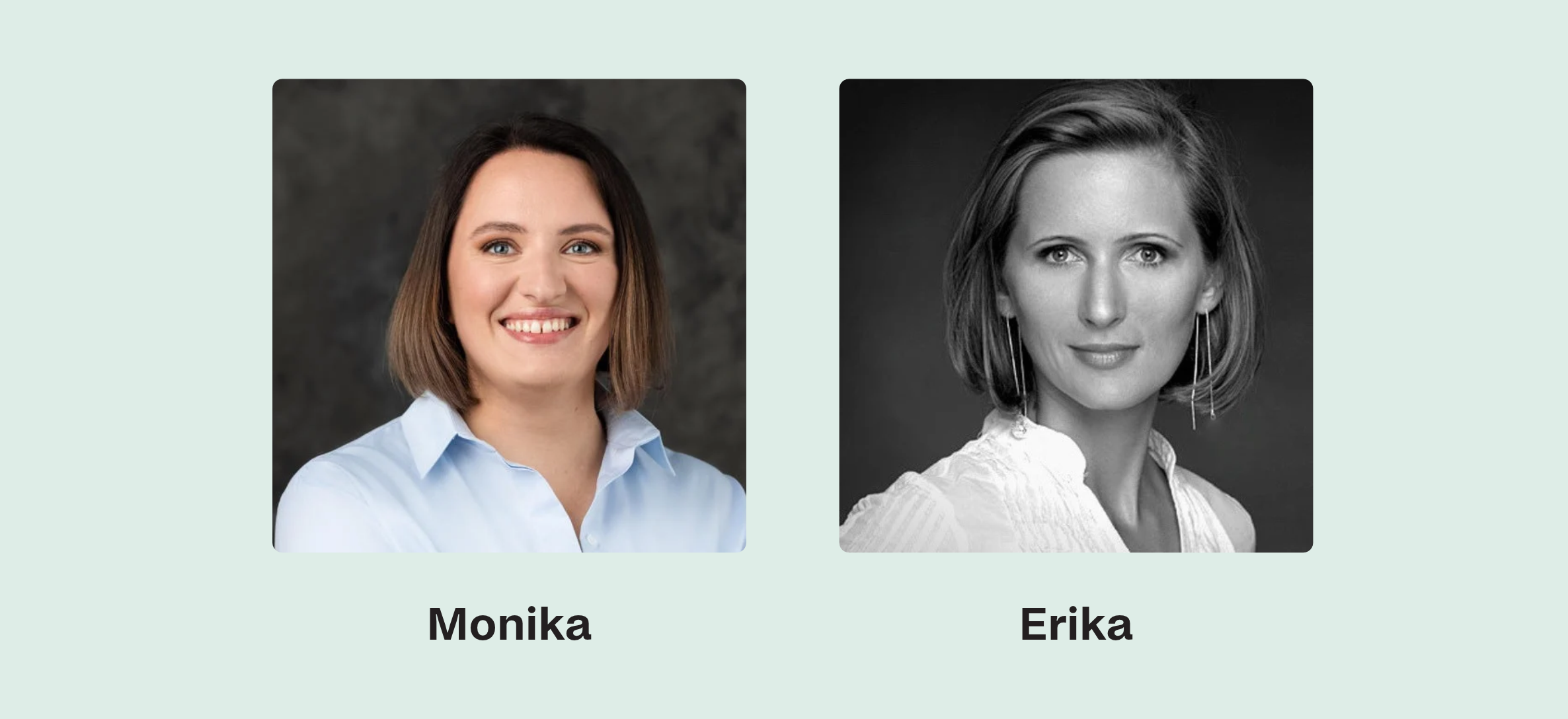
Erika Margelytė is Director at Turing College, based in Berlin. She led Turing College's entry into the German market as Country Manager Germany from 2025 and helps applicants prepare their case for the Agentur für Arbeit. She has worked in German further education and career services for more than a decade, setting up career coaching programmes and helping hundreds of learners with CVs, interviews and job placements. She holds a master's degree in European Studies from RWTH Aachen University.
Monika Simaškaitė is Senior Admissions Manager at Turing College, where she has worked since 2020 and has conducted more than 1,300 admissions interviews. Before Turing College, she ran tech education projects in Lithuania, including the Women Go Tech mentorship programme and research into the country's ICT skills market. She holds a master's degree in Industrial Engineering and Management from Kaunas University of Technology.
Check if you qualify
Take our Bildungsgutschein eligibility quiz, then explore our funded AI programmes. Our admissions team will help you prepare your documents for the consultation.

Sources (accessed 16 October 2026): Bundesagentur für Arbeit: Bildungsgutschein; mein NOW course search; Der Paritätische: changes from 1 January 2025; § 3a SGB II, Vorrang der Vermittlung; § 38 SGB III, registering as job-seeking; Stepstone salary data for KI-Entwickler/in; § 81 SGB III; https://lexmea.de/de/gesetz/sgg/84.