Certified AI Ethics course
Detect bias. Build better systems. Shape ethical AI that serves everyone.
Self-paced, 100% online
10h/week recommended
3-4 months to graduate
Created in partnership with







Build responsible AI systems
Artificial intelligence is already shaping high-stakes decisions: who gets hired, who qualifies for a loan, who gets access to services. But when it’s not built responsibly, it can amplify inequality, limit opportunity, and erode trust.
This course is part of the DIVERSIFAIR project, an EU-backed initiative created to help professionals build ethical AI that’s fair, transparent, and accountable — not just technically accurate.
Is this AI Ethics course for you? Yes, if you’re:
A data professional with 1+ year of experience in a coding-based role (e.g. Data Scientist, Machine Learning Engineer, AI Engineer)
Looking to stay ahead of regulations like the EU AI Act
Ready to embed fairness and accountability into your daily work
What can you expect?
Self-paced learning and flexible schedule
Learn when it works for you — no fixed hours, no pressure. Just consistent progress on your terms.
Practical projects based on real-world scenarios
Create solutions to challenges you’ll actually face on the job.
Certificate that proves your skills in ethical AI development
Show employers you can build AI that’s both effective and responsible.
Tools & languages you’ll use
- Python
- Fairlearn
- AIF360
- Pandas
- scikit-learn
- Jupyter Notebooks
Programme outline
You’ll complete 3 main sprints — each packed with hands-on learning and insights from real-world case studies. They will take you from foundational knowledge to practical application, and then into a specialization that fits your role.
01Foundational Concepts of Ethics in AI
01Foundational Concepts of Ethics in AI
02Technical Approaches to Fairness
02Technical Approaches to Fairness
03Emerging Fairness Frontiers and Implementation Strategies
03Emerging Fairness Frontiers and Implementation Strategies
04Specialization — Practical Fairness for Data Scientists
04Specialization — Practical Fairness for Data Scientists
Learn anytime, anywhere
This is a fully virtual programme. Study from anywhere, on your schedule — with support from your peers and mentors when you need it.

Learn from professionals
Our Senior Team Leads and mentors are experienced professionals who are 100% up-to-date with the industry trends and will provide you consultations, 1on1 project reviews, and feedback.
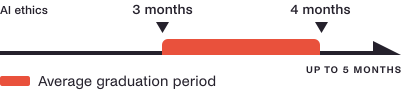
Graduate in 4 months or less — you set the pace
This programme is flexible by design. Most learners complete it in 3–4 months with a ~10 hour/week commitment. But if you need to move faster or slower, that’s totally up to you. You’re in control.


Our learners work at top companies


























How admissions works
Our application process has two simple steps designed to help you and our team understand whether the programme is the right next step for you.
- 1
Application
Tell us about your background and answer two short questions about your motivation and goals. Your application goes straight to our admissions team, who review it personally and get back to you within 24 hours on working days. - 2
Consultation
If the programme matches your goals, we’ll invite you to a 20-30 minute consultation. This is your chance to ask anything, understand exactly how the programme works, check your financing options, and decide whether it’s the right fit for you.
Basic admission requirements:
Dedication of at least 10 focused hours per week
Dedication of at least 10 focused hours per week
Focused hours are:
- · Working on a computer (not a smartphone)
- · Uninterrupted working time in a dedicated space
- · Rested, not overworked (not after intense cognitive work)
Strong motivation
Strong motivation
Experience in coding-based data role
Experience in coding-based data role
Good English skills
Good English skills
Up-to-date computer
Up-to-date computer
Join waiting list!
Our graduates have achieved life changing growth. You can too.






FAQ
Why is it important to learn about AI ethics and governance now?
Why is it important to learn about AI ethics and governance now?
How is this certification course different from others?
How is this certification course different from others?

This project has received funding from the European Education and Culture Executive Agency (EACEA) in the framework of Erasmus+, EU solidarity Corps A.2 – Skills and Innovation under grant agreement 101107969.
Funded by the European Union. Views and opinions expressed are however those of the author(s) only and do not necessarily reflect those of the European Union or the Culture Executive Agency. Neither the European Union nor the granting authority can be held responsible for them.