








After completing a PhD in Astrophysics in 2018, Algimantas transitioned into data science and now works at IBM’s Client Innovation Center. His focus areas are natural language processing and large language models, and his work has led to both scientific publications and a US patent in machine learning. Learners at Turing College benefit from his blend of research depth and applied industry experience, especially in NLP and AI innovation.
100% funded with a Bildungsgutschein
AI Engineering programme
Build on your coding experience to develop, test and deploy AI applications. Create projects you can show employers, with 1:1 expert feedback and career support to help you prepare for your next role. The programme is taught in German or English.
“In numbers, there's probably going to be significantly more AI Engineers than there are ML engineers / LLM engineers.”
Andrej Karpathy
Founding member of OpenAI, ex-Director of AI at Tesla
Data/research focused
- ML researchermodels trainingevals
- ML engineer / Data scientistmodels deploymentdata preparation
- AI engineerchains/agentsinfrastructure
- Fullstack engineerproductplatform
Product/user focused
Repeatedly recognised 4 years in a row
- Best Data Science Bootcamp, Course Report 2022
- Best Data Science Bootcamp, Course Report 2023
- Best Data Science Bootcamp, Course Report 2024
- Best European Bootcamp, Course Report 2025
- Best AI/ML Bootcamp, Course Report 2025
- Best Digital Marketing Bootcamp, Course Report 2025
- Best Data Science Bootcamp, Course Report 2025
- Best Online Bootcamp, Course Report 2025
- Best Coding Bootcamp, Course Report 2026
- Best AI/ML Bootcamp, Course Report 2026
- Best Online Bootcamp, Course Report 2026
Featured in




Highly rated
4.9/5

Graduates hiring rate
88%
of graduates get hired 6+ months after graduation*
*Germany, as of July 2026. Includes learners whose programme ended at least six months earlier and whose employment status could be confirmed. Unconfirmed outcomes were excluded.Our mentors bring first-hand experience from companies and universities such as:


The companies and institutions mentioned have no institutional affiliation or official partnership with Turing College.
Build on your coding experience for a career in AI engineering
In three months, learn to build, evaluate and deploy LLM applications and AI agents. Apply your Python or JavaScript experience to hands-on projects, with 1:1 expert feedback to improve your work and a portfolio to demonstrate your skills to employers.
The programme runs fully online, with 30 hours of learning per week, equivalent to 40 academic hours of 45 minutes each.
100% funded with a Bildungsgutschein
A Bildungsgutschein is an education voucher issued by the Agentur für Arbeit. If funding is approved for your place on our AI Engineering programme, it covers 100% of your tuition.
You may qualify if you are unemployed or at risk of unemployment, for example because your fixed-term contract is ending. Eligibility is assessed individually. Contact your Agentur für Arbeit or Jobcenter to discuss your situation.
Our AI Engineering programme is AZAV-certified and approved for Bildungsgutschein funding.
The Agentur für Arbeit makes the final funding decision. Funding must be approved before you start the programme.
Looking for a self-funded alternative? Explore our flexible AI Engineering programme.
How the programme prepares you for AI engineering roles
A portfolio employers can review
Build four AI applications and get technical feedback on each one. The last is a capstone of your own design, taken from concept to a deployed, end-to-end LLM application. All four are hosted and documented, so you can show employers working projects, not just a certificate.
Career support built into your programme
In the Capstone module, before you start your final project, you can join an optional career module to turn your experience and new AI skills into a focused job search, with opportunities to practise for interviews.
Explore your career supportDaily stand-ups, group sessions and 1:1 reviews
Your timetable includes daily stand-ups with your group. Each project gets a 1:1 review with a mentor, an experienced AI engineer who gives you technical feedback on what to improve. Between reviews, you can join open sessions, group calls where you discuss your projects, the course material and questions about working in AI. You can also join workshops on specific AI tools and processes. You get used to explaining your work and solving problems with others, the way you would in an engineering team.
A structured full-time schedule
Follow a fixed full-time timetable, from your first project to a deployed capstone.
The tools you'll build with
Languages
- Python
- JavaScript
Frameworks
- LangChain
- LangGraph
- Streamlit
- Next.js
Models
- OpenAI GPT
- Google Gemini
- Meta Llama
- Anthropic Claude
Methods
- RAG
- MCP
- AI agents
- Prompt engineering
- Vector databases (ChromaDB)
AdmissionsLearningProjectProject reviewSprints
Learn with mentors during scheduled core hours.
Learn in a fixed group with mentors. Supervised live sessions and work on your own projects are both part of your learning day.
Core learning hours: Monday to Friday, 09:00 to 16:30
Three months full time, with support during core learning hours
Build and test a working application.
Four AI applications, including a capstone of your own design
Get 1:1 feedback and use it in your next sprint.
Personal technical feedback in one-to-one project reviews with mentors
Career support before your capstone
In the Capstone module, before you start your final project, an optional career module helps you practise HR and technical interviews, polish your CV and LinkedIn profile, and join live career sessions.
On completion, you receive a provider certificate and a reviewed project portfolio.

Claude Team Premium included at no extra cost
Your Bildungsgutschein-funded AI Engineering programme includes a Premium seat on Claude's Team plan, giving you access to Claude and Claude Code, Anthropic's AI coding agent.
You get ~6 times the per-session usage allowance of Claude Pro.
Programme outline
Co-created with industry AI experts, the programme has three sprints and a capstone project, delivered full time over three months at 30 hours a week.
1Foundations of LLM application development
1
Foundations of LLM application development
Understand how large language models work in practice: capabilities, limitations, and ethical considerations. Set up your development environment and integrate APIs from OpenAI, Anthropic, and Google. Master prompt engineering, including few-shot prompting and system message design.
Python / JavaScriptOpenAI APIAnthropic APIGoogle GeminiPrompt engineering
2Building applications with LangChain and RAG
2
Building applications with LangChain and RAG
Build LLM-powered applications that connect to external data sources using retrieval-augmented generation. Use ChromaDB for vector storage and LangChain to structure LLM workflows, then build your first full-stack app with Streamlit or Next.js.
LangChainRAGChromaDBStreamlitNext.js
3AI agents
3
AI agents
Design and build AI agents that carry out multi-step tasks autonomously. Use LangGraph for agent development, and implement short- and long-term memory so agents retain context over time.
LangGraphAI agentsMemory systemsMCP
4Capstone project
4
Capstone project
A self-directed project of your own design, taken from concept to a deployed, end-to-end LLM application.
Learn online, but not alone
Join daily stand-ups to share your progress, discuss what’s happening in the industry and get to know the people learning alongside you.
In workshops, industry professionals demonstrate practical skills, with topics often shaped by what learners want to explore that week. Learn from their experience, ask questions and exchange ideas with your peers.
Daily stand-ups to share updates and build connections
Practical workshops led by industry professionals
Opportunities to learn from other learners’ experience
Experts who support you
You'll learn from professionals who work with AI every day, from ML engineers to data scientists and AI product managers. Our mentors bring experience from companies like IBM, Vinted, Nord Security, and Perplexity AI, giving you insights grounded in real practice.

With more than 15 years of experience in machine learning and AI, Andrius has worked on projects ranging from computer vision and deep learning to fraud detection and large language models. At Vinted, he develops algorithms that protect the platform from malicious threats and ensure a safe experience for millions of users. Learners at Turing College benefit from his deep technical expertise and his passion for mentoring the next generation of data scientists.

Augustinas is a Senior Data Engineer at the Scandinavian telecom company Telia. With over 8 years of Python experience and previous roles at Gjensidige, PwC, Ignitis, and other leading companies, he has worked across data and software engineering. At Turing College, he emphasises project structure, code readability, and quality, helping learners develop the habits of writing clean, reliable, and professional code.
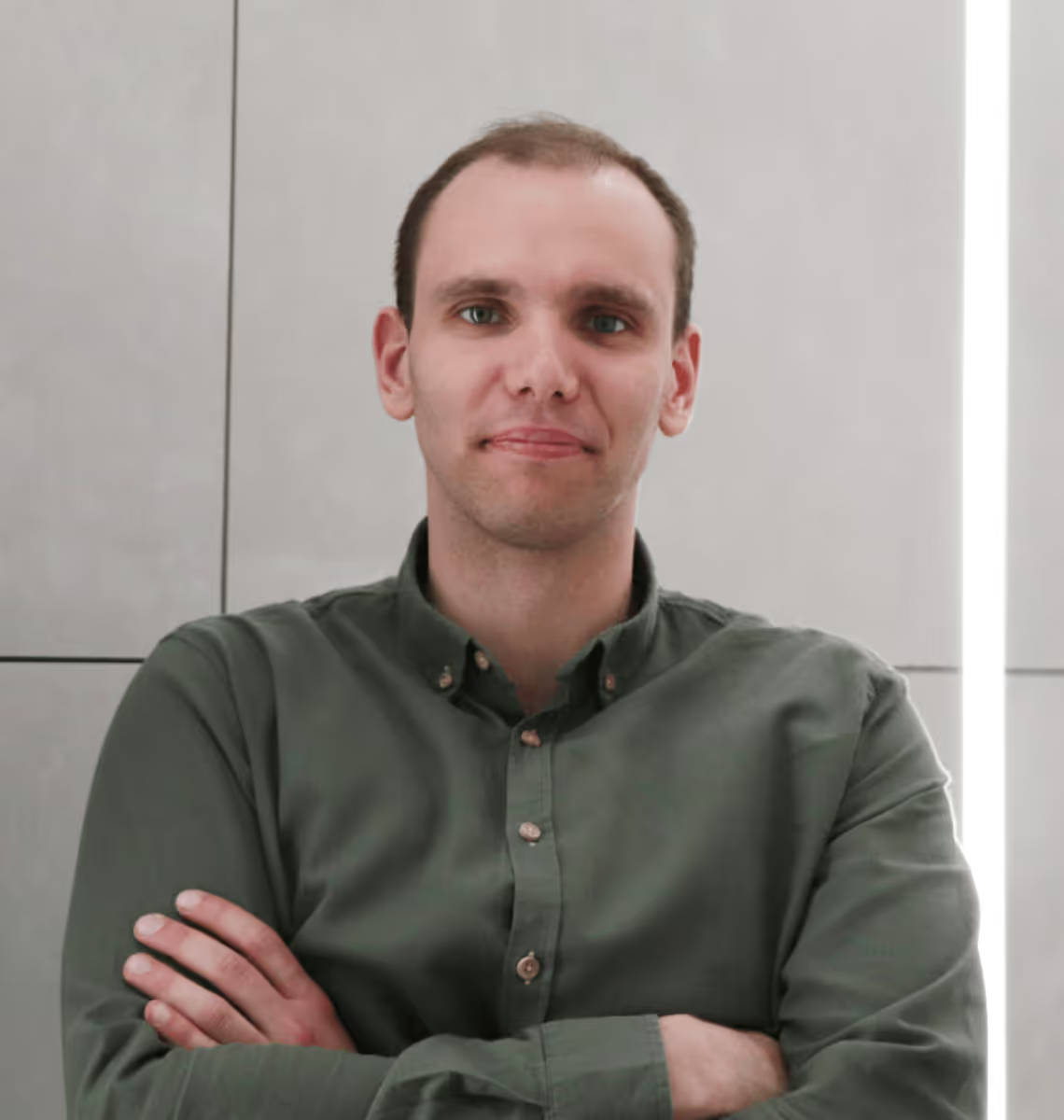
Gedmantas brings over five years of experience working with data across logistics, oil and manufacturing. At Continental, he builds forecasting models and automates operational tasks. With a background in applied mathematics, he draws on his industry work to help Turing College learners approach data problems and put mathematical concepts into practice.
What our learners build
AI Engineering graduates complete a self-directed capstone project as the final stage of the programme. Each project is built independently, using the tools and techniques covered throughout: LLMs, LangChain, RAG, vector databases, and AI agents. Projects are reviewed 1:1 by a mentor before completion.

wae.
Explains the Korean cultural nuance that YouTube subtitles miss.
Created by Gain Choe · AI Engineering

Card Battle Auto-Balancer
A team of AI agents plus simulation balances a card game automatically.
Created by Oleg Reva · AI Engineering

Plantopia
A plant-health agent that asks questions before it diagnoses.
Created by Felix Bögge · AI Engineering
Find the right Turing College AI course for you
Compare the programmes to find one that fits your experience and the work you want to do. The details below show Bildungsgutschein-funded study for AI Engineering and Building with AI Agents, and self-funded study for AI for Business.

AI Engineering
- Duration
- 3 months, full time
- Pace
- 30 hours/week (40 academic hours)
- Bildungsgutschein
- 100% funded
- Who it's for
- Developers who want to use their coding skills to build, evaluate and deploy LLM applications and AI agents
- Experience required
- At least 1 year of Python or JavaScript
- What you'll build
- Applications that answer questions using external data (RAG), agents that carry out multi-step tasks, and an independently designed AI application
- LangChain
- LangGraph
- RAG
- ChromaDB
- MCP


Paying for AI Engineering yourself? Explore the flexible learning option
Career support for your next role
Build your job search around your experience and new AI skills. With Bildungsgutschein-funded AI Engineering, you can join an optional career module, which opens on the learning platform in the Capstone module, before you start your final project. It helps you identify suitable roles, prepare your applications and practise for interviews, and you can join regular live career sessions.
Job-search planning: identify target roles and analyse what employers are asking for.
CV and LinkedIn preparation: present your experience and skills clearly.
Mock HR and technical interviews: practise before real recruitment conversations.
Weekly career Q&A: bring your questions to live drop-in sessions.
Monthly career webinars: explore a different career topic each month.
Graduates across all our programmes and countries








How admissions works
Our application process has two simple steps designed to help you and our team understand whether the programme is the right next step for you.
- 1
Application
Tell us about your background and answer two short questions about your motivation and goals. Your application goes straight to our admissions team, who review it personally and get back to you within 24 hours on working days. - 2
Consultation
If the programme matches your goals, we’ll invite you to a 20 to 30-minute consultation. This is your chance to ask anything, understand exactly how the programme works, check your financing options, and decide whether it’s the right fit for you.
Funding support (Bildungsgutschein)
If you're applying with a Bildungsgutschein, we'll guide you through the funding process after your consultation. We'll help you:
understand your eligibility
prepare for your appointment with your case worker (Vermittler)
Basic admission requirements:
30 focused hours per week
30 focused hours per week
Focused hours are:
- · Working on a computer (not a smartphone)
- · Uninterrupted working time in a dedicated space
- · Rested, not overworked (not after intense cognitive work)
Strong motivation
Strong motivation
You need a clear and strong reason for joining this programme. It should be your personal goal, and you should have specific reasons for wanting to improve your skills.
Coding experience
Coding experience
You need a minimum of 1 year of coding experience with Python or JavaScript.
German or English at B2+
German or English at B2+
You need German or English proficiency at B2 level or above, depending on your chosen teaching language.
Up-to-date computer
Up-to-date computer
You'll need a computer that can handle large datasets smoothly and runs an actively supported and updated operating system.
Flexible payment and funding options
Fully funded
Education voucher (Bildungsgutschein)
German residents eligible for a Bildungsgutschein
€0
With a Bildungsgutschein
- Live online, fixed timetable
- Fixed, 3 months
- 30 h per week
- Claude Team Premium seat included
Apply now
Group start: November 25th
Upfront payment
Learners who want the lowest total price by paying upfront
€3,500
Save 17%- Self-paced, flexible schedule
- Flexible, 3-4 months
- 10+ h per week
- 14-day money-back guarantee
Apply now
Group start: November 25th
Instalments
Learners who prefer to split self-payment into monthly instalments
€1,055× 4 months
0% INTEREST- Self-paced, flexible schedule
- Flexible, 3-4 months
- 10+ h per week
- 14-day money-back guarantee
Apply now
Group start: November 25th

We have limited seats. Apply now!
- Apply now
November 25th
What our AI Engineering graduates say




AI Engineering learner
AI Engineering graduate
Staff Engineer, Eurowings Digital (Lufthansa Group)
AI Engineering graduate, funded via Bildungsgutschein
Postdoctoral Research Associate · University of Pittsburgh Eye and Ear Institute · Max Planck Institute for Human Cognitive and Brain Sciences
Drag to browseSwipe to browse
Reviews relate to Turing College and its international programmes, not only our German AZAV-certified ones.
A unique learning experience powered by technology
Online learning is tough when you're left on your own. That's why we built Intra, our learning platform that combines the best of both worlds: human support and smart structure. We've also built adaptive AI features that personalise your learning even further, so your journey adjusts closely to your pace, needs, and progress.

FAQ
What is AI Engineering?
What is AI Engineering?
AI Engineering is an online Turing College programme for people with at least one year of Python or JavaScript experience who want to build, evaluate and deploy LLM applications and AI agents. Some learners move into AI engineering roles. Others use the skills to lead AI products, or to apply AI in the field they already work in. You work with tools such as LangChain, LangGraph, RAG and MCP. The funded programme is taught in German or English, runs full time for three months, is AZAV-certified and can be fully funded with a Bildungsgutschein.
Do I need previous coding experience?
Do I need previous coding experience?
Yes. You need at least one year of experience with Python or JavaScript. The programme builds on that foundation and teaches you to develop, evaluate and deploy applications using large language models, retrieval-augmented generation and AI agents.
What will I build?
What will I build?
You build four AI applications and get technical feedback on each one. They include applications that answer questions using external data (RAG) and agents that carry out multi-step tasks. The last is a capstone of your own design, taken from idea to a deployed application. All four are hosted and documented, so you can show what you've built to employers, your team or clients.
What support and tools are included?
What support and tools are included?
Your timetable includes daily stand-ups with your group, and each project gets a 1:1 review with a mentor, an experienced AI engineer. You can also join optional open sessions and workshops. Funded learners get a Premium seat on Claude's Team plan for the programme. Plan usage limits apply.
Does the Arbeitsamt pay for AI Engineering?
Does the Arbeitsamt pay for AI Engineering?
It can, if your advisor approves it. AI Engineering is AZAV-certified, so the Agentur für Arbeit (often called the Arbeitsamt) or the Jobcenter can cover your tuition with a Bildungsgutschein. Residence in Germany alone does not establish eligibility. Funding is decided individually and is not automatic. Speak to your advisor before the programme starts.
Can I get a Bildungsgutschein if I'm still employed?
Can I get a Bildungsgutschein if I'm still employed?
Possibly. Funding may be considered if you are at risk of losing your job, your fixed-term contract is ending, your industry is changing or you are affected by reduced working hours. Your advisor will assess your situation and decide whether the training is necessary.
How do I apply for a Bildungsgutschein?
How do I apply for a Bildungsgutschein?
First, apply to Turing College and complete the admissions process, which includes a 20 to 30-minute consultation. If the programme is a suitable fit, we provide the information you need for your funding application. Then book an appointment with your Agentur für Arbeit or Jobcenter. Take your CV, relevant job adverts and a clear explanation of the role you want to move towards. Your advisor makes the final decision.
What does the Bildungsgutschein cover?
What does the Bildungsgutschein cover?
If your application is approved for this specific programme, the Bildungsgutschein can cover the programme tuition. Your voucher will state the approved training goal, duration and other conditions. Ask your advisor which additional costs, if any, are covered in your case.
What if my Bildungsgutschein application is rejected?
What if my Bildungsgutschein application is rejected?
Ask for the decision in writing and check the reason given. If appropriate, you may be able to challenge the decision within the relevant deadline. Read how one Turing College learner challenged a rejection and went on to build KlarAmt, a tool designed to help other people navigate the Bildungsgutschein process: Bildungsgutschein rejected? How to appeal and win.
How much time do I need?
How much time do I need?
The funded programme runs full time for three months, with 30 hours of study a week on a fixed weekday schedule. Some course documents say 40 academic hours a week: that is the same time, counted in academic hours (Unterrichtseinheiten) of 45 minutes each. If you need to study alongside work, the self-funded option is flexible, at 10 or more hours a week over three to four months.
Is the programme taught in German or English?
Is the programme taught in German or English?
The programme is taught online in German or English. You need B2-level or higher proficiency in your chosen teaching language. Your funding meeting with the Agentur für Arbeit or Jobcenter may take place in German.
What career support is included?
What career support is included?
You can join an optional career module, which opens in the Capstone module, before you start your final project. It covers job-search planning, CV and LinkedIn preparation, and one mock HR interview and one mock technical interview. You can also attend weekly career Q&A sessions and monthly career webinars. No course can guarantee a job: your results depend on your previous experience, the roles you apply for and employer requirements. If you join from the June 2026 group onward, you keep access to the career module, mock interviews and live career events for six months after your funding period ends.
What certificate will I receive?
What certificate will I receive?
After completing the required programme, you receive a Turing College certificate for AI Engineering. The Germany-funded certificate records 520 academic hours (Unterrichtseinheiten).
Should I choose AI Engineering or Building with AI Agents?
Should I choose AI Engineering or Building with AI Agents?
Choose AI Engineering if you have at least one year of Python or JavaScript experience and want to build, evaluate and deploy LLM applications and AI agents.
Choose Building with AI Agents if you want to turn a business or workplace problem into a working AI tool and do not need coding experience. You will learn how to plan, build, test and launch solutions such as internal tools, dashboards, websites and AI assistants.
If you want to move into AI product management, choose AI Engineering to stay close to the technical work, or Building with AI Agents to focus on turning business needs into working AI tools.
Both programmes include practical projects and career support. The right choice depends mainly on your existing technical experience and the type of work you want to do next.
Is AI engineering the right career for you in 2026?
Is AI engineering the right career for you in 2026?
AI Engineering could be a good fit if you want to build and deploy AI applications, develop a portfolio of real projects and use those projects to demonstrate your skills to employers. It suits people who enjoy solving difficult problems, learning continuously and working through uncertainty.
You’ll need a solid coding foundation and the motivation to keep developing your technical skills. Watch the video to explore five questions that can help you decide whether AI Engineering fits your experience, working style and career plans.
Can I become an AI engineer in three months?
Can I become an AI engineer in three months?
If you already have the required programming experience and can study full time, you can build a practical AI engineering foundation in three months. You work with existing models and build real applications rather than training models from scratch. Not everyone joins to become an AI engineer: many learners want to lead AI products or bring AI into their current field. Whether you get a particular role depends on your background and the jobs you apply for.
Next group starts on November 25th