Bildungsgutschein rejected? How to appeal and win
8 min · June 17, 2026 · Updated July 20, 2026

Can you appeal a Bildungsgutschein rejection?
Yes. If the Agentur für Arbeit turns down your application, you can file a formal objection, a Widerspruch, within one month of receiving the decision. The appeal works best when it argues against the specific legal grounds the Agentur used to reject you, drawing on the rules in § 81 SGB III and the AZAV. Dragan, a Turing College learner who'd lived and worked in Germany for nearly a decade, did exactly that after he was rejected for his level of German. He won. Then he built a tool so other applicants could do the same.
Here's his story, and what you can take from it if you're holding a rejection letter right now.
How Dragan appealed his Bildungsgutschein rejection and won
Dragan had lived and worked in Germany for nearly a decade, most recently spending three years leading a team at a tech company that worked in English. Then he was laid off. A Bildungsgutschein, the training voucher issued by the Agentur für Arbeit, was his route to retrain as an AI engineer and get back to work. It would cover the cost of a program and the skills to make the move.
The Agentur said no. His German wasn't strong enough, they decided, for the training to count as suitable for him, even though he'd built a career in Germany over nearly 10 years.
For a lot of people, that's where it ends. The letter feels final, the deadline is short, and the language of the decision is dense enough to discourage a response. Dragan almost stopped there, too.
Then he looked closer at how the decision was actually made. A Bildungsgutschein isn't granted automatically. Under § 81 SGB III, it's an Ermessensleistung, a discretionary benefit. There's no automatic right to one. The Agentur decides, on a case-by-case basis, whether the training is necessary to get you into work and whether the program and provider are properly certified under the AZAV. That cuts both ways. If a rejection misapplies those rules or overlooks an argument in your favor, the decision can be challenged on those exact grounds. The applicants who lose are usually the ones who never make the legal case, because they don't know it exists.
So Dragan made it. He fed his rejection letter into ChatGPT, described his German level, his program, and his professional background, and asked which law actually governed his case. He found his argument: the Agentur had applied a stricter language standard than the law required for an AI Engineering program taught in English, and his German was sufficient for professional integration, as nearly a decade of work in Germany had shown. He drafted a Widerspruch built on that specific point rather than a generic complaint, and filed it within the one-month window.
The whole thing took him two evenings. A single four-paragraph letter, and the Agentur reversed its decision.
From a rejected voucher to a working tool: KlarAmt
The win could have been the end of it. It wasn't, because by this point Dragan was a learner at Turing College, deep in the AI engineering program, and the experience made him think beyond his own case.
He's an international living in Germany, and he'd just learned the hard way how much a Bildungsgutschein decision can hinge on knowing the right German law. There had to be many more people in his position: internationals who want to change their employment situation through a Bildungsgutschein, but who don't read German legal code and don't know that an appeal is even an option. They get the letter, take it as final, and stop.
Dragan had found a way through, so he decided to build it for them. Sprint 2, the point in the program where learners build a working prototype from scratch, became his deadline. The result is KlarAmt. He went from a rejected applicant to the builder of the tool that helps the next applicant, all within a single program. That's the kind of thing Turing College learners build: real tools that solve a problem they've lived through.
What KlarAmt does
KlarAmt drafts a Widerspruch when the Agentur für Arbeit rejects a Bildungsgutschein application. You give it the actual denial letter, and it identifies the legal grounds the Agentur invoked, then produces a draft grounded in the relevant SGB III and AZAV paragraphs. Not a template. An argument built for the specific rejection in front of you.
It works in German, English, or Serbian, so you can argue your case in the language you think in. It recognizes the common rejection patterns the Agentur uses, including language requirements (Sprachvoraussetzungen), missing AZAV certification, cost and proportionality (Verhältnismäßigkeit), and distance from the labor market (Arbeitsmarktnähe), and tailors the legal argument to whichever applies to you.
Here's what changes when you use it:
| The old way | With KlarAmt |
|---|---|
| Read a terse rejection letter with no legal citations | Upload the letter, and KlarAmt identifies the denial pattern |
| Spend hours hunting for the relevant SGB III paragraph | The tool surfaces the applicable legal basis automatically |
| Write a generic appeal with no specific legal grounding | Get a draft citing the paragraphs relevant to your case |
| Get lost in the Agentur's counter-response | Track the full lifecycle: draft, sent, response, next round |
| Give up because the system feels impenetrable | Iterate on the letter until the argument is right |
One note: KlarAmt is built to surface your strongest legal argument and help you put it in writing. It isn't legal advice and can't guarantee a reversal, as the decision is discretionary and rests with the Agentur. What it does is close the gap between people who know which rules to cite and people who don't.
What to do in the next 48 hours if your Bildungsgutschein was rejected
If you've just received a rejection letter from the Agentur für Arbeit, here's how to move while the clock is still in your favor.
- Note when you received the decision. You have one month from the date of receipt of the rejection to file a Widerspruch, and it must be submitted in writing to the Agentur. Mark the deadline now so it doesn't slip. If the rejection was only given verbally, ask for a formal written decision (Bescheid), because that written notice is what your appeal runs against, and the one-month clock runs from when you receive it.
- Identify the reason you were rejected. The letter names a reason even when it doesn't cite the law, and it usually maps to one of the following patterns: language, cost, and proportionality; AZAV certification; or labor-market relevance. If the reason is unclear, contact your case worker or the Agentur to talk it through. Just don't let that conversation eat your deadline, because the one-month clock keeps running whether or not you've spoken to anyone.
- Don't send a generic appeal. "I believe I'm eligible" isn't an argument. A Widerspruch with no legal grounding is easy to dismiss. Argue against the specific reason on its own terms.
- Get a KlarAmt access code. During the closed beta, Turing College is offering free access to rejected applicants. Contact us at study@turingcollege.com or via website chat, and we'll send you a code.
- Iterate on the draft. Dragan's first version wasn't his best. A standard code gives you five drafts, so use them to get the wording right.
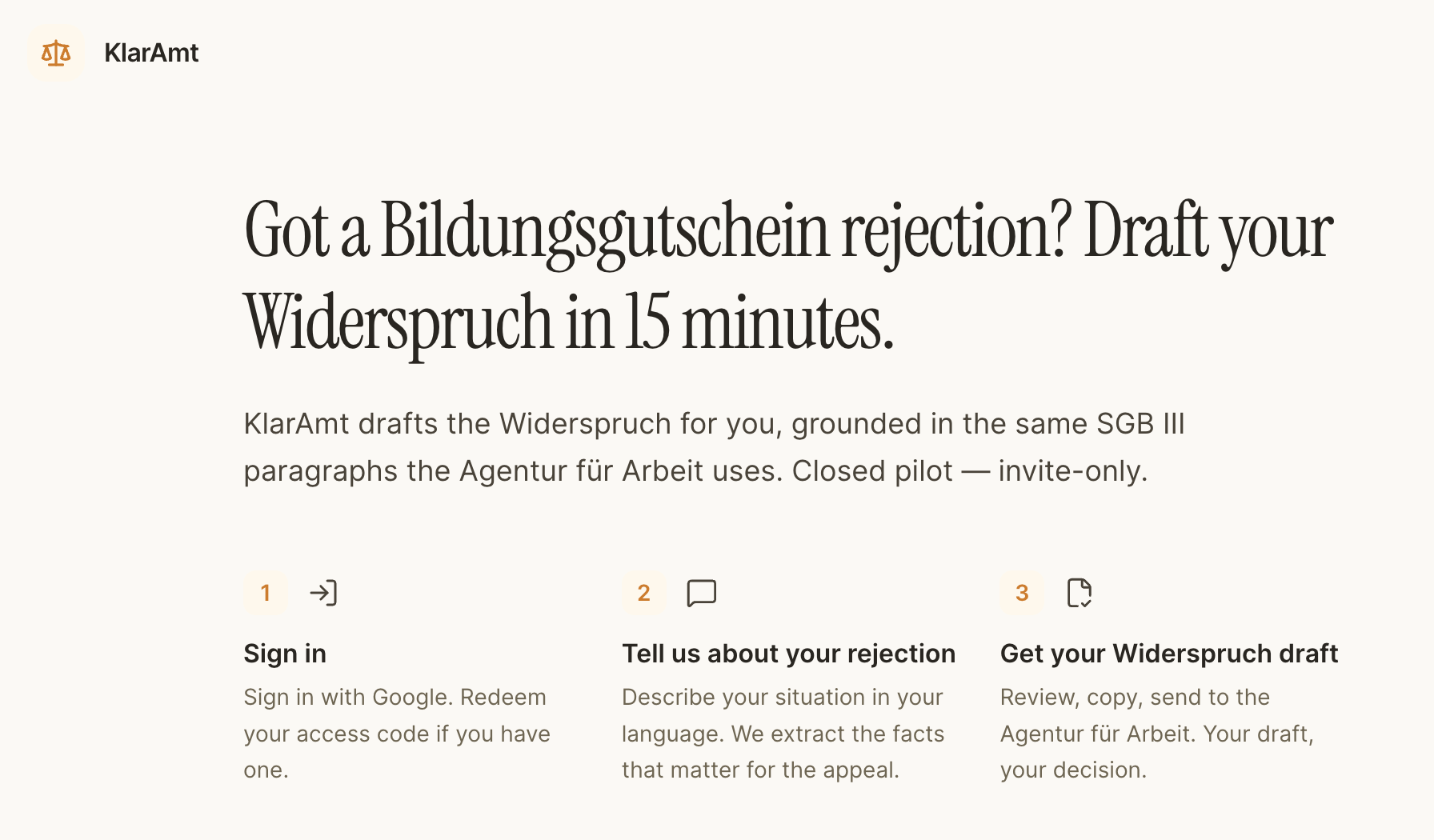
Got a rejection letter? Let's get you a draft.
A rejection doesn't have to be final. You can build an appeal grounded in the actual rules, the way Dragan did, instead of starting from a blank page or a generic template.
KlarAmt is in closed beta and free for early users. Contact us, we'll share an access code for app.klaramt.de, and you can turn that letter into a Widerspruch while the one-month deadline is still on your side.
Common questions about appealing a Bildungsgutschein rejection
How long do I have to appeal?
You have one month from the date you receive the rejection (the Widerspruchsfrist). The Widerspruch must be submitted to the Agentur für Arbeit in writing within that window. You can't lodge it by phone. Miss the deadline, and an appeal is only possible in rare exceptions, so act quickly.
What grounds can I appeal on?
The strongest appeals argue that the training is individually suitable and necessary for getting you into work, which is the core test under § 81 SGB III. Recognized reasons include a missing or outdated qualification, gaps in the skills required by the target job, and a concrete prospect of employment after the program. The point is to address the specific reason the Agentur gave and counter it on its own terms.
Do I need a lawyer?
Not necessarily. A Widerspruch is something you can write yourself, and many successful appeals are. What matters is that the argument cites the correct legal basis rather than simply stating that you want the funding.
Should I talk to my case worker first?
It helps. A rejection letter rarely spells out the full reasoning, so contacting your caseworker or the Agentur für Arbeit can clarify what tipped the decision and what they'd like to see. Do it alongside your appeal, not instead of it. The one-month deadline runs regardless, so file the Widerspruch in time even if a conversation is still pending.
Can I use AI to write the appeal?
Yes, and Dragan's case shows it can work. AI is useful for finding the relevant law and structuring the argument. Treat the output as a strong first draft, check the specifics for your situation, and remember that a tool can support your case but can't guarantee the result.