Some AI companies now charge for finished work, such as a reviewed contract, instead of selling software licences. This model is called services as software. It depends on people who know a job well enough to say what a finished result looks like, and marketers, finance and operations professionals can now build a first version of such a tool themselves.
Rimvydas Samulionis spent more than 20 years managing construction projects. In Building with AI Agents he built Ceiling Advisor, an app that answers architects' questions about ceiling products from technical datasheets and shows the source. His head start was knowing which questions come up on building projects and where the answers sit in the documents.
This guide is for people who know their work well: marketers, finance and operations leads, consultants, legal assistants and project managers. It covers which tasks in your job could be delivered as finished work, what Turing College learners have built from their own experience, and how to build a first version of a tool for one task. The figures on companies and market size come last, for readers who want the bigger picture.
Services as software in five facts
Services as software means an AI company charges for the finished result instead of a software licence. The AI law firm Crosby, for example, charges $250 to $1,000 per reviewed contract.
What these companies need most is knowledge of how a job is done: which step takes the time, what a finished result contains and how to check it.
With AI coding agents such as Claude Code, people without a coding background can build a first working tool for a task they know. Turing College learners have built tools for architects, law firms and Berlin landlords.
Companies spend far more on work than on software: about $58 trillion a year on labour (our estimate from ILO and World Bank data) against $1.24 trillion on software (Gartner's 2025 forecast).
Building with AI Agents teaches people in marketing, finance or operations to build these tools, with no coding experience required. AI Engineering teaches developers to make them reliable. In Germany, both can be up to 100% funded with a Bildungsgutschein if you're eligible.
What does it mean when an AI company sells finished work?
A software company sells a tool, usually per seat or per licence, and your team still does the work. A company that sells finished work takes on the task itself and charges for the result: a reviewed contract, a finished wall, a processed claim.
This model is often called "services as software", which is also the name of Nikola Lazarov's Eilla newsletter. AI makes it possible because a system can now do enough of a task, reliably enough, for a company to promise the result and put a price on it.
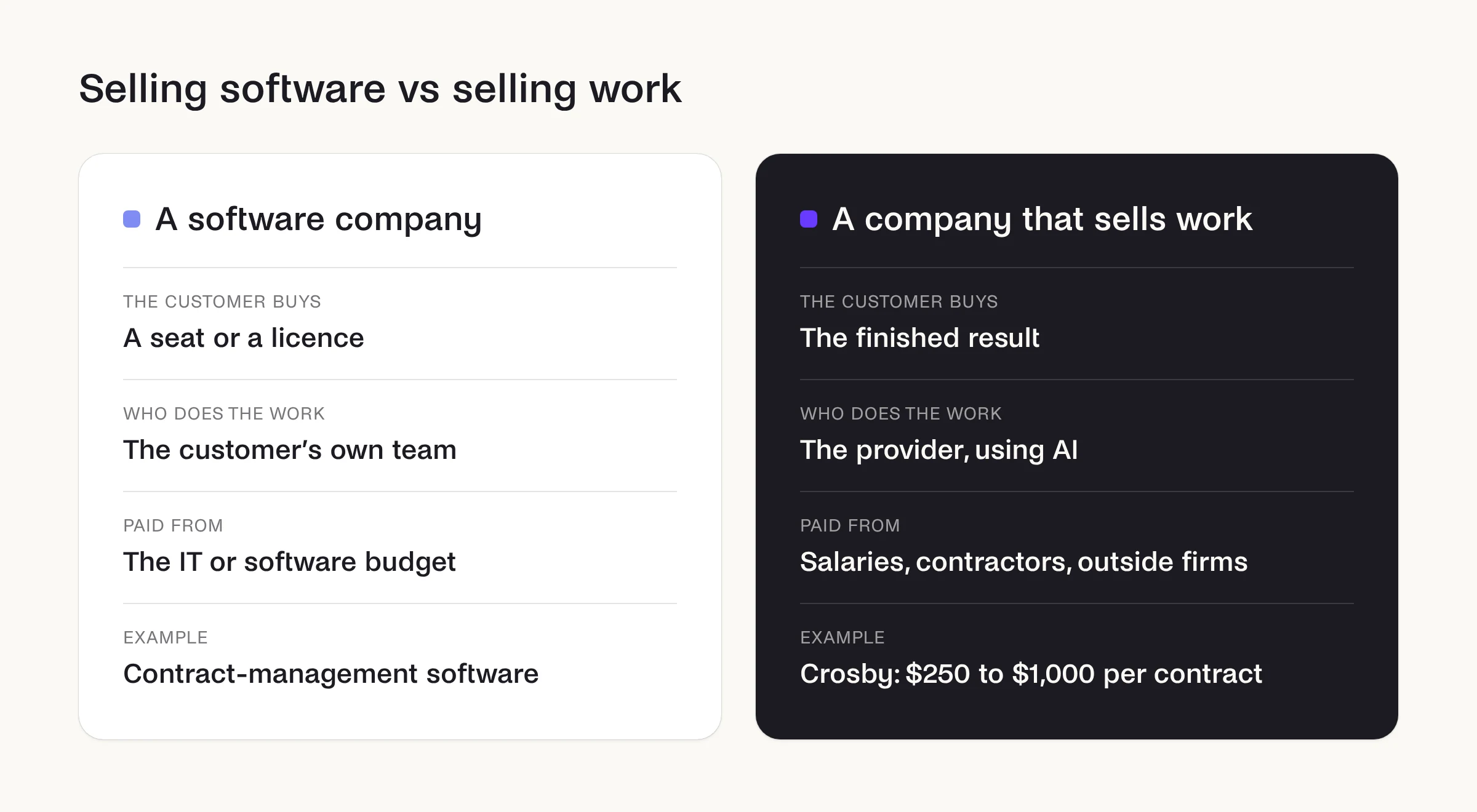
What changes when an AI company sells the finished result instead of a licence.
For you, the useful part is what these companies have to get right. A contract review sold per contract only works if someone has defined what a finished review contains, which clauses matter and how to spot a mistake. That knowledge comes from people who have done the work for years.
Which tasks in your job could AI deliver as finished work?
The best candidates are tasks you repeat often, that end in a result you can check, and that follow steps you could explain to a new colleague. The table shows examples by role. They're illustrations to help you look at your own work, not a list of tasks AI already does reliably.
Role | Recurring task | What "done" looks like | How you'd check it |
|---|---|---|---|
Marketing | The monthly campaign report | One page with spend, results and the changes you recommend | The numbers match the ad platforms, and each recommendation follows from the data |
Finance | Matching supplier invoices to purchase orders | Every invoice matched, or flagged with the reason | Spot-check flagged and unflagged invoices against the source documents |
Operations | Answering colleagues' questions about internal processes | A correct answer with a link to the policy it comes from | The linked policy says what the answer says |
Legal and admin | Taking in a new client case | A complete case file a lawyer can work from | No required detail or document is missing |
Construction and engineering | Answering product questions from technical datasheets | An answer with the page it comes from | The datasheet says what the answer says |
Two questions help you choose. How often do you do the task? A task you do every week pays back the effort of building a tool much sooner than one you do twice a year. And can you tell a good result from a bad one in a few minutes? If you can't check the result, you can't trust a tool that produces it.
Companies are already looking in the same places. In 2025, about 20% of EU companies with 10 or more employees used at least one AI technology, according to Eurostat. Among those, the two most common purposes were marketing or sales (34.7%) and organising business administration or management (31.1%).
What have professionals built from their own work?
Turing College learners have built AI tools that each take on one specific piece of work in a field they know. Each started from years of experience in that field.
Learner | Experience they started with | What they built | Programme |
|---|---|---|---|
More than 20 years managing construction projects | Ceiling Advisor, an AI app that answers architects' questions about ceiling products from technical documents and cites its sources | Building with AI Agents | |
More than 20 years building websites for law firms in Berlin | Unfall-Hilfe, a digital intake system for traffic accident cases, which he sells to law firms | AI for Business | |
Aviation design engineer, then data scientist and AI engineer | Condense, which cuts the tokens AI coding agents use. Edvard was accepted to a startup programme run by a16z | Data Science, then AI Engineering | |
Five learners funded through their Bildungsgutschein | Amt-Buddy, an AI agent that shortlists tenant applications for Berlin landlords. It won Battle of the Tech Schools 2026 against six other schools | Yoav had finished AI Engineering a week earlier |
Rasim's product follows the same logic as Crosby. The law firm receives a finished, machine-readable case file from each client, instead of an email it has to sort out first. "It's not user-centric," Rasim says of most law firm websites. "It's lawyer-centric."
"The interesting problems are often not technological problems at all. They are ordinary business problems that people have learnt to live with." Rimvydas Samulionis, Building with AI Agents learner
How do you turn a task you know into a working AI tool?
Start with one task and a clear description of the finished result, then build and test against real examples. The six steps below follow the order the work happens in.
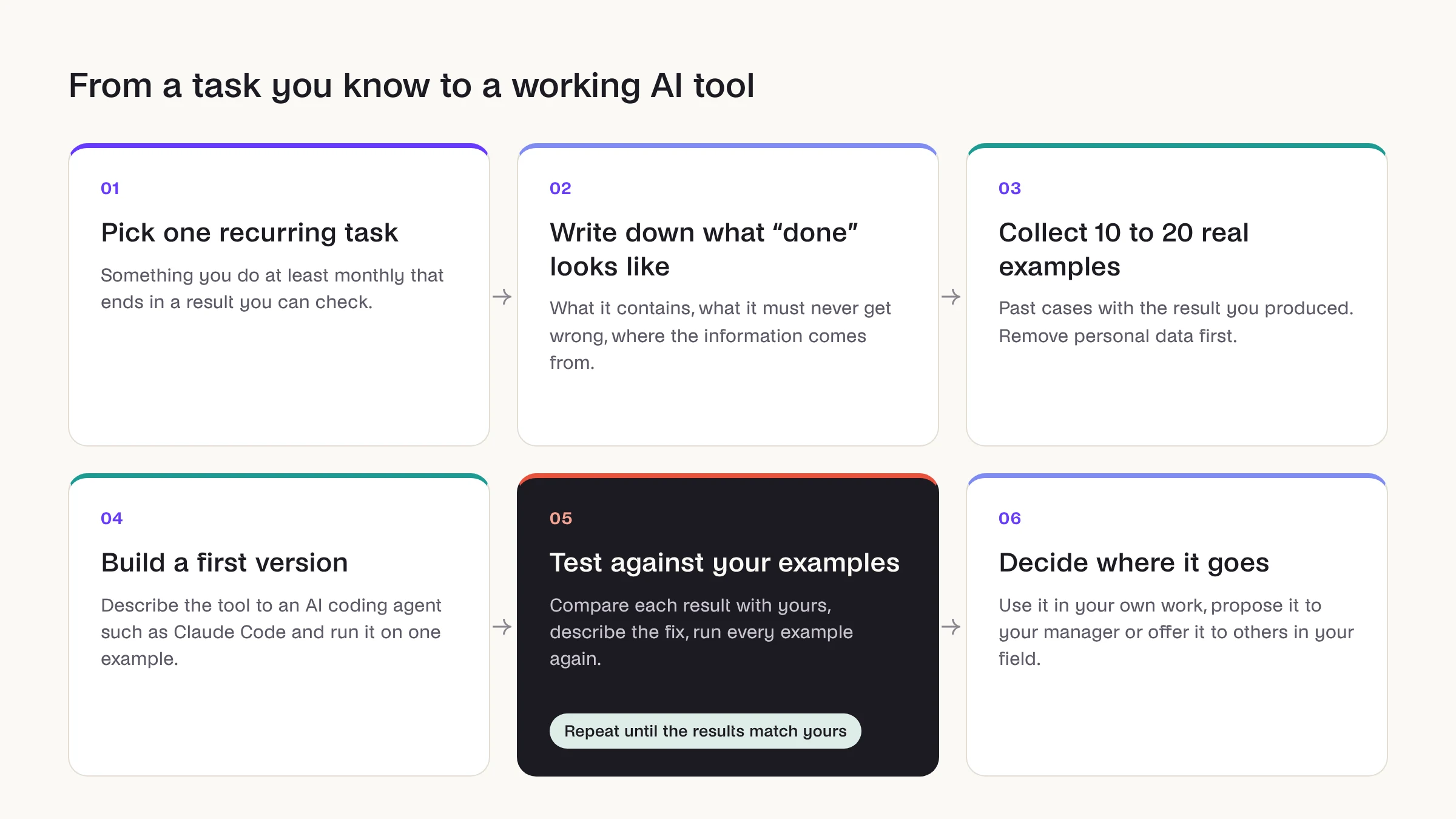
From a task you know to a tool you can trust. Step 5 is where most of the work happens.
Pick one recurring task. Choose a task from your own work that you repeat at least monthly and that ends in a result you can check.
Write down what "done" looks like. Describe the finished result as you would to a new colleague: what it contains, what it must never get wrong and where the information comes from.
Collect 10 to 20 real examples. Use past reports, invoices, questions or case files, together with the result you produced. Remove personal data first. These examples become your test cases.
Build a first version with an AI coding agent. Describe the tool to an agent such as Claude Code, let it write the code, and run the tool on one example at a time.
Test it against your examples and fix what fails. Compare each result with your own. Write down where it goes wrong, describe the fix to the agent and run all the examples again.
Decide where the tool goes. Use it in your own work, show it to your manager as a proposal, or offer it to others in your field, as Rasim did with law firms.
"The quality of the result depends heavily on the quality of the description." Rimvydas Samulionis, Building with AI Agents learner
Step 5 decides whether a tool is useful. It's also where a company that sells finished work makes or loses money: when you charge per result, every error costs you.
Which skills does a company that sells finished work need?
Two: knowledge of the work being done, and engineering that makes AI do it correctly every time. Many founding teams combine people with each.
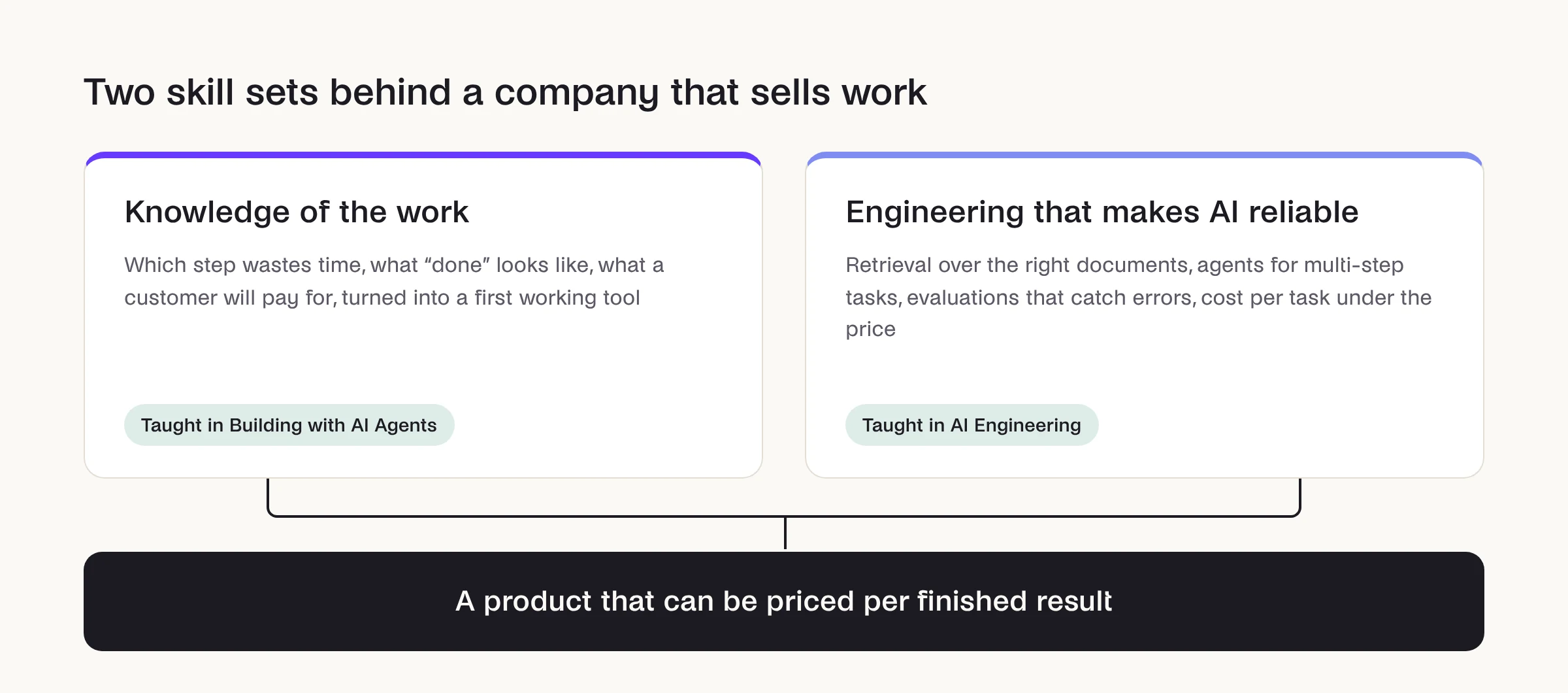
The two skill sets map to Turing College's two AI programmes.
People who know the work. A legal assistant knows what a complete intake file looks like. A finance manager knows which invoices cause trouble every month. A marketer knows which report three people touch before it goes out. That knowledge decides what to automate, what "done" means and what a customer will pay for. With AI coding agents, these people can now build the first working version themselves.
Engineers who make the AI reliable. When a company charges per contract, the tool has to get it right every time. That takes retrieval over the right documents, agents that complete tasks with several steps, evaluations that catch mistakes before a customer does, and keeping the cost of each task below its price.
Which programme fits you: Building with AI Agents or AI Engineering?
Choose Building with AI Agents if you know a business problem well and want to build the tool yourself. No coding experience is required. Choose AI Engineering if you already write code and want to build AI systems that hold up for real users.
Who it's for | People in marketing, sales, consulting, finance, product and operations | Developers and engineers who already write code |
Entry requirement | No coding experience required | At least one year of Python or JavaScript |
What you build | Five projects, ending in a capstone of your own design. You describe what you need to Claude Code, then test and fix the result. Covers databases, sign-in, AI assistants, and GDPR and EU AI Act basics | LLM applications with retrieval (RAG), agents with LangGraph, evaluations, local models and a capstone of about 40 hours |
Its role in a company that sells work | Turning your knowledge of the work into a first working tool | Making the tool reliable enough to charge per result |
Self-funded study | Around 12 hours a week for three and a half to four and a half months | Around 10 hours a week for three to four months |
Funded study in Germany | Full-time, synchronous study for three months: 30 hours a week, Monday to Friday 09:00 to 16:30. Up to 100% funded with a Bildungsgutschein | Full-time, synchronous study for three months: 30 hours a week, Monday to Friday 09:00 to 16:30. Up to 100% funded with a Bildungsgutschein |
In both programmes, a Senior Team Lead reviews each of your projects one to one, and you can publish your capstone on the Turing College showcase. Learners funded through their Bildungsgutschein also get the Career Module, with interview practice. Both programmes are taught in English. You can also compare all Turing College programmes.
What results have Turing College learners had after finishing?
In our latest audit (data as of July 2026, updated in September 2026), 31 of 35 Bildungsgutschein-funded learners (88.6%) were employed six or more months after their programme ended.
No one was left out of the count. Building with AI Agents is too new to be part of this audit. Our placement rates guide explains how we counted.
A result like this isn't a promise for every learner. Your own outcome depends on your experience, the projects you build and the roles you apply for.
Why are companies paying for finished work now?
Because the budget for work is far larger than the budget for software. Software is paid from an IT budget. Work is paid from the budget for salaries, contractors and outside firms, which is roughly 47 times larger than global software spending.
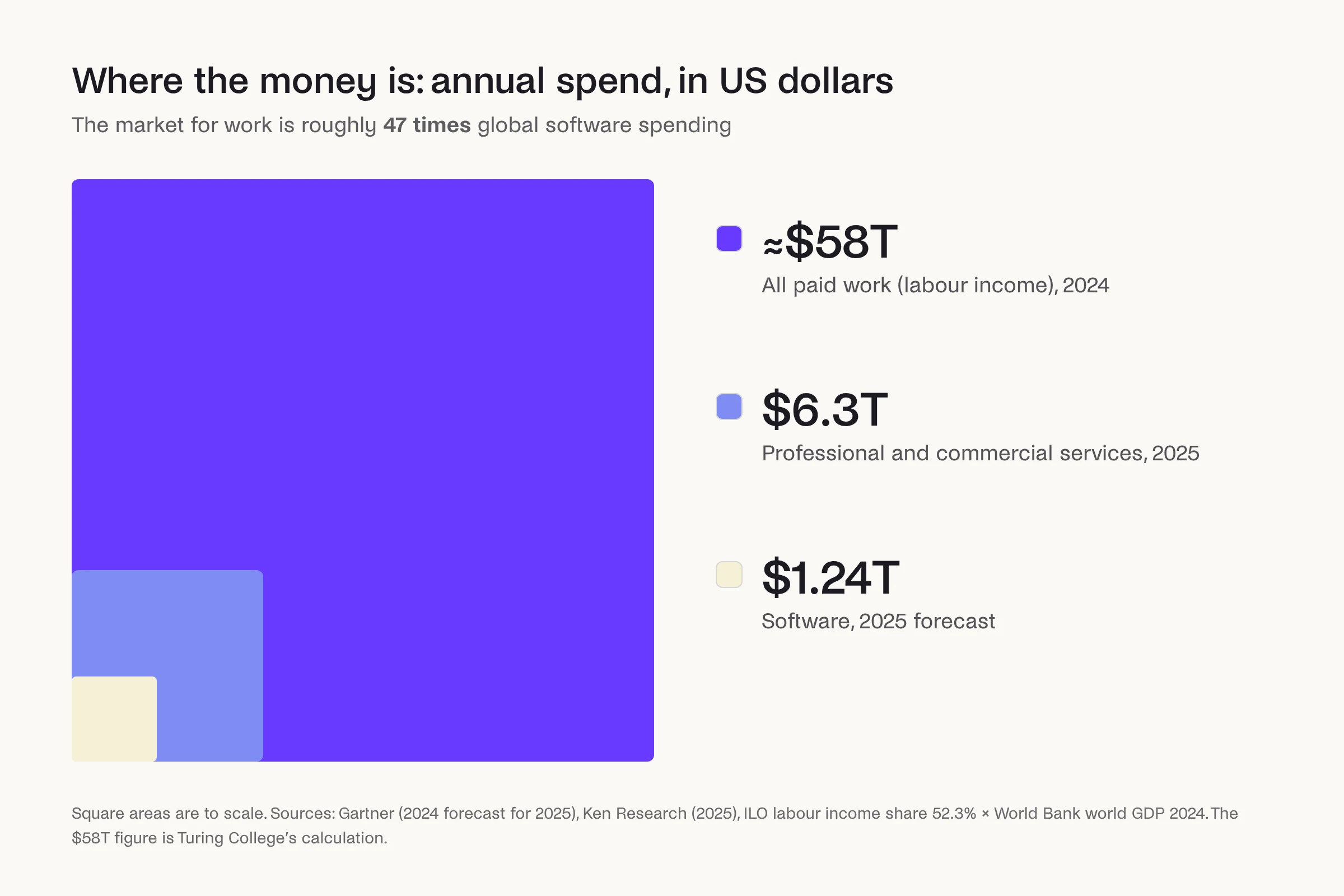
Annual spend in US dollars, areas to scale. Sources: Gartner for software (2025 forecast), Ken Research for professional and commercial services (2025, a market-research estimate), and our calculation for all paid work: the ILO labour income share of 52.3% × World Bank world GDP for 2024 of $111.7 trillion.
The $58 trillion figure is an estimate that combines different years: the ILO's labour income share (52.3% in 2022, unchanged through 2024), world GDP for 2024 and Gartner's software forecast for 2025. Read it as an order of magnitude. The labour income share also includes what self-employed people earn, so it covers more than salaries alone. The point holds either way: a company that sells finished legal work competes for what firms spend on lawyers, which is far more than they spend on legal software.
"Markets move to whoever delivers more for less," writes Lukas Kaminskis, CEO of Turing College, in his essay AI is repricing work. Europe should move first, which looks at how AI is lowering the price of knowledge work.
Which AI companies already charge for finished work?
Legal work and construction are the clearest examples so far. Each company below takes on a task that people used to do in full and is paid for the result.
Company | Work it takes on | What the customer pays for | Source |
|---|---|---|---|
Crosby | Contract review by a law firm that uses AI agents, with a lawyer checking each result | Each contract, at $250 to $1,000, instead of billable hours | |
Monumental (Amsterdam) | Bricklaying by robots on building sites in the Netherlands and the UK, with a US launch planned | The finished wall, quoted per brick or per square metre | |
microagi (Munich) | Recording how people do physical tasks and turning it into training data for factory robots | Robot training data and robots adapted to a specific factory job |
"We're selling them a wall," Monumental's founder Salar al Khafaji told Fortune when the company raised a $32 million Series B led by Khosla Ventures. Contractors pay for bricks laid. In law, Lawhive bought a regulated UK law firm in September 2025, so it can deliver legal work itself.
microagi says it reached a $100 million annualised revenue run rate six months after launching Shift, its programme that pays people in 15 countries to record themselves doing tasks. The figure is the company's own and hasn't been independently verified. As Humanoids Daily points out, it projects recent revenue over a year and is counted from Shift's launch rather than the company's founding. Dealroom adds that it doesn't separate recurring data revenue from one-off robot deployments. In July 2026, microagi raised a $55 million seed round.
FAQ
What does "services as software" mean? It means a company uses AI to deliver a service and charges for the finished result, such as a reviewed contract, instead of selling software licences. The AI law firm Crosby, for example, charges $250 to $1,000 per contract.
Which tasks in my job are good candidates for an AI tool? Tasks you repeat at least monthly, that end in a result you can check in a few minutes, and that follow steps you could explain to a new colleague. Examples include a monthly campaign report, matching invoices to purchase orders, or answering questions from technical documents with the source.
Can I build an AI tool for my job without coding? Yes, you can build a first working version by describing what you need to an AI coding agent such as Claude Code, then testing and fixing the result. Building with AI Agents requires no coding experience. You'll work with code during the programme, but you build by directing the agent.
Do I need to start a company to use this? No. Most people start by building a tool for their own work or their team, and some go on to offer it to others in their field. Rasim Baybars, for example, sells his intake system for traffic accident cases to law firms.
Will AI companies that sell finished work replace my job? Some tasks in many jobs will be done differently, and nobody can say exactly how fast. The companies in this article still depend on people who know what a finished result looks like and can check it. Knowing a task well, and being able to build and test a tool for it, is a way to use that knowledge yourself.
Is microagi's $100 million figure verified? No. microagi's $100 million figure is an annualised run rate that the company reported itself, counted from the launch of its Shift data programme. No outside source has verified it.
Can I get Building with AI Agents or AI Engineering funded in Germany? Yes, both can be up to 100% funded with a Bildungsgutschein if you're eligible. The Agentur für Arbeit or Jobcenter decides. Check your eligibility with our eligibility quiz.
Related reading
From construction to Building with AI Agents: Rimvydas's story
Do you have the skills these job ads are asking for? 2026 self check
Bildungsgutschein for AI training: who qualifies and who pays
Sources
All sources accessed between 19 and 27 October 2026.
Eurostat: use of artificial intelligence in enterprises, data extracted December 2025
Ken Research: global professional and commercial services market (market-research estimate)
ILO: World Employment and Social Outlook, September 2024 Update (labour income share)
World Bank: world GDP in current US$ (NY.GDP.MKTP.CD), via FRED
Humanoids Daily: microagi's $100M run rate claim, 10 October 2026
Eilla: Services as Software newsletter, Nikola Lazarov, 14 October 2026