

Key takeaways
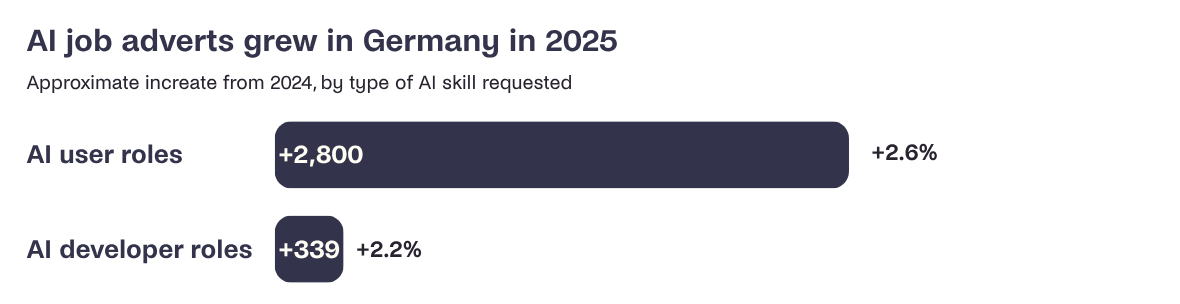
In Germany, AI-related job postings grew by around 3,000 in 2025 to 1.3% of all postings, and most of that growth is in roles that use AI, not roles that build it (PwC, 2026).
Review at least five job ads for roles you're considering. Note what each responsibility actually asks you to do, not just the title.
Mark each responsibility DONE, PARTLY DONE or NOT YET DONE, with one concrete example for each.
Turn what you can already prove into specific CV wording, then decide what's genuinely worth learning next.
Job titles used to give you a rough idea of the work you might be applying for. AI-related roles make that harder. An “AI Transformation Specialist” and an “AI Automation & Operations Manager” can both be asked to find where AI could improve a process, even though the titles sound quite different. Their other responsibilities and experience requirements may differ. So if you recognise some of the work but the title makes you hesitate, read beyond it before deciding whether the role fits.
That's a growing pattern in Germany as well. AI-related job postings here grew by around 3,000 in 2025 to reach 1.3% of all postings, and most of that growth was in roles that use AI day to day rather than roles that build it, according to PwC's 2026 AI Jobs Barometer for Germany.
You might be looking for a new role, wondering how your current work is changing, or trying to work out what to learn. Rather than a generic list of "AI skills" to tick off, the steps below work from real job ads: you'll see what employers are asking for and check it against your own experience.
Start with at least five ads for jobs you would like to do now or in the near future. Compare what they ask for with work you have already done, then use that evidence on your CV or in a conversation at work. You may find several things you want to learn. You may find that you already have stronger evidence than you thought. Either way, you will have a clearer picture of which roles fit and what, if anything, to work on next.
If you are weighing a full career change, 10 Signs It’s Time to Change Your Career Path may help you decide where to start. Then come back to this check.
Translating the job-ad language
Different phrases can point to similar work, but the words alone will not tell you how much experience the employer expects. Use this table to work out what to check in each ad.
What the ad may ask for | Phrases you might see | What to check in the full ad | In plain English |
Use AI to carry out a task |
| What will you produce? Are you expected to check AI output, make decisions from it or develop a method others will use? | Use AI to help produce or analyse something, then check whether the output is suitable to use. |
Find where AI could help |
| Are you identifying possibilities, deciding which are worthwhile, or responsible for putting them into practice? | Examine how work is done and identify tasks where AI might be useful. |
Build or run a workflow |
| Does the role ask you to make a prototype, connect it to existing systems, roll it out to colleagues or keep it working afterwards? | Set up, test or maintain a process that can be used repeatedly. The ad will tell you which of those steps you would own. |
Build an AI application |
| What software development experience, programming languages, data systems and production responsibilities does the employer require? | Develop software that uses AI, connects to data or other systems, and is tested for use beyond a demo. |
The same phrase can describe different levels of responsibility. Keep the ad’s experience, tool and industry requirements beside the tasks as you compare roles.
Step 1: Read past the job title
Save at least five recent ads for jobs you would consider, from different employers in your location. For each one, note:
What you would be expected to do.
Any experience, technical skills or tools the employer says you need.
Write down all the responsibilities that seem relevant, not just one task per ad. Then look across the five ads and group tasks that describe similar work, even when employers use different words.
You can use the AI job-ad skills check to keep your notes together. The link opens a Make a copy screen: save your own copy, look at the Worked example tab, then fill in the Your turn tab. Add a separate row for each responsibility, even when several come from the same ad.
For example, GRIMME's AI Transformation Specialist ad asks someone to find uses for AI with different departments and analyse existing processes. It also asks for implementation coordination, tool evaluation and staff training. Creative Dreams' AI Automation & Operations Manager ad asks someone to find where processes lose time or quality and develop automations for the team. Both checked 21 September 2026.
Both roles involve looking at a process and finding where AI could help. Their other responsibilities differ. Keep those differences in your notes, along with each ad’s experience and tool requirements. You will use them in Step 2 to check what you have already done and what each role would ask you to do next.
Step 2: Match the tasks to your experience
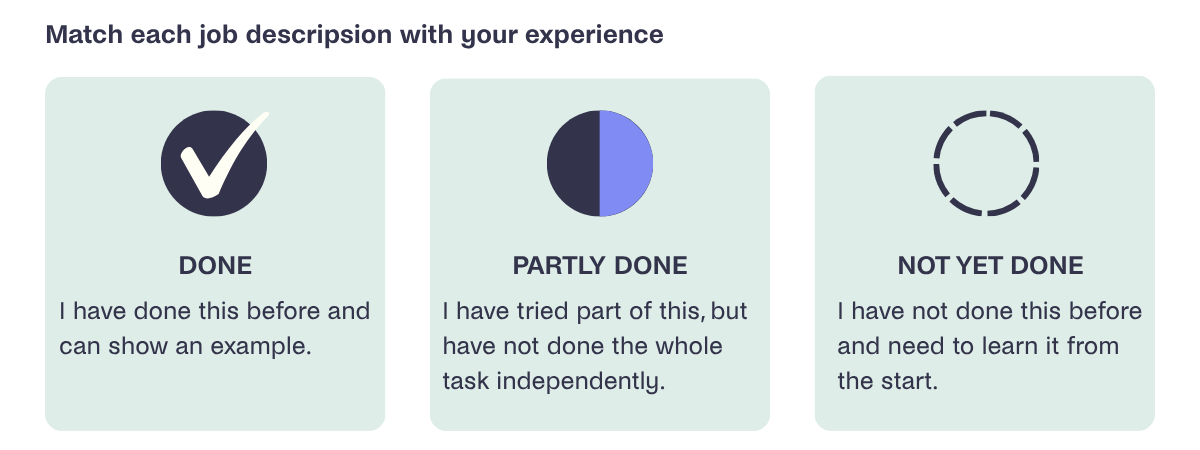
For each responsibility you noted in Step 1, mark it:
DONE: I have done this before and can show an example.
PARTLY DONE: I have tried part of this, but have not done the whole task independently.
NOT YET DONE: I have not done this before and need to learn it from the start.
Add a short example beside each answer. For PARTLY DONE, note what you did and which part you have not done independently.
Imagine you are an operations manager with 15 years of experience. You have automated parts of your reporting spreadsheets and use Copilot to draft report summaries. You have learned by trying things at work, without formal AI training.
One Creative Dreams responsibility is to find where internal processes lose time or quality. You might mark this done if you identified the manual steps in your reporting process, changed them and can explain what improved.
Another responsibility is to develop automations that take work off the team. You might mark this partly done. You have automated parts of your own reporting, but have not yet built and tested a workflow that colleagues can use reliably. Your notes could look like this:
What I have done: Automated parts of our reporting spreadsheets and used Copilot to draft report summaries.
What I have not done yet: Built, tested and rolled out a repeatable workflow for the team.
What I could try: Test an automated weekly report, check its figures against the manual version and document the steps so someone else can try it.
Do this for the responsibilities that recur across your saved ads. Think about experience from earlier roles, even when the job titles seem unrelated. Someone who moved from a shop floor role into merchandising may understand how late stock deliveries affect staff and customers. That first-hand knowledge could help them spot a problem in the stock planning process. Record that knowledge, but be clear about it: did you notice the problem, suggest a change or help put one into practice? Then check the experience and technical requirements for each role. A small project may help you practise a new task, but it does not establish years of experience or show that you have run a system used by a team.
Step 3: Update your CV with the AI work you can prove
Look across your five or more ads. Which responsibilities appear in several of them, and which can you show you have done? Bring those examples forward on your CV. In the operations manager example, that might mean describing improvements to weekly reporting. It would not mean claiming to have built an AI workflow for the whole team.
“Experienced with AI and automation” tells an employer little. This operations manager could be more specific:
Automated repetitive steps in weekly reporting spreadsheets; used Copilot to draft report summaries and checked them before sharing.
If you have done only part of a responsibility, describe the part you have done. You do not need to claim the whole task to show relevant experience.
If a responsibility is new to you, look for a real problem you could work on. Could you automate part of a weekly report or create a dashboard that refreshes when its data changes? The problem might be at work or in your own life. Start small, check that the result works and ask someone who would use it for feedback. Once you have built and tested something, you can include it on your CV as a project. Say what you did and whether anyone else used it.
Use wording from the ads where it accurately describes your work. If you measured an improvement, include the result and how you checked it. A project can show a skill you are developing, but it does not establish every experience requirement for a role. For help discussing your examples, see how to talk about AI experience in a job interview.
You can use the same evidence in a performance review, an internal application or a conversation about how your role is changing.
Step 4: Decide what you want to learn next
Your notes may show tasks you can already do, tasks you would like to try and tasks that do not interest you. Pay attention to all three. A responsibility appearing in several ads does not mean you need to learn it if those roles are not right for you.
Think about the work you would like to do more of. Do you want to use AI to improve your own research, reporting or everyday tasks? Would you rather build a tool or automation that other people can use? Or do you want to develop AI applications as a software engineer? Your answer will help you choose what to practise next.
Those AI and automation titles from the job ads aren't hypothetical, either. Looking back at our own learners hired over the past year, roughly one in seven landed a role with "AI" or "automation" in the title itself, including AI Engineer, AI Consultant, AI Program Lead, Automation Specialist and Full Stack AI Engineer. The rest went into roles that use AI as part of a broader job without it being the headline label, which is exactly why reading past the title matters.
You could start with a problem at work, build a small project or look for structured learning.
We have three short programmes for different starting points and goals: |
|---|
Building with AI Agents helps you turn a problem you know from work into a useful solution, such as an internal tool, dashboard or automation. You learn to plan it, guide AI as you build it, test it and make it ready for others to use. The result is a working project you can show, alongside your existing experience in operations, sales, marketing or another field. For a quick check of this one pathway, the programme’s free AI-building-level quiz offers a rough starting point. |
AI for Business helps you use AI in a business role: make sense of information, improve reports and presentations, work with spreadsheets and cut down recurring manual tasks. You also learn to check AI output before using it. This fits a gap in applying AI to work you already understand, and gives you a project you can discuss in an interview. No coding background is required to start. |
AI Engineering helps developers build applications that use company information, carry out multi-step tasks and work reliably beyond a demo. You practise connecting data, testing results and deploying an application you can discuss with employers. This path requires at least one year of Python or JavaScript experience to start; engineering vacancies may ask for more software experience. |
Compare the programmes side by side to see what you would learn and what experience you need before applying. Then return to the ads for roles you want: check whether the work appeals to you and which requirements a project or programme could help you meet.
If you are in Germany, funding may be available depending on your circumstances and the programme. Our Bildungsgutschein guide explains how to explore that option.
Your four-step job-ad check ✅
Decode the work: compare at least five relevant ads and group tasks that mean the same thing, check each role’s experience and technical requirements.
Sort the recurring tasks: what have you done, tried in part, or never done before?
Update your CV: show the work you can prove that matches repeated responsibilities.
Decide what comes next: practise a repeated task you cannot yet show, or use the evidence you already have.
You should finish with examples you can back up, a clearer view of which roles fit your experience, and a better sense of whether you need to learn anything next. You can use that evidence on a CV, in a review or in a conversation about your current role.