
Key Takeaways
- The 2021–2022 hiring frenzy was a bubble, not a baseline. Indeed’s SWE posting index peaked at ~230 (indexed to Feb 2020) on cheap capital and pandemic panic. The current ~70 is organic demand — and it’s climbing.
- The Jevons Paradox explains what happens next. When steam engines got more efficient, coal consumption didn’t fall — it exploded. When AI makes software 10x cheaper to build, companies won’t build the same amount with fewer people. They’ll build 10x more.
- Companies now expect a 1.5x–10x output boost per engineer. Every AI token is a line item. Every developer must justify the tools the company pays for. The performance bar moved.
- Anthropic’s CEO says AI will automate SWE. Anthropic has 448 open roles. The contradiction tells the whole story: writing code got automated; engineering judgment became the job.
- Software engineering + AI engineering cannot lose. Naval Ravikant calls software engineers "among the most leveraged people on earth." a16z says we’ll need vastly more software. The combination of both skills is the widest moat in 2026.
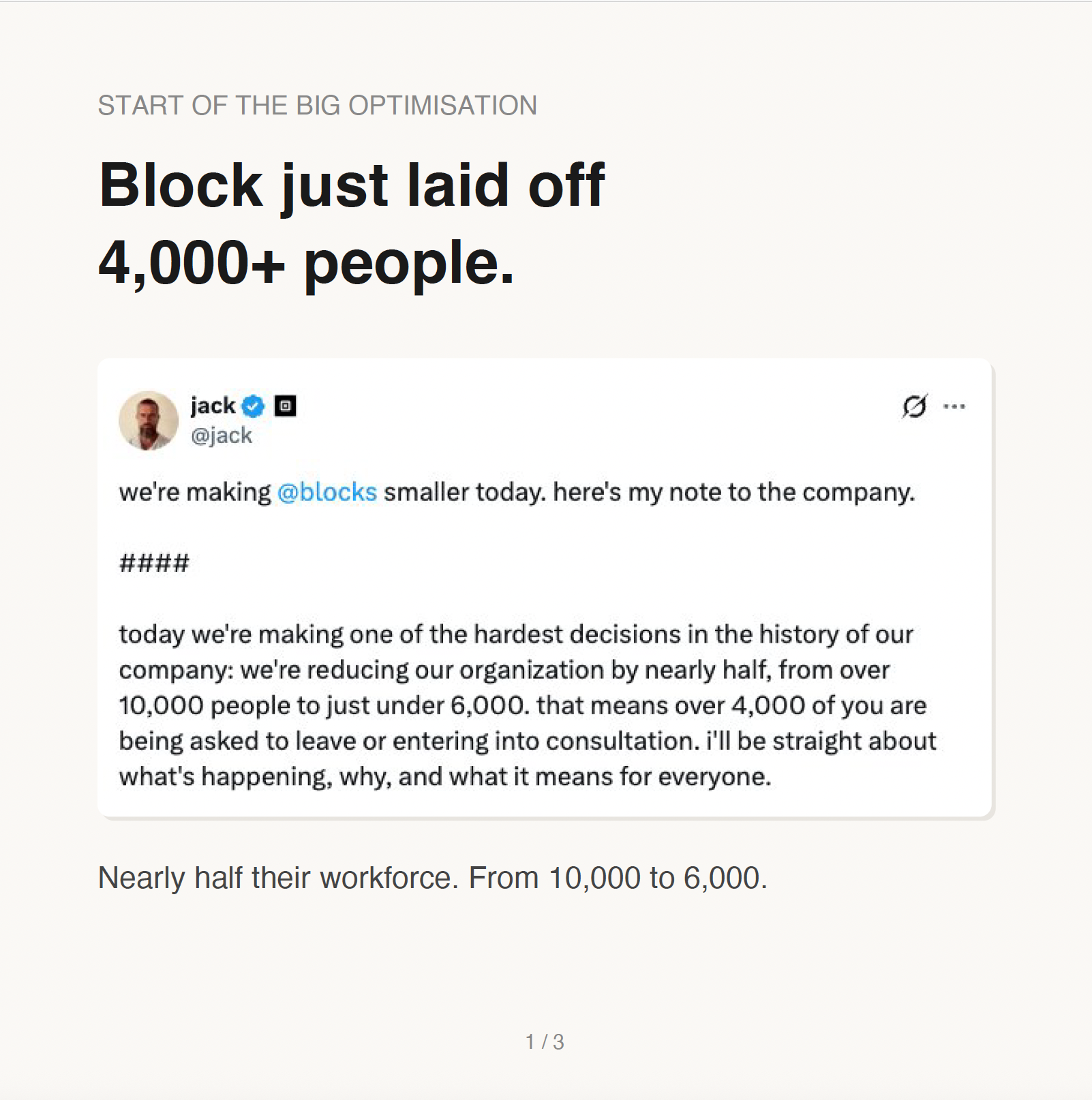
On Wednesday, February 26, 2026, Jack Dorsey posted a lowercase memo on X. Block — the fintech behind Square and Cash App — would cut its workforce from 10,205 to just under 6,000. Over 4,000 people gone.
Not because the company was struggling. Block’s Q4 gross profit had climbed 24% year-over-year to $2.87 billion. The stock surged 24% in after-hours trading. Dorsey’s explanation was blunt: AI tools meant the company could do more with fewer people, and he’d rather make one honest cut than bleed headcount for years.
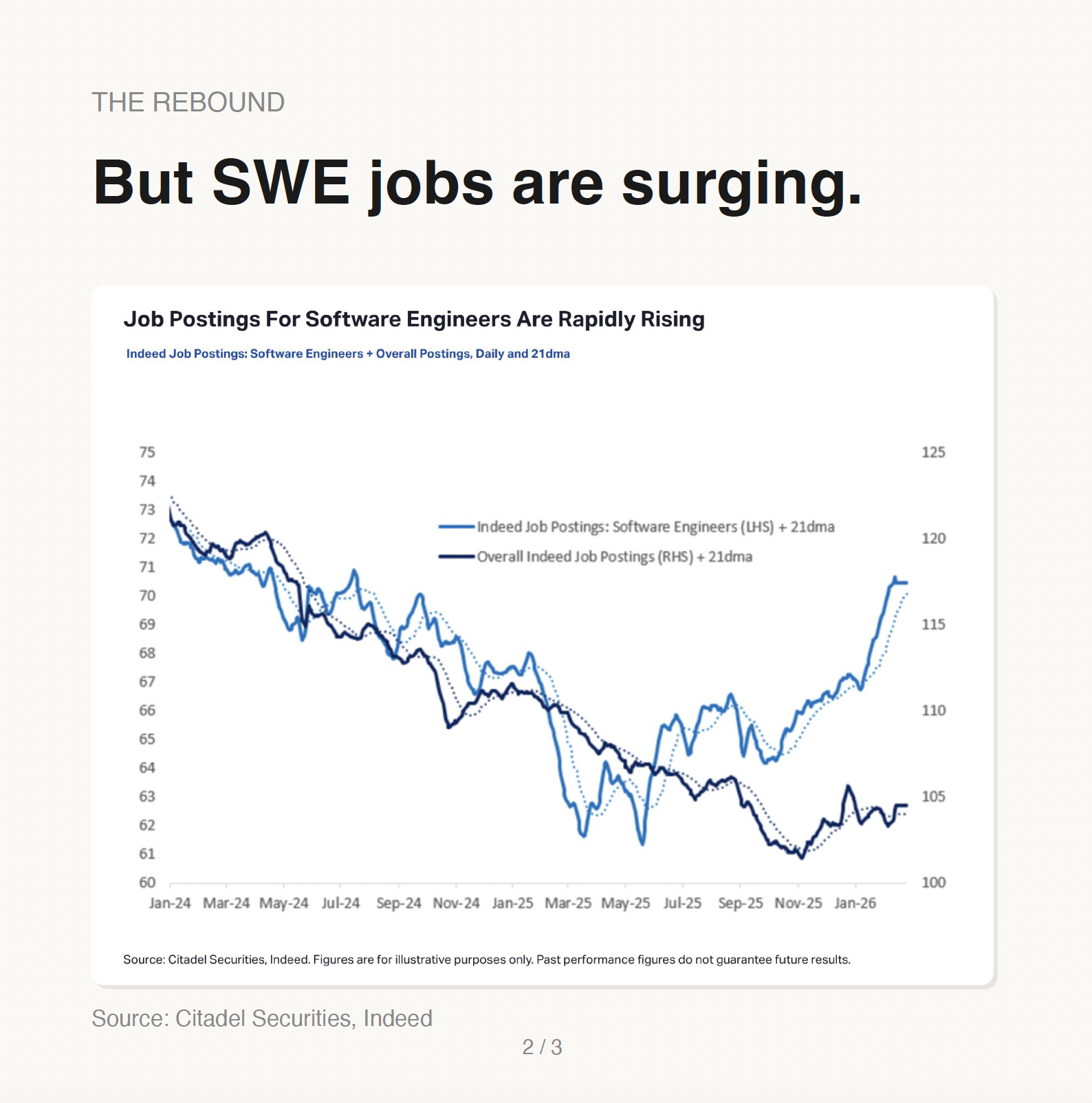
That same week, a chart from Citadel Securities went viral. It showed Indeed’s software engineering postings climbing — a clear upward trend after two years of decline. People shared it as proof the market was healing.
At first glance, these stories cancel each other out. One says companies are shedding engineers. The other says companies are hiring them. But sit with both for a moment and a third story emerges.
Block didn’t cut 4,000 people because software engineering became worthless. It cut them because AI made each remaining engineer dramatically more productive. Dorsey told analysts he believes most companies will reach the same conclusion within a year. And when something becomes cheaper and more efficient to produce, a strange thing happens: you don’t get less of it. You get more.
Economists have a name for this. It’s called the Jevons Paradox. And it explains nearly everything happening in the software engineering job market right now.
What Is the Jevons Paradox, and What Does It Have to Do with Software Engineering?
The Jevons Paradox states that when technology makes a resource cheaper to use, total consumption increases rather than decreases. Applied to 2026: AI makes software development 2x–10x faster, which makes thousands of previously unjustifiable projects economically viable. Companies don’t build less software with fewer engineers. They build dramatically more.
In 1865, William Stanley Jevons noticed something counterintuitive about coal. James Watt’s steam engine had made coal usage far more efficient. Conventional wisdom said coal demand would drop. The opposite happened. Efficiency made coal-powered industry viable in thousands of new applications. Total consumption skyrocketed.
The same pattern repeated with computing. Cheaper transistors didn’t mean fewer transistors. We put computers in everything. Cheaper bandwidth didn’t mean less data consumed. We invented streaming video and TikTok.
Now apply this to software development.
AI tools have made certain kinds of software dramatically faster to build — internal dashboards, prototypes, CRUD apps, small-scale automation. A senior Google engineer reported that Claude Code recreated a year’s worth of work in an hour. For these categories — bounded scope, well-understood patterns, low stakes if something breaks — the productivity gain is real, somewhere between 2x and 10x. For large-scale production systems with complex architecture, security requirements, and millions of users, the gains are more modest and the verification costs higher. But the Jevons mechanism doesn’t need the multiplier to be universal. It just needs the economics of enough software projects to shift. And they have.
But that’s the coal fallacy again. Companies won’t build the same products with fewer people. They’ll build products they never could have justified before. Internal tools that required a team of five for six months can now be prototyped in a week. Custom AI integrations that sat on the "nice to have" backlog for three years become two-sprint projects. The total surface area of "things worth building" has expanded by an order of magnitude.
Steven Sinofsky of a16z, in a February 6, 2026 essay, traced the same pattern across three previous platform shifts. The PC was supposed to kill the mainframe. Instead, data centers grew alongside PCs. Amazon was supposed to kill retail. Instead, both Amazon and Walmart became trillion-dollar companies. Netflix was supposed to kill traditional media. Instead, more content is produced today — across every category — than at any point in history.
Every time, the prediction was destruction. Every time, the outcome was expansion.
This is why his conclusion hits hard: "There will be more software than ever before. This is not just because of AI coding or agents building products. It is because we are nowhere near meeting the demand for what software can do."
More software means more engineers. But not the same kind.
Are Software Engineering Jobs Actually Growing in 2026?
Yes — but from a recalibrated baseline. The 2021–2022 hiring spike (Indeed SWE index ~230) was a bubble driven by cheap capital and pandemic panic-hiring. The current index near ~70 reflects organic demand, and the Citadel Securities / Indeed data shows clear upward momentum through late 2025 into early 2026.
This is where most career advice goes wrong. It treats 2021 as normal and measures everything against it.
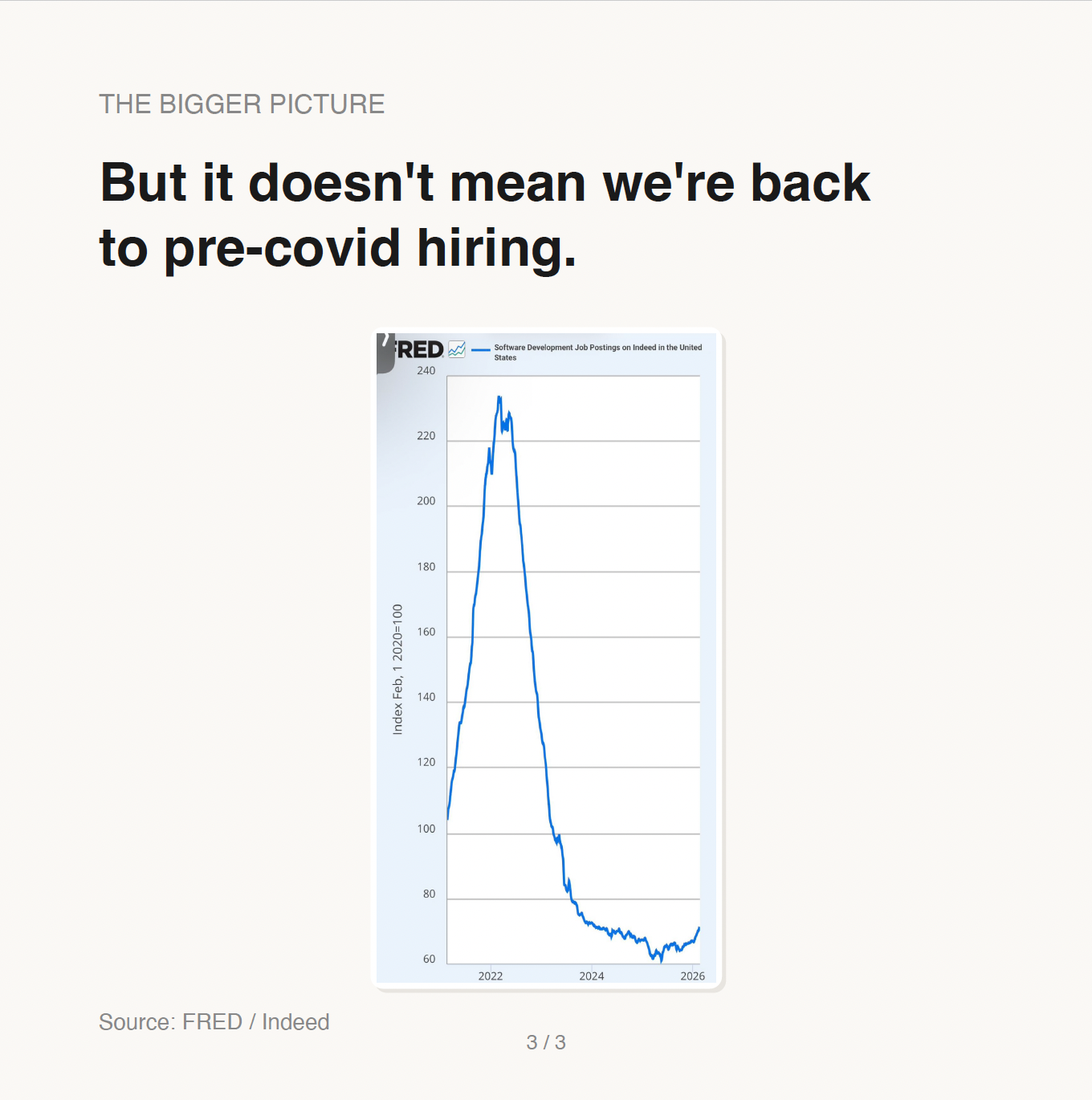
Pull up the FRED data for software development postings on Indeed, indexed to February 1, 2020. The index starts at 100. By mid-2022, it hit roughly 230 — more than double. Then it collapsed. By late 2024, it sat near 60–65.
The instinct is to see that decline as catastrophic. But consider what drove the peak. Zero-percent interest rates made venture capital free. Companies hired the way a startup hoards cloud credits — because they could. Block’s own workforce exploded from 3,900 in 2019 to 12,500 in 2022. When capital got expensive, the correction was brutal but predictable.
The better question isn’t "why did we fall from 230?" It’s "where is the organic floor, and are we growing from it?"
The Citadel chart says yes. SWE postings have climbed through late 2025 into 2026. The ~70 isn’t a recovery to the bubble peak. It’s real demand — companies spending actual budget on engineers they genuinely need.
Germany tells the same story from the employer side. The Bitkom 2025 study (855 companies surveyed) found 109,000 unfilled IT positions. Down from 149,000 in 2023, but 79% of companies expect the shortage to worsen. And here’s the Jevons signal: 42% anticipate needing additional IT specialists specifically because of AI adoption.
AI doesn’t reduce the need for IT talent. It creates new categories of IT work that didn’t exist before.
| Dimension | 2021–2022 Bubble Peak | 2026 Organic Growth |
|---|---|---|
| Job volume | Indeed SWE index ~230 (inflated by cheap capital) | Indeed SWE index ~70 and climbing (real demand) |
| Hiring driver | "We have budget, fill headcount" | "We need someone who can direct AI to solve this problem" |
| Typical role | Junior/mid-level SWE, often vaguely scoped | Senior + AI-literate engineer with domain context |
| Capital environment | Near-zero interest rates, abundant VC | Normalized rates, disciplined spending |
| Productivity expectation | Ship features, meet sprint goals | 1.5x–10x output boost using AI tools |
| Career trajectory | Ride the wave, job-hop for raises | Compound skills, master AI tools, deepen domain expertise |
But if demand is growing, why does the market feel so much harder?
Because more demand doesn’t mean easier demand. It means different demand. And that difference shows up most clearly in a number no one used to track: the cost of your AI tokens.
What Does 1.5x–10x Output Expectation Mean for Software Engineers?
Companies spend thousands per developer per month on AI tools and API tokens. That investment creates a new implicit contract: if we give you a 10x multiplier, we expect measurably more output. Engineers who demonstrate productivity gains thrive. Those who don’t face uncomfortable performance conversations.
When a company provisions Claude Code or Cursor or Copilot for its engineering team, that’s not a free perk. Enterprise subscriptions run $20–$100+ per developer per month. API token costs for teams building with LLMs climb into thousands monthly. These line items show up on someone’s P&L.
And that someone will eventually ask: what are we getting for this?
The answer they expect isn’t "same output, developer seems happier." They expect more. The range we hear from engineering managers — and see reflected in job postings — is a baseline expectation of 1.5x to 10x improvement. The floor, not the ceiling.
This reframes the whole employer-developer relationship. Before AI tools, a developer’s value was their individual output. In 2026, it’s their leveraged output — what they produce given the tools the company pays for. The tools are the investment. Your ability to wield them is the return.
This is pressure. But it’s the kind of pressure that increases the value of skill, not decreases it. A developer who can frame the right problem, direct AI toward the solution, evaluate the output for bugs and architectural weakness, and compound the leverage across testing, documentation, and deployment — that developer isn’t threatened by AI. They’re the reason the AI investment pays off.
Which brings us to the most interesting contradiction in the industry right now.
Why Does Anthropic Say SWE Is Dead While Hiring Hundreds of Engineers?
Anthropic’s CEO told Davos in January 2026 that AI could handle "most, maybe all" of what SWEs do within 6–12 months. His company simultaneously posted 448 open roles (146 in software engineering) and plans to double headcount to 2,000+. The contradiction reveals the truth: writing code got automated. Engineering judgment became the entire job — and it became more valuable.
On January 21, 2026, Dario Amodei sat across from The Economist’s editor-in-chief at the World Economic Forum and said: "I have engineers within Anthropic who say, I don’t write any code anymore. I just let the model write the code."
He estimated 6–12 months until AI handles most of what software engineers do end-to-end. At the India AI Impact Summit, he went further: even Anthropic itself would need fewer software engineers as models improve.
Then check Anthropic’s careers page. As of March 2026: 448 open positions. Software engineering is 33% of those — 146 roles. The company grew from roughly 500 employees in early 2024 to over 1,000, with plans to reach 2,000+. Senior AI researchers command compensation exceeding $1 million annually.
This only looks like a contradiction if you assume "software engineering" still means what it meant three years ago. Anthropic isn’t hiring people to write for loops. They’re hiring people who understand systems at the deepest level — who can evaluate AI output, architect novel solutions outside the model’s training distribution, and push the frontier of what’s possible.
This is the Jevons Paradox in corporate form. AI made the code-writing part of engineering more efficient. So Anthropic didn’t shrink their team. They expanded it — to tackle problems they couldn’t have staffed for before.
Naval Ravikant articulated why this happens with a clarity no one else has matched.
Why Are Software Engineers More Valuable Now, Not Less?
Naval Ravikant argues that software engineers — even those not training models — are "among the most leveraged people on earth." They think in code. They understand what happens underneath. And all abstractions are leaky. When AI tools produce buggy, suboptimal code, the person who understands the substrate catches failures everyone else misses.
Naval’s argument matters because it explains the mechanism, not just the trend.
Software engineers think in code. When Claude Code writes a program, it will produce bugs. Suboptimal architecture. Edge cases it mishandled. Someone who understands the substrate — the operating system, the network stack, the data model — catches those failures. Someone who doesn’t ships broken products and calls it "vibe coding."
All abstractions are leaky, Naval says. The person who understands what’s underneath plugs the leaks as they occur. That skill didn’t become less valuable when AI started writing code. It became the bottleneck.
His second point is about markets. AI tools create winner-take-all dynamics. "There is no demand for average," Naval argues. The better app wins essentially 100% of the market.
But here’s the turn that makes his argument optimistic rather than terrifying: "The set of things you can be best at is infinite. You can always find some niche that is perfect for you."
His old tweet still applies: "Become the best in the world at what you do. Keep redefining what you do until this is true."
The engineer who combines software fundamentals with AI fluency doesn’t compete for a shrinking pool of junior roles. They occupy a niche that barely existed 18 months ago — the AI-literate builder. And every signal in the market — the Jevons Paradox, the a16z thesis, Anthropic’s hiring spree, the Bitkom data — says that niche is expanding faster than any other in tech.
So the question becomes practical: what exactly should you learn?
How to Apply This: The Skill Combination That Cannot Lose
Software engineering fundamentals + AI engineering fluency is the highest-leverage career position in 2026. Software foundations let you evaluate what AI produces. AI fluency lets you produce at 10x the speed. Together, you become the builder every company is hunting for.
The baseline expectation for engineering hires in 2026 has crystallized around four questions:
- Can you find problems independently — without a manager writing the spec?
- Can you connect dots across business context — understanding why a feature matters?
- Can you direct AI to build the solution — using Claude Code, Cursor, or equivalent?
- Can you verify what AI produces — catching bugs, evaluating architecture, identifying risks?
This requires two skills rarely taught together:
Software Engineering Fundamentals. Data structures, system design, networking, databases, version control, testing. The substrate. The thing that lets you know what's happening when the abstraction leaks.
AI Engineering. Prompt engineering, LLM integration, LangChain, RAG architectures, agentic workflows, evaluation frameworks. The force multiplier that turns a competent engineer into someone who ships at 10x.
This is why we restructured our Turing College programs around this exact combination a year ago. The signal from companies scrambling for AI-literate engineering talent across the US, UK, and Germany was too loud to ignore.
The path splits depending on where you start. If you already write code — you've shipped features, you understand Git, you can read a stack trace — the AI Engineering program adds the multiplier layer in 3 months: LLMs, LangChain, AI agents, 4 hands-on projects with 1:1 expert feedback. You walk in as a developer. You walk out as someone who can architect AI-native systems.
If you're starting from zero — career-switcher, adjacent role, no programming background — the Software & AI Engineering program builds both layers from the ground up. Python fundamentals, system design, then full AI application development. The substrate and the multiplier, taught as one continuous arc.
Both programs are AZAV-certified and 100% funded via Bildungsgutschein in Germany. In the UK, Boom Training offers equivalent sponsorship paths.
The Jevons Paradox tells us what comes next: as AI makes software cheaper to build, total demand for software explodes. The engineers who ride that wave — directing AI, evaluating its output, compounding their leverage — land in the strongest career position the industry has ever offered.
Software engineering + AI engineering. That combination cannot lose.