
I’m Turing College’s Career Content Lead, and I coach professionals who are going through exactly this transition. They’ve finished an AI programme in Germany, or they’re close to it. They have new skills, a portfolio of projects and professional experience from before their studies. Now they need a job.
Some of what I’ll say here will be encouraging. Some of it will be harder to hear.
The short answer: you can find work in Germany without fluent German, but your options are narrower. Most English-speaking roles are in tech companies and international teams in the bigger cities, and your previous professional experience is usually your strongest selling point. Most of what follows applies to anyone job-hunting in Germany in English, but the specifics on timelines, obligations and support get sharper if you’re doing this through a Bildungsgutschein
I'm Turing College's Career Content Lead, and I coach professionals who are going through exactly this transition. They've finished an AI programme in Germany, or they're close to it. They have new skills, a portfolio of projects and professional experience from before their studies. Now they need a job.
Some of what I'll say here will be encouraging. Some of it will be harder to hear.
The short answer: you can find work in Germany without fluent German, but your options are narrower. Most English-speaking roles are in tech companies and international teams in the bigger cities, and your previous professional experience is usually your strongest selling point.
How many jobs in Germany don't require German?
Most employers in Germany expect you to speak German. A 2026 study by the IAB (Institute for Employment Research), based on a 2025 survey of 9,549 employers, found that 57% required German at B2 level or above for their most recent vacancy. Another 27% asked for up to B1. Only 10% said German wasn’t needed at all, and the remaining 6% gave no answer.
How much German do German employers expect?
-
B2 or above
-
Up to B1
-
No German needed
-
No response
Source: IAB Job Vacancy Survey, Q2 2025 (9,549 employers).
Job ads show the same pattern. Indeed's Hiring Lab looked at ads posted on Indeed between September 2023 and August 2024 and found that just 2.7% stated outright that German wasn't required. So the ad alone rarely tells you whether a role works in English.
English-speaking roles do exist, but they're concentrated in specific sectors and cities.
Where English-speaking roles cluster:
Tech startups and scale-ups, where English is often the default working language
International companies with distributed teams
Fintech, B2B SaaS, consulting, research and pharma
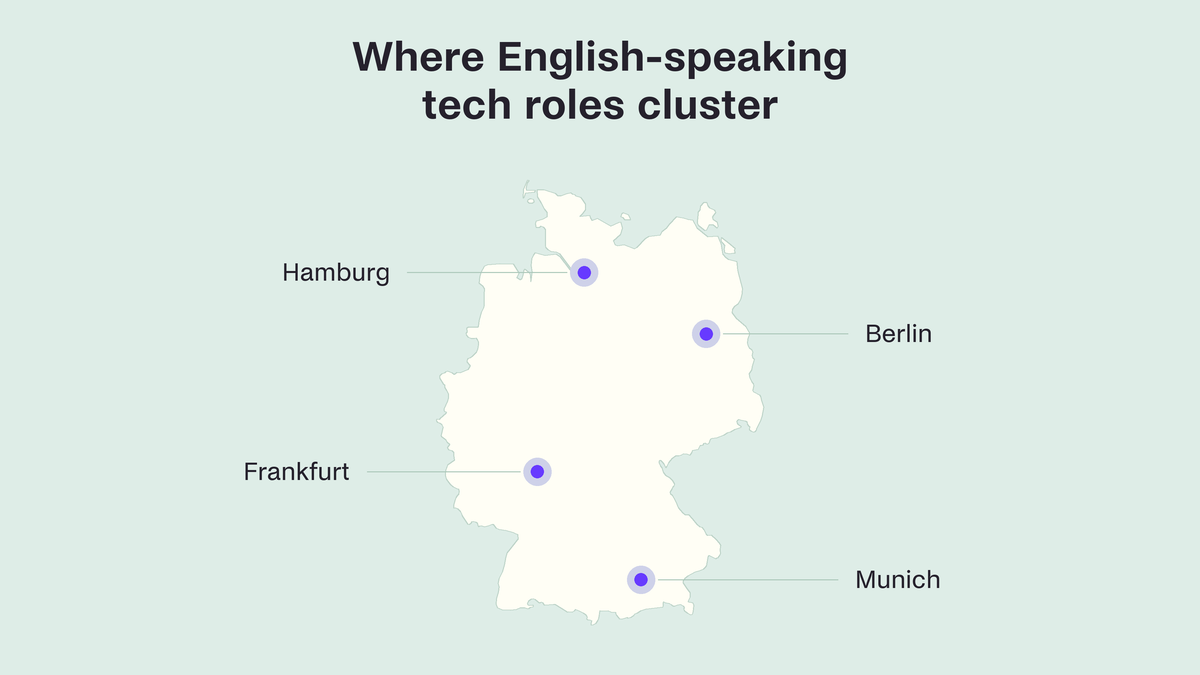
Cities with large international workforces: Berlin, Munich, Hamburg and Frankfurt
Berlin is generally seen as the most English-friendly market, with Munich, Hamburg and Frankfurt close behind (Germany Compass).
Where German is usually expected:
Public-sector roles
Healthcare and social services
Trades and manufacturing (the Mittelstand), where at least some German is usually needed even if B2 isn't always required
Client-facing positions across most industries
The IAB data backs this up: 74% of healthcare and social services employers and 66% in public administration required at least B2 for their most recent vacancy.
You can still find work without fluent German if you know where to look and which roles match your current language level.
How is finding a job different after a Bildungsgutschein-funded course?
If you studied through a Bildungsgutschein (a training voucher from the Agentur für Arbeit), a few things about your situation matter for what comes next. The Agentur für Arbeit expects you to be actively searching: documenting your applications, attending appointments and reporting your progress. Falling behind on those obligations can affect your benefits. That timeline pressure is real, and it shapes how you approach everything below.
You've spent a few months building projects, learning to work with AI tools and adding a technical skill to your profile. But the job market you're entering is mostly German-speaking, and your professional background is in a different field. You're not starting from zero, but your profile doesn't fit neatly into one category either.
This is where most of the professionals I work with get stuck. The questions I hear again and again are variations of:
"I have 10 years of experience in marketing (or finance, or project management), plus these new AI skills. How do I explain that to an employer without sounding like I'm starting over?"
"I've learned all these new AI skills, but I don't know what job title to look for. The roles keep changing and nothing seems to match exactly what I can do."
"I don't want to undersell my experience, but I also don't want to oversell what I can do with AI yet."
"Should I apply for junior roles? Senior roles? Something in between?"
If you're asking yourself these questions, you're in good company. The sections below cover how to answer them before you start applying.
You also don’t have to work through them alone. If you study with a Bildungsgutschein at Turing College, career support is part of your programme. It includes a career module (job-search planning, CV and LinkedIn preparation, and mock HR and technical interviews), a weekly career Q&A and monthly career webinars (correct at the time of writing; see our Bildungsgutschein page for the latest details).
Where to find English-speaking jobs in Germany
Not every company that lists "English" on a job posting actually operates in English day to day. And not every company that lists "German required" needs native-level fluency. Learning to read the signals saves you weeks of wasted applications.
Signs a company operates in English
- Careers page is written in English
- Blog posts and product updates are published in English
- International team visible across the company's LinkedIn profiles
- Interview process runs in English
Start with companies where English is the working language. International startups and scale-ups are the clearest examples. Their teams often work in English, their documentation is in English and their hiring processes run in English. Look for signals: is their careers page in English? Are their blog posts and product updates written in English? Do their employees on LinkedIn come from different countries? None of this is a guarantee, but it helps you filter quickly.
Expand into roles where your previous industry expertise matters more than your German level. If you spent years in supply chain management and you've now added data analysis or AI skills, a logistics company may value that combination enough to work around your B1 German. The language bar is lower when you bring domain knowledge that's hard to find.
Diversify your sources. Use LinkedIn for international and English-speaking roles, XING for traditional German companies and regional positions, and StepStone and Indeed for broad coverage. Check company career pages directly, especially at startups that don't always post on the big boards. Germany's tech scene has active meetups and Slack communities where roles get shared before they hit the boards. Groups like Startup Berlin, 2hearts (especially relevant if you have an immigration background) and Tech Explorer run in English and cover jobs, events and introductions across Berlin, Munich and Hamburg.
Treat networking as part of your job search, not an extra. This is where I see the most underinvestment. Attending events, reaching out to people in roles you're interested in and maintaining those connections is not optional. It's how many positions in the English-speaking job market in Germany get filled. A referral from someone who's seen your project work carries more weight than a cold application.
How to explain your career change and AI skills to German employers
The answer I give most often is the same: your AI skills are a layer on top of what you already bring, not a replacement for it. The role you’re looking for probably won’t have a clean title yet. Look for positions where your previous expertise is the core requirement and AI skills make you a stronger candidate. If you come from marketing, search for “Marketing Analyst”, “Marketing Automation Specialist” or “Growth Analyst” rather than generic “AI Engineer.” If your background is in finance, try “Financial Data Analyst” or “Risk Analyst” with AI or machine learning as a keyword. The closer the title is to your previous field plus your new skill, the more your full experience counts.
As for junior versus senior: don’t default to junior just because AI is new to you. If you have eight years of professional experience, applying for a junior role undersells what you bring. Look for mid-level roles where your domain expertise is the main requirement and AI skills are a plus. You’ll likely need to accept that the title may be lateral or slightly below where you were, but junior is usually a step too far down.
The biggest mistake I see is people presenting themselves as two separate halves: the experienced professional from before, and the AI beginner from after. Employers don’t hire halves. They hire someone who can solve a specific problem, and your job is to show how your combined background does that.
Build one story, not two. If you spent eight years in HR and then completed an AI programme, describe yourself as someone who understands workforce data, employee experience and organisational processes, and who can now build tools to improve them. The framing matters. Lead with the problem you solve, not the career change you made. For a real example, Rimvydas went from construction project management to building AI agents by framing his operational experience as the foundation, not the thing he left behind.
Your CV should reflect this. Put your AI projects and your professional experience on the same page without splitting them into "before" and "after" sections. A project where you built an automated candidate-screening tool is directly connected to your HR background. Show that connection. German employers, particularly in larger companies, tend to read CVs closely and expect a clear professional narrative. If you’re new to the German market, know that a Lebenslauf (CV) typically includes a professional photo, follows a structured reverse-chronological format and often comes with a short cover letter (Anschreiben). These conventions matter: a CV that looks like a UK or US resume can get filtered out before anyone reads it.
Prepare for the "why did you switch" question. Most interviewers will ask it. The answer should be specific and forward-looking: what you noticed in your previous work that made you want to learn these skills, what you built during your programme and what you want to do with that combination. Avoid framing your previous career as something you're escaping from. For questions about the AI skills themselves, see how to talk about AI in job interviews.
Don't aim for your ideal role on day one. When you're entering a new field, your first role after transitioning probably won't be your target role. It'll be a stepping stone: a position that lets you apply your new skills professionally, build a track record and grow into the work you want. Careers after a transition are rarely linear, and treating that first role as a bridge rather than a destination keeps your expectations realistic and your momentum going.
Show your projects. The portfolio you built during your programme is your most concrete proof. Link to it from your CV and your LinkedIn profile. When a recruiter can see a working project that demonstrates what you're capable of, it answers questions that a list of skills on a CV can't. To see what a hiring tech lead looks for in project work, read how to get your first AI engineering job.
What does a realistic job search in Germany look like after a career change?
If you studied through a funded programme, you were probably registered as job-seeking when you started and now need to find work. You want to be earning again. That creates pressure, and pressure can lead to either rushing or freezing.
Neither helps. What helps is starting before you feel ready. You don't need perfect German, a perfect CV or a perfect portfolio to begin. Applying is how you learn what the market responds to, where your gaps are and which roles are realistic. Waiting until everything feels polished costs you time and information.
Too many people treat job searching as a passive exercise. Three applications a week and waiting for replies is not a job search. An effective search means networking actively, reaching out to people at companies you're interested in, attending events, posting about your work on LinkedIn and keeping those conversations going. The people who find work sooner are usually the ones who are visible, not the ones with the strongest CV.
If your target sector requires German, you'll need it eventually. But don't wait until you reach B2 to start applying. Apply to English-friendly roles now while you improve your German for the next stage. In my experience, some companies hire at A2 or B1 if you bring the right technical skills and commit to continuing your language development.
A career transition takes time. Six months of active searching is a reasonable reference point, not a guarantee. Our own placement data shows a range: 88% of funded learners (31 of 35) found work within six months of finishing, though some took as little as two months and others closer to nine. What matters is staying active and adjusting your approach based on what you learn. And if you've been targeting one specific role for months with no results, consider adjacent positions. A role that's not your ideal title but uses your skills and gets you into the industry is worth more than a perfect application for a job that never replies. The same applies to salary. If you're switching fields, your first role in the new area may not match what you earned before, especially if your German isn't strong yet. That's normal. Once you're in and building a track record, your salary can catch up.
Sources: IAB Kurzbericht 07/2026: Language requirements in the German job market (9,549 employers surveyed, Q2 2025); Indeed Hiring Lab: language requirements in German job ads (2.7% of Indeed ads state German is not required, September 2023 to August 2024); English-speaking jobs in Germany 2026: sectors and cities; German language requirements by sector and company size (IAB sector data).