AI Leadership Units: A 2026 Guide for Leaders
10 min · April 14, 2026 · Updated June 4, 2026
Key Takeaways
- Boom Training begins delivering government-approved AI Leadership Apprenticeship Units in May 2026 — the first formally assessed, levy-fundable route to AI governance training for senior managers in the UK.
- Units run 30–140 hours over 1–16 weeks and map to occupational standards including ST0480 (Senior Leader) and ST1512 (AI & Automation Practitioner).
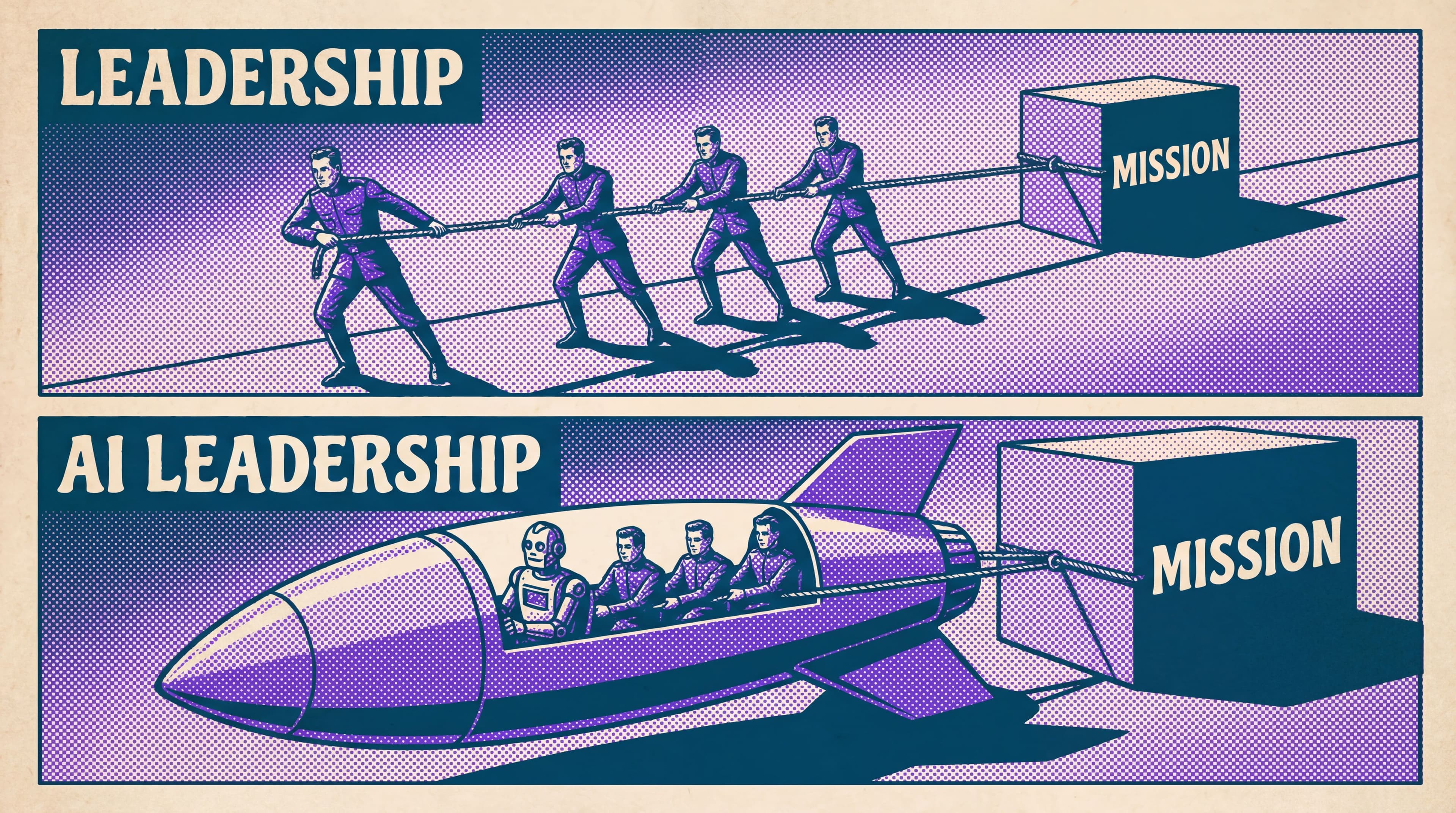
- The latest LLMs made English the programming language — the skills problem moved to the top because the capability moved to everyone.
- The unit combines strategic governance frameworks with hands-on AI project work — the same combination that produces calibrated judgment, not just policy literacy.
- Levy-paying employers can fund units through existing apprenticeship accounts — no additional budget required.
- Turing College CEO Lukas Kaminskis built a Notion alternative in 7 days using AI tools, saving $5,040/year — a working model of what AI-native senior leadership looks like in practice.
Most organisations think their AI skills problem sits in the engineering team. Until 2024, that was a reasonable assumption. Building things required technical training. That line organised everything — who could make, and who had to ask.
Models like Claude Opus 4.6 erased it. Nvidia CEO Jensen Huang, speaking at London Tech Week in June 2025, put it plainly: "There's a new programming language. This new programming language is called 'human'." "Everybody in the world is now a programmer," he said. A manager who can describe a problem clearly can build a working solution today, without writing a line of code. The capability moved to everyone, so the skills problem moved to the top.
Which is exactly why the economic stakes are landing at the leadership level. AI-related business investment surged 18% annualized in the first half of 2025, adding a full percentage point to US GDP growth in Q2 alone. PwC projects AI will contribute $15.7 trillion to the global economy by 2030. 75% of executives already believe they risk going out of business within five years if they don't scale AI, according to Accenture. BCG's Matthew Kropp framed the competitive logic plainly: "In five years, your competitors won't be companies adapting AI to fit their needs — they'll be companies built AI-first from the ground up."
The pressure arrives before the preparation. Senior leaders now carry accountability for systems — and for entire organisations using those systems — they were never trained to govern. The subscriptions got approved. The tools got deployed. The governance layer is still catching up.
That gap is what the AI Leadership Apprenticeship Unit is designed to close. Boom Training — the apprenticeship delivery arm of Turing College — begins delivering these government-approved units in May 2026.
What Is an AI Leadership Apprenticeship Unit?
An AI Leadership Apprenticeship Unit is a short, government-backed training programme — 30 to 140 hours, delivered over 1 to 16 weeks — for employed professionals in or approaching leadership roles. Units are grounded in employer-led occupational standards and cover AI governance, procurement, risk management, and cross-functional change delivery. Levy-paying employers can fund them with no additional budget.
A full apprenticeship is a multi-year programme. A unit is a targeted module drawn from that same framework — the same quality assurance, the same occupational standards, the same formal assessment — scoped to a single capability gap. An organisation does not need to enrol a director on a degree-level programme to give them AI governance literacy. They start with the unit that closes the specific gap.
The delivery model matters here, and it is worth being precise about it. The government funding rules require synchronous learning — tutor and learner in the same physical or virtual space, training delivered in the learner's normal working hours. For a senior manager with a full calendar, that is a real constraint. The question is whether the training provider has built a delivery model that genuinely works around it, or one that simply asks the learner to rearrange their week.
Turing College has spent several years solving exactly this problem in other markets. The learning model we built for working professionals — structured around synchronous sessions that fit inside a working week rather than disrupting it — has been tested across thousands of learners in demanding roles. Boom Training brings that same model to apprenticeship unit delivery. The result is one of the most flexible synchronous learning programmes in this market: cohort-based, tutor-led, and built from the ground up for people who cannot afford to disappear from their organisations for days at a time.
The curriculum does not bend. The delivery does.
Why AI Has Made Every Manager's Job Description Obsolete
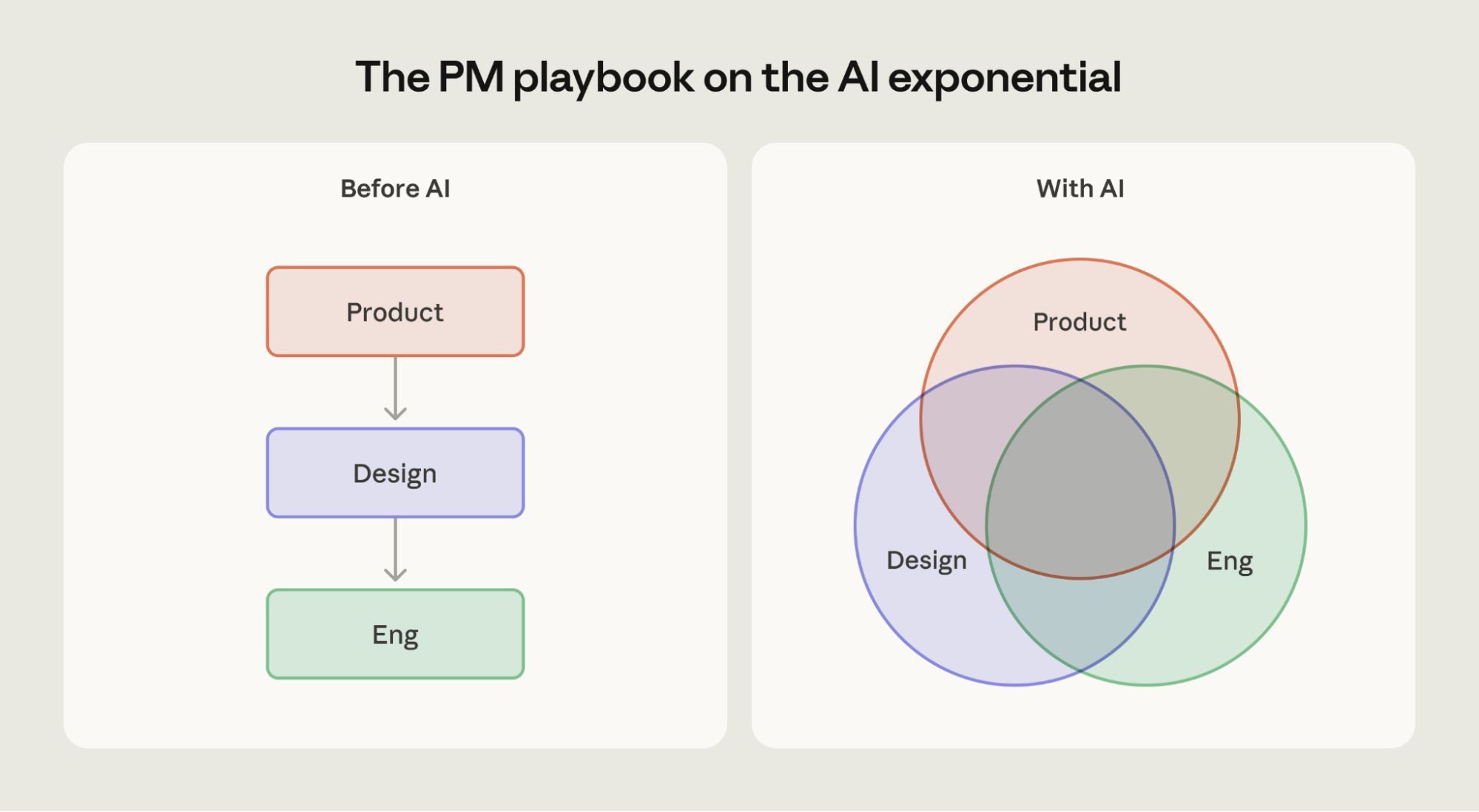
AI collapsed the linear workflow that defined senior management for a generation — the clean handoff from product to design to engineering. Those three functions now overlap almost entirely. What remains at the senior level is judgment, governance, and technical credibility — three things that require actual familiarity with the tools being governed.
Before AI, the relationship between product, design, and engineering looked like a pipeline. Product defined requirements, design interpreted them, engineering built. Each function had clear ownership. Senior managers governed by sitting at the junctions between them.
With AI, those three circles collapsed into each other. A product manager prototypes in an afternoon using tools that required a specialist a year ago. A designer ships copy. An engineer scopes the product brief in the same session.
Authority in organisations has always tracked competence. When AI blurs role boundaries, the manager who cannot operate the tools loses standing — not formally, but functionally. They cannot challenge a vendor's claims with any credibility. They cannot assess whether a procurement decision creates lock-in three years from now. They cannot lead an AI governance discussion because they cannot yet distinguish a well-governed AI system from a poorly governed one. The AI Leadership unit builds that competence at the level where the decisions actually get made.
What the Unit Actually Teaches
The unit combines the strategic knowledge required by the AI Leadership occupational standards — governance, procurement, risk, regulatory representation — with hands-on AI project work. Participants leave with both a governance framework they can apply immediately and direct experience building with AI tools.
Most AI training programmes produce people who can talk about governance but struggle to exercise it. The knowledge and the experience stay separate. This is the same problem as reading a design pattern in a book and then forcing it into a project — the solution lives in the theory, not the practice, so it fits awkwardly when it meets reality. It is only when you are designing to solve specific problems that there is a close connection between understanding and effectiveness.
The unit addresses this directly. The strategic layer covers what the occupational standards require: evidence-based procurement, ethical governance frameworks, enterprise risk management, change leadership, and regulatory representation — each formally assessed against a named occupational standard. The practical layer is where those competencies get tested. Participants work through hands-on AI projects of the same kind that underpins Turing College's wider programmes — structured, outcome-focused, and designed to surface the failure modes that no vendor slide deck mentions.
The connection to the Lukas Kaminskis example is direct. The visible outcome of his seven-day Notion replacement was a $5,040 saving. The less visible outcome was a precise, tested understanding of where AI tools hit their limits and how to work through them. That understanding does not transfer through frameworks alone. It accumulates through the work. The unit is designed to produce exactly that accumulation — for senior managers who carry governance responsibility but have had the fewest opportunities to build the calibration that makes governance real.
- AI Procurement — Evidence-based investment and procurement decisions for AI tools, platforms, and suppliers, addressing vendor lock-in, data resilience, and exit planning.
- Ethical Governance — Sponsor and operate a governance framework embedding accountability and transparency into organisational decision-making.
- Enterprise Risk — Oversee AI risk within the enterprise risk framework, ensuring audit readiness and continuous monitoring.
- Change Leadership — Lead cross-functional AI-enabled organisational change, assessing workforce impacts and supporting targeted upskilling.
- Regulatory Representation — Represent the organisation in external AI discussions with regulators and sector bodies, embedding compliance readiness into business processes.
What an AI-Native Senior Leader Actually Looks Like
An AI-native senior leader does not just approve AI projects — they understand AI capabilities well enough to stress-test vendor claims, redesign workflows around AI-augmented roles, and build governance structures that hold under audit.
The question most senior managers are quietly sitting with is a practical one: what does this actually look like day-to-day? It is worth having a concrete answer, because the abstract version — "leaders need AI literacy" — has been repeated so many times it has stopped meaning anything.
Here is the concrete version. Turing College CEO Lukas Kaminskis noticed that Notion was costing the company $12 per user per month. With 35 team members, that is $5,040 per year. The standard response would be to accept the cost or find a cheaper SaaS alternative. Lukas built a replacement instead. In seven days, using AI coding agents and the prompting and debugging skills his own platform teaches, he shipped Doku — a functional, open-source Notion alternative with document editing, navigation, and team collaboration. Zero lines of code written manually. The $5,040 annual subscription was cancelled on day seven.
What makes this story useful for thinking about AI leadership is not the cost saving. It is what the story reveals about the relationship between understanding and authority. Lukas could evaluate his tools accurately because he had used them under pressure. He knew where they hit limitations — on day three, the coding agents ran into constraints that required precise prompting and debugging to resolve — and he knew how to work through those limitations because he had developed a calibrated view of what the tools could and could not do. That calibration is not something you acquire by reading about AI. It accumulates through the work.
A manager who has never seriously used these tools tends toward one of two failure modes: over-delegation, where AI output is accepted without scrutiny, or dismissal, where the tools are underestimated and under-deployed. Both produce bad decisions. The leader who has shipped something real with AI — who has hit the first wall and found the workaround — has a different kind of authority in conversations about procurement, governance, and risk. They are reasoning from experience, not theory.
That is the standard the AI Leadership unit is built to produce. When we benchmark what graduates of this programme are held to, Lukas's published record at building-with-ai.turingcollege.com is the reference point — not as an exceptional case, but as a demonstration of what becomes possible when a senior leader closes the gap between understanding AI and governing it.
How to Get Your Organisation Enrolled in May
Boom Training begins delivering AI Leadership Apprenticeship Units in May 2026. Organisations can apply now through a short discovery conversation to confirm eligibility and match the right occupational standard to the organisation's skills gap.
- Identify the gap. Which of your senior managers would struggle to hold an AI governance conversation under external scrutiny? That person — or that cohort — is the starting point.
- Check levy eligibility. Levy-paying employers fund units through their existing apprenticeship account. Non-levy employers may qualify for co-investment, where the government covers 95% of the training cost and the employer contributes 5%.
- Contact Boom Training. Fill in the enquiry form at boom-training.com/contact. The team confirms unit fit, eligibility, and a May start date.
- Confirm the occupational standard. Units map to ST0480 (Senior Leader), ST0272 (Chartered Manager), ST1512 (AI & Automation Practitioner), or ST1398 (Machine Learning Engineer) depending on the learner's current role.
- Start in May. The first cohort opens May 2026.
The organisations that govern AI well over the next 18 months will not be the ones with the most tools. They will be the ones whose senior leaders understand what they are governing — and can demonstrate it when asked.
Contact Boom Training to enrol your organisation →
Boom Training is the apprenticeship delivery arm of Turing College. The first AI Leadership cohort opens May 2026. Register your interest at boom-training.com/contact.
Want to start building with AI?
Ship real products with AI agents on our hands-on Building with AI programme.