AI Leadership Apprenticeship Units: From Spectator to Operator in 90 Hours
16 min · April 24, 2026 · Updated June 4, 2026
Key Takeaways
- Senior leaders are the binding constraint on most enterprise AI adoption — not the technology, not the budget, not the engineers.
- The managers who matter in 2026 have used the tools enough to evaluate them honestly, and know how to govern, procure, and deliver AI through a large organisation.
- Hands-on familiarity is the entry ticket. Strategy, procurement, governance, and delivery are the real leadership work — the programme covers all of it.
- Boom Training's 90-hour AI Leadership apprenticeship units run as three standalone units that stack: strategy, adoption & governance, then delivery.
- For most UK businesses, the programme is 100% funded by the UK government through the apprenticeship levy. The out-of-pocket cost is zero.
- Built for any manager leading AI adoption — from an SME owner making the company AI-first to a multi-national enterprise VP.
- Deep business context, plus enough hands-on familiarity to judge what is real, plus governance and delivery muscle — that is the defensible combination.
There is good news buried inside a hard truth.
The hard truth first. Dario Amodei, CEO of Anthropic — 2,500 employees, $380 billion valuation — says he spends up to 40% of his time on company culture, not on products or models. He said it on the Dwarkesh Podcast in February 2026, picked up by Fortune the same month. The person closest to the AI frontier has concluded that the technology is not the hard part.
Harvard Business Review's February 2026 research on leader AI adoption confirmed what most CTOs we speak to already suspected: the bottleneck in enterprise AI is not the models, the data, or the engineers. It is the layer of the org chart between the executive team and the people writing the code. McKinsey's work on building leaders in the age of AI reaches the same point. A majority of AI transformations fail to deliver what the board was promised, and the recurring variable is leadership capability.
So managers have a problem. The standard response — books, conference keynotes, a two-day executive course — has produced a class of confident spectators. They can describe the field. They cannot operate inside it. That gap is where AI programmes stall.
Now the good news. The training that closes the gap already exists, is practical rather than theoretical, and for most UK employers is fully funded by the government. The Boom Training AI Leadership apprenticeship units are a 90-hour programme split into three stackable units covering the full arc: strategy and opportunity, adoption and governance, and delivery. Most UK employers pay nothing out of pocket for any of it.
The contrarian point: in 2026, theory about AI is the least valuable thing a manager can own on its own. Your team already has it. Your competitors' teams already have it. What almost nobody has is a manager who has used the tools enough to evaluate them honestly, and who can then make the procurement, governance, and delivery decisions that turn an idea into a deployed system.
Why leaders are stuck on AI adoption
Leaders are stuck because they are trying to lead a technical shift they have never personally touched. Executives can describe what AI should do for their business, but cannot evaluate the tools their teams are already using. Without that fluency, they cannot tell a good AI project from a bad one, procure the right vendor, or build the governance scaffolding that makes adoption stick. This is a pattern we have watched repeat across six years of upskilling enterprise teams.
Six years of upskilling European organisations has taught us one thing above all. The manager version of this conversation almost always starts the same way. A head of operations, a COO, a VP — someone senior — tells us they want to "do more with AI" and asks for a training budget for their team. When we ask what they have personally tried with the tools, the answer is almost always nothing serious. They have watched their team work. They have used Claude or ChatGPT for a few emails. But they have never sat with a real business problem, taken a tool through a credible test, and then followed the work through to procurement, governance and rollout.
This is not a criticism of the individual. It is a structural observation. Most managers got their seat by being good at people, process, and P&L. Nobody told them the job would suddenly require them to operate inside the technology, not just around it.
The consequence is what McKinsey keeps documenting: AI transformations that stall at the pilot stage, money spent on consultants who write decks rather than code, a widening gap between companies where the leadership has touched the tools and can run the change, and companies where it has not. The second group is running out of runway. Until 2024, a manager could credibly delegate the entire AI conversation downwards. That window has closed.
The operator advantage
The most valuable profile in 2026 is the operator: a leader who understands the business deeply, has used the AI tools enough to evaluate them honestly, and knows how to govern and deliver AI through a large organisation. Hands-on familiarity is the entry ticket — it is how you separate signal from sales pitch. The actual leadership work is procurement, governance, change management, and ROI.
Nikolay Storonsky, founder and CEO of Revolut — now Europe's most valuable private company at a $75 billion valuation — put the foundational piece about as plainly as anyone in an interview with the Financial Times:
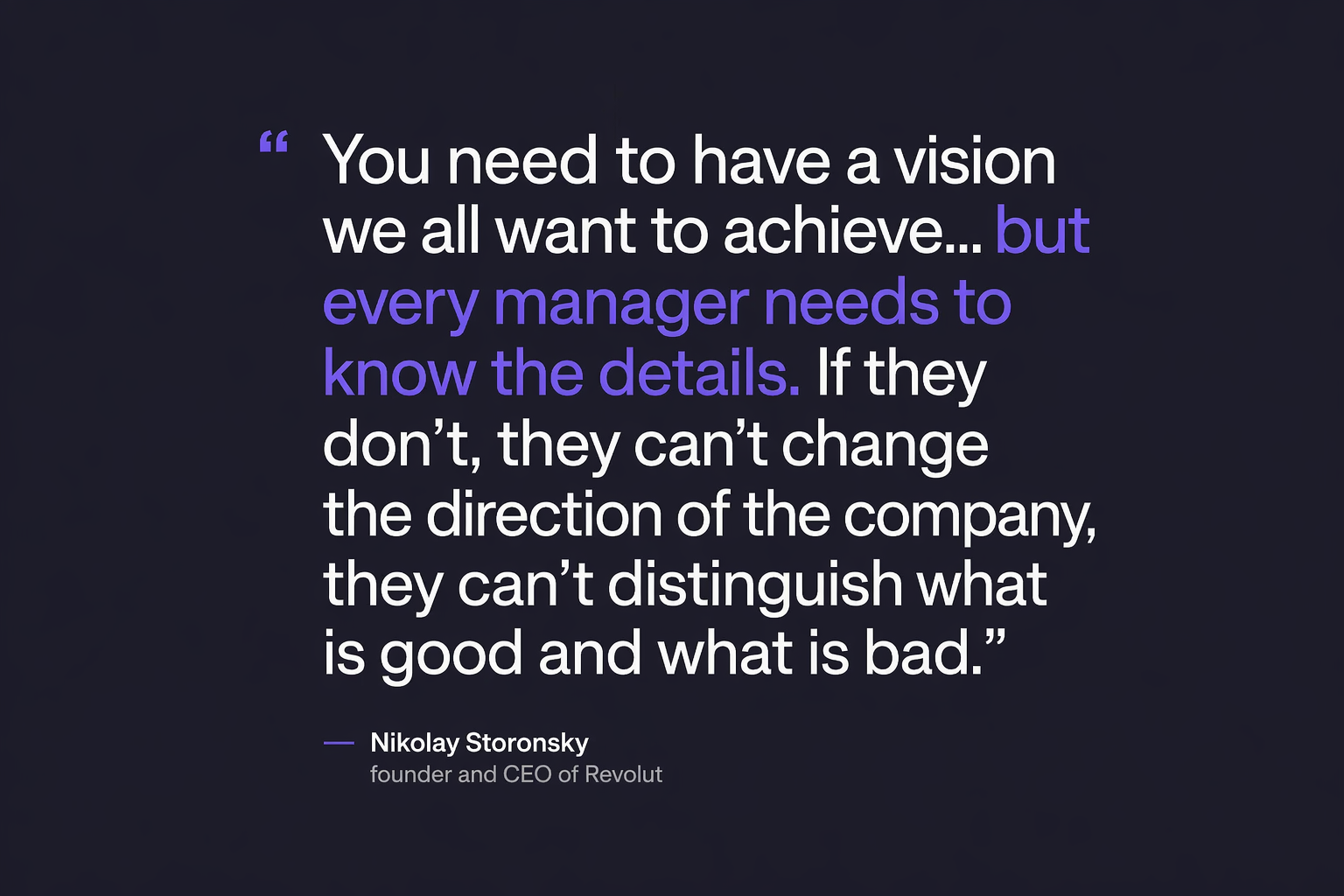
Storonsky was talking about banking infrastructure, not AI. The principle transfers. A manager who cannot evaluate the thing they are managing cannot tell a good decision from a bad one. In the AI context, "knowing the details" starts with having tried the tools on a real problem — not expertly, not exhaustively, but honestly enough to know what is easy, what is hard, and what a credible attempt looks like. From that foundation the real work becomes possible: picking the right vendor instead of the loudest one, writing governance that engineers will actually follow, and sponsoring a change-management plan that survives contact with the organisation.
When we piloted this format with our first manager cohort at Boom Training, the pattern was clear. The learners who actually engaged with the tools on a real problem, then drove the work through procurement and governance, went on to lead AI programmes inside their organisations within six months. The ones who treated the programme as a lecture series produced a strategy deck and stalled at pilot stage — most of them were still "building the business case" a year later.
The reason is structural. An engineer without business context produces technically impressive things that solve the wrong problem. A manager who has never tried the tools approves technically mediocre things and cannot tell the difference. A manager who has tried the tools but cannot govern ends up with a pilot that never makes it into production. The operator collapses all three translation layers: they see a bottleneck on Monday, can evaluate a candidate solution credibly, and know how to route it through procurement, risk and delivery by the end of the quarter.
This is also why Amodei's 40% figure makes sense. When a company is full of people who have used the tools and understand the mission, the CEO's job becomes making sure those people trust each other and pull in the same direction. The culture is the moat. But that only works if the people have the full skill set in the first place.
Why lecture-based AI training fails leaders
Lecture-based AI training fails leaders because the gap it needs to close is not a knowledge gap — it is a reps gap. Judgement about AI tools comes from using them on real problems, not from reading about them. Managers do not need another explainer on transformer architecture. They need enough time with a tool to form an honest opinion of it, plus the governance, procurement and delivery muscle to put that opinion to work.
Here is the comparison, in the terms that matter:
The right-hand column is the Turing College model, which Boom Training delivers into UK apprenticeship programmes. We built it over six years of technical upskilling, and the belief behind it is simple: real skills come from hands-on practice on real problems, not from listening — and that applies as much to governance and delivery as it does to tool selection. The difference shows up the first time a manager sits in a room where their engineering team is debating which model to fine-tune, and they can participate instead of nodding. It shows up again the first time they have to defend a procurement decision, and again when they have to sign off on a rollout plan.
Inside the 90-hour AI Leadership apprenticeship units
The Boom Training AI Leadership apprenticeship units are a 90-hour programme built from three stackable standards. They launch in May 2026 and are designed for any manager leading AI adoption — from an SME owner making their company AI-first, to a director in a mid-market business, to a VP inside a multi-national enterprise. Each unit combines theory, hands-on practice with the relevant tools, and a piece of deliverable work the learner presents to their own team or business stakeholders at the end.
The three units are a progression, and they stack in the order the work actually arrives. Unit 09 is strategy — where do we play, what can AI do for this business. Unit 10 is one layer deeper: the detailed adoption plan, the procurement decisions, the governance model. Unit 11 is how you actually deliver it through a real organisation. Skip a layer and you end up with a governance framework for a strategy that does not exist, or a delivery plan for a tool nobody has chosen.
The progression: three units, three questions
| 09 | AI Leadership: AI Strategy and Opportunity The question: where are the real AI opportunities for our business, and what can AI actually do? |
↓
| 10 | AI Leadership: AI Adoption, Procurement and Governance The question: strategy is set — what is the detailed adoption plan, and how do we procure and govern what we need? |
↓
| 11 | AI Leadership: AI Delivery and Organisational Transformation The question: the plan is clear — how do we actually implement it, measure ROI, and deal with regulation? |
Unit 09 — AI Leadership: AI Strategy and Opportunity
Where are the real AI opportunities for our business, and what can AI actually do?
You cannot set a direction for AI until you have a calibrated sense of where the technology is genuinely useful and where it is marketing noise. Unit 09 is about reading that terrain and then deciding where your organisation should play — which problems are AI-shaped, which are adjacent, which are hype. The hands-on element here is light but deliberate: enough exposure to the tools to make your judgement honest. The bulk of the unit is turning that judgement into a defensible opportunity map. Without this unit, the next two are guesswork.
Unit 10 — AI Leadership: AI Adoption, Procurement and Governance
Strategy is set — what is the detailed adoption plan, and how do we procure and govern what we need?
Unit 10 lives one layer below strategy. The direction is set in Unit 09; Unit 10 is where it becomes a concrete plan the organisation can act on. Which tools. Which vendors. How procurement gets done without being hostage to the loudest salesperson. How governance is structured so the whole thing does not fall over the first time a regulator, an auditor or a board member asks a hard question. This is the unit where most AI programmes die in practice, and most AI courses skip over in theory.
Unit 11 — AI Leadership: AI Delivery and Organisational Transformation
The plan is clear — how do we actually implement it, measure ROI, and handle regulation?
The plan on the slide and the plan in the wild are rarely the same plan. Unit 11 is about making things ship inside a real organisation: managing the change, measuring returns honestly, and handling the regulatory and organisational resistance that kills most AI initiatives before they produce value.
Take one, take all three
Each unit works as a standalone programme. If you already have strong strategy fundamentals and the gap you feel is delivery, enrol on Unit 11 on its own. If you are newer to the space, start at Unit 09 and work forwards. Each unit on its own produces a certified apprenticeship completion.
Complete all three and you receive the full AI Leader certificate — a stacked credential that covers the whole arc from opportunity to implementation. The certificate is being backed by a partner network of major global companies, to be announced shortly. Full syllabus and unit breakdown at programmes.boom-training.com/course/ai-leadership.
What makes the programme different
Our edge is not in how the formal apprenticeship assessment works — that part follows the standards like any other apprenticeship does. Our edge is in what the learning itself forces you to do. Every unit requires you to engage with the tools on a real problem in your own organisation, present the work to your own stakeholders, and work through the governance, procurement or delivery decisions that go with it. The hands-on element gives you the credibility and the judgement. The rest of the unit gives you the muscles that make that judgement matter past the pilot stage.
We built it this way because of what we kept seeing across our cohorts at Turing College and Boom Training: the managers who actually engaged with the tools, then drove the work through the rest of the organisation, carried themselves differently in every subsequent AI conversation. They had earned the right to have an opinion, and they had the evidence that they could execute one. In enterprise settings, that is worth more than any job title.
Why UK businesses pay nothing for these apprenticeship units
For most UK businesses, the AI Leadership apprenticeship units are 100% funded by the UK government through the apprenticeship levy. Large employers draw the cost directly from their levy pot. Smaller employers access the same funding through the co-investment route, where the government covers the vast majority of training costs. In practice, most teams enrolling a manager pay nothing out of pocket.
This usually surprises managers when it comes up. They assume an executive-level AI programme runs at executive-level prices, so they quietly shelve the idea until the next budget cycle. The reality is the opposite. Because the three units are delivered as formal apprenticeship programmes, they sit inside the UK's existing apprenticeship levy framework — the same framework that has been funding L&D in British companies for years, now pointed at the skill that actually matters.
If your organisation has a wage bill over £3 million, you are already paying into the levy whether you use it or not. The money is sitting there. Most large employers spend a fraction of what they contribute, and what they do not spend expires. Turning your managers into operators with full adoption and delivery muscle is one of the best uses of levy funds right now.
If your organisation is smaller and does not pay the levy, the co-investment route still covers the overwhelming majority of the cost. Full eligibility criteria, employer size rules, and application process on the Boom Training apprenticeship levy page. Short version: unless your finance team has a very unusual setup, the programme is free at the point of use.
That changes the decision. The question is no longer can we justify the training spend? It is why are we leaving government-funded AI leadership development on the table?
Course details, intake dates, and unit breakdowns are at programmes.boom-training.com/course/ai-leadership.
FAQ
Who are the AI Leadership apprenticeship units for?
The units are for any manager leading AI adoption inside their organisation — an SME owner deciding how to make their business AI-first, a director in a mid-market company, a VP inside a multi-national enterprise. They assume business seniority and zero prior AI experience with the tools. Not engineering courses, but not theory courses either. Every participant produces deliverable work in each unit, combining hands-on practice with governance, procurement and delivery planning.
Can I take one unit without doing all three?
Yes. Each of the three units is a standalone apprenticeship and can be enrolled on separately, depending on where the gap is in your own practice. Complete all three and you receive the combined AI Leader certificate — a stacked credential backed by a partner network of major global companies (full partner list to be announced). See the full syllabus at programmes.boom-training.com/course/ai-leadership.
How much do the apprenticeship units cost?
For most UK businesses, the out-of-pocket cost is zero. The three units are delivered as formal apprenticeships and are 100% funded through the UK apprenticeship levy. Levy-paying employers draw from their existing pot. Smaller non-levy employers access the same funding through government co-investment, which covers the overwhelming majority of the cost. Full details on the Boom Training apprenticeship levy page.
How is this different from other AI leadership courses?
Most AI leadership courses are lecture-led. Ours are practice-led across the whole arc: you spend time with the tools, and you work through the procurement, governance and change-management decisions that go with them. Hands-on familiarity is the entry ticket, not the whole course. The approach comes from six years of running the Turing College upskilling model across UK and European organisations.
Do I need a technical background to enrol?
No. The units are built for managers with deep business context and limited coding experience. The tools we use are chosen so that a non-engineer can produce something concrete enough to show stakeholders inside the 90 hours. If you can use a spreadsheet and follow a written brief, you can complete the programme.
When do the units launch and how do I apply?
The AI Leadership apprenticeship units launch in May 2026 through Boom Training, Turing College's apprenticeship delivery arm. Full syllabus, timelines and application details at programmes.boom-training.com/course/ai-leadership.
If you take one thing from this piece, take this. The managers who win the next five years will not be the ones who understood AI earliest, and not the ones who can only describe it. They will be the operators — the ones who have used the tools enough to evaluate them honestly, can govern and procure them, and can deliver them through a real organisation. The market is starting to notice the difference. The UK government has decided to pay for the gap. The only remaining question is whether your organisation uses that money before someone else's does.