





Our mentors bring first-hand experience from companies and universities such as:


The companies and institutions mentioned have no institutional affiliation or official partnership with Turing College.
“In numbers, there's probably going to be significantly more AI Engineers than there are ML engineers / LLM engineers.”
Open the door to the most in-demand tech careers
The AI Engineering course will give you hands-on experience designing and building applications with Large Language Models (LLMs), LangChain, and AI agents. You’ll learn the tools and gain the knowledge needed to thrive in high-demand AI-roles like AI Engineer, LLM Engineer, ML Engineer, Software Engineer, Data Scientist and Backend Developer.
Professionals with AI expertise earn up to a 25% higher salary
AI Engineering Online-Kurs – Werde zum KI-Entwickler in nur 3 Monaten
Du möchtest dich zum AI Engineer weiterentwickeln und in nur 3 Monaten (bei 8–12 Stunden pro Woche) lernen, wie du mit LLM-Modellen, LangChain und AI Agents echte Anwendungen baust? Unser AI Engineering Kurs ist vollständig online, flexibel und bietet dir persönliche 1:1-Mentorings. Ob du AI Developer werden oder dich in KI Weiterbildung weiterqualifizieren willst – hier lernst du alles, was du für den Einstieg in High-Demand-KI-Rollen benötigst.
What can you expect?
Self-paced learning and flexible schedule
Learn at your own pace, anytime. We recommend 8-12 hours a week to meet deadlines, but you can adjust to fit your lifestyle with 24/7 access to materials.
Experience with practical projects
Build confidence tackling real business problems with mentor feedback. In four projects (~120 learning hours), you'll leverage AI to address real-world challenges.
1:1 mentoring
Receive detailed feedback from mentors.
AI tools and languages you’ll use
Program outline
This course, created by AI professionals, combines intensive sprints with practical, hands-on projects. Each sprint focuses on key areas of AI engineering, guiding you from foundational skills to building real-world applications.
Foundations of LLM Application Development
Lay the groundwork for developing Large Language Model (LLM) applications with a focus on understanding their capabilities and ethical implications. This sprint introduces you to key LLM concepts, such as prompt engineering and LLM settings, development environment in Python or JavaScript. Through hands-on labs, you’ll explore APIs like OpenAI, Anthropic, and other APIs, and practice crafting and optimizing effective prompts. By the end of this sprint, you’ll have a solid understanding of how to harness LLMs responsibly and effectively for real-world applications.
Building Applications with LangChain, RAGs, and Gradio
Dive deeper into the world of LLM-powered applications by learning to integrate external knowledge and build interactive tools. This sprint focuses on LangChain and its capabilities for enhancing LLM workflows, Retrieval-Augmented Generation (RAG) for accessing external data, and vector databases like ChromaDB for storing and retrieving embeddings. You’ll gain hands-on experience with building structured outputs, prototyping chatbots. The sprint culminates in using LangChain and Gradio to create applications that combine LLMs with real-world data, preparing you to build cutting-edge AI solutions.
AI Agents
Master the art of creating AI agents that can perform complex, automated tasks. This sprint introduces you to the fundamentals of AI agents, from basic chains to advanced agents capable of executing code, interacting with APIs, and performing long-term tasks. You’ll also explore memory mechanisms that enable agents to retain context over time. With hands-on labs and a final project, this sprint equips you to design and deploy intelligent, autonomous systems tailored to specific goals.
Is AI Engineering course for me? Yes, if:
You have tech background (worked in roles such as developer, software engineer or product manager) and are looking to transition into AI roles
You are a tech professional looking to explore AI-driven innovations
New to programming?
Our beginner-friendly Software & AI Engineering course might be a better fit for you.
Kickstart your new career
We don’t make empty job promises. Instead, we focus on what actually works: real-world skills, personalized career support, and a strong portfolio that shows employers what you can do.
Lorem ipsum dolor sit amet, consectetur adipiscing elit. Suspendisse varius enim in eros elementum tristique.


A unique learning experience powered by technology
Online learning is tough when you’re left on your own. That’s why we built Intra, our learning platform that combines the best of both worlds: human support and smart structure. We’re also developing adaptive AI features to further personalize learning so that, in the future, your journey will adjust closely to your pace, needs, and progress.


Learn from professionals
Our Senior Team Leads and mentors are experienced professionals who are 100% up-to-date with the industry trends and will provide you consultations, 1on1 project reviews, and feedback.

Flexible graduation: you set the pace
Die Kursdauer beträgt 3–4 Monate, abhängig davon, wie viel Zeit du investierst. Du kannst jedoch schneller fertig werden, wenn du intensiv lernst.
Our graduates from various countries work at


How application works
Our application process consists of three steps:
Application
You’ll complete an application form, sharing your personal and academic background with us.
Video/audio recording
You’ll record your answers to a few questions so we can assess whether the AI Engineering program is the right fit for you. Don’t worry – you don’t need to prepare much. You’ll have time to think through your answers and you can re-record if needed. We’ve implemented and certified this step to ensure we admit the most suitable candidates.
Interview
You’ll have a short interview call with our admissions manager to make sure you’ll get the most out of the program.
Basic admission requirements:
Focused hours/week
Focused hours are:
- Working on a computer (not a smartphone)
- Uninterrupted working time in a dedicated space
- Rested, not overworked (not after intense cognitive work)
Strong motivation
You need a clear and strong reason for joining this program. It should be your personal goal, and you should have specific reasons for wanting to improve your skills.
Coding experience
You need to have a minimum of 1 year of coding experience with Python or Javascript.
Good English skills
You must demonstrate an English proficiency of at least B2 level to join the program.
Up-to-date computer
You’ll need a computer that can handle large datasets smoothly and runs an actively supported and updated operating system.
Flexible financing options
You’re resident of:
Education voucher (Bildungsgutschein)
Best for
German residents eligible for a Bildungsgutschein
Course duration
Fixed, 3 months
Time commitment
30 h per week
Price
With a Bildungsgutschein
Upfront payment
Best for
Learners who want the lowest total price by paying upfront
Course duration
Flexible, 3-4 months
Time commitment
15+ h per week
Price
Installments
Best for
Learners who prefer to split self-payment into monthly installments
Course duration
Flexible, 3-4 months
Time commitment
15+ h per week
Price
Upfront payment
Best for
Learners who want the lowest total price by paying upfront
Course duration
Flexible, 3-4 months
Time commitment
15+ h per week
Price
Installments
Best for
Learners who prefer to split self-payment into monthly installments
Course duration
Flexible, 3-4 months
Time commitment
15+ h per week
Price
We have limited seats. Apply now!
Starting dates
June 22nd
Deadline for applications:
June 15, 2026
July 22nd
Deadline for applications:
July 15, 2026
Our graduates have achieved life changing growth. You can too.

Turing College has been a great experience. I loved the structure and content of the material. I had constant contact with instructors and peer learners. I find the peer and senior review concept really efficient.
FAQ
What is the difference between an AI Engineer and an ML Engineer or Data Scientist?
An AI Engineer builds products and systems using existing AI models. The work is practical: integrating APIs, building retrieval pipelines, designing multi-agent systems, and shipping applications that work in production. A Machine Learning Engineer works closer to the model itself, focusing on training, fine-tuning, and infrastructure. A Data Scientist analyses data to generate insights and build predictive models.
The distinction that matters if you're considering this programme: AI Engineering is the applied layer. You're building with AI, not building AI. LinkedIn's 2026 Jobs on the Rise report ranked AI Engineer as the number one fastest-growing job title globally, with job postings rising 143% year-over-year. It's also the layer that doesn't require a research background or advanced mathematics to enter.
Is AI Engineering in demand in 2026?
Yes, and the data across multiple sources points in the same direction. Machine learning and AI engineer listings are up 59% from pre-pandemic levels, while generalist software engineer postings are down 49%. The market hasn't contracted - it has split, and AI Engineering is on the right side of that split.
The reason is structural. In 2025, 88% of organisations used AI in at least one business function, up from 78% the year before. Every organisation integrating AI needs engineers who can build and maintain those systems, and job listings for agentic AI roles alone jumped 985% in 2024. Supply has not kept pace.
Can I become an AI engineer in 3 months?
That depends on where you're starting from. The programme requires at least one year of coding experience in Python or JavaScript. If you're coming in with that foundation, you can build a solid, portfolio-ready set of AI Engineering skills in 3 to 4.5 months. If you're newer to coding, this programme isn't the right starting point yet - our Software Engineering programme builds that foundation from scratch, or if you want a shorter introduction to working with AI tools, Building with AI is worth looking at first.
What the programme delivers in that timeframe is practical: four hands-on projects using models from OpenAI GPT, Google Gemini, Meta Llama, and Anthropic Claude. Graduates have built full-stack LLM applications, chatbots with RAG and vector databases, AI agents with memory and context tracking, and self-directed capstone projects. Alwin Brehde, Founder and Managing Director at Rundblick 3D, completed the programme and described it as "a practical, build-first path into AI engineering" - his capstone was his first agentic AI system. What you walk away with is a portfolio that shows employers exactly what you can build.
Do I need a PhD to become an AI engineer?
No. AI Engineering is a practical discipline, not a research one. PhDs are relevant for roles that involve developing new models, publishing papers, or advancing the field itself. The work of building AI applications requires programming skills and hands-on experience, not academic credentials.
The hiring market reflects this: employers increasingly prioritise demonstrated practical experience over formal qualifications.
Is this course suitable for career changers?
The programme is primarily designed for software engineers, web developers, and technically grounded professionals who want to add AI Engineering skills to what they already do. If you already write code and want to start building AI-powered applications, this is built for you.
Gartner predicts that 80% of the engineering workforce will need to upskill to keep pace with generative AI by 2027. The programme gives you the practical toolkit to do that: by the end, you can build full-stack LLM applications, design multi-agent systems, and work with the APIs and frameworks that appear in real job postings. You leave with four completed projects as your main evidence for employers.
What skills do I need before starting?
You need working knowledge of Python or JavaScript - enough to write functions, work with APIs, and understand basic data structures. No prior machine learning knowledge is required, and no computer science degree is needed.
A practical way to check: have you built something with code before, even something small? If yes, you have enough to begin.
How is AI Engineering different from traditional software engineering?
Traditional software engineering builds systems from explicit logic: you write rules, the system follows them. AI Engineering adds a layer where models make decisions, generate outputs, or reason about inputs in ways that aren't fully deterministic.
The practical difference is in what you build and debug. As an AI engineer, you work with prompts, context windows, retrieval pipelines, agent loops, and model APIs. You think about evaluation (does the output meet the standard?), reliability (does the system behave consistently?), and orchestration (how do components work together?). These are distinct skills that traditional software engineering doesn't cover, which is why experienced developers still benefit from dedicated AI Engineering training.
What tools and technologies will I learn?
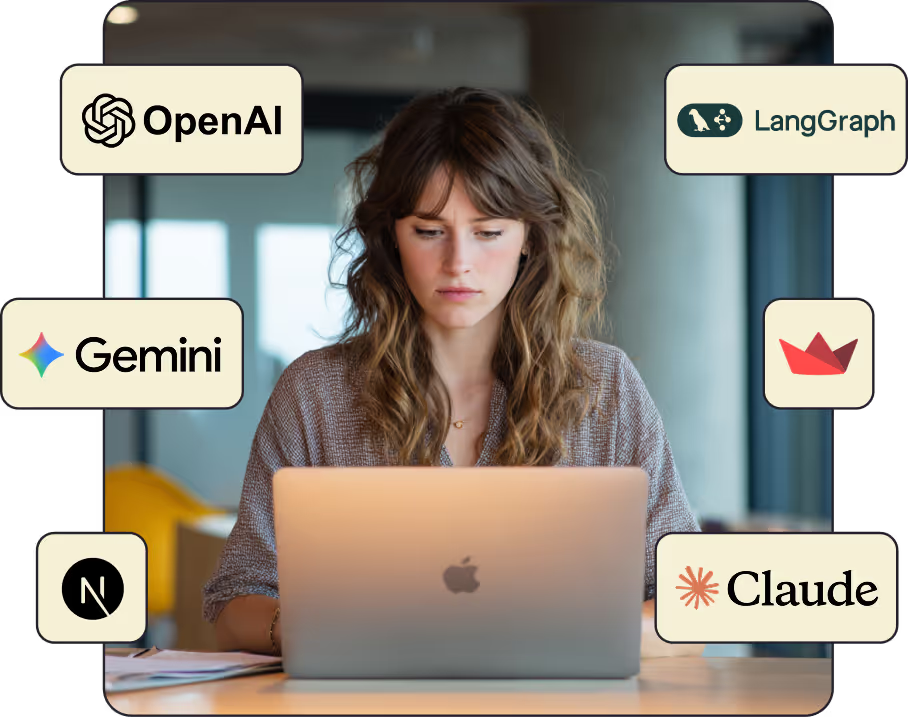
The programme covers Python, LangChain, LangGraph, OpenAI GPT models, Google Gemini, Meta Llama, Anthropic Claude, prompt engineering, RAG (Retrieval-Augmented Generation), vector databases using ChromaDB, AI agents, and front-end deployment with Gradio, Streamlit, or Next.js.
Each tool is taught in the context of a project rather than in isolation. By the time you finish, you understand how each tool works and how they fit together in a production application.
What kinds of projects will I build?
Across the programme you build four projects: a full-stack LLM application using LangChain and Streamlit or Next.js, a chatbot with RAG and a vector database, an AI agent with memory and context tracking, and a self-directed capstone LLM-powered application of your choosing.
You can also see what our graduates have built in the Turing College project showcase. Recent projects include a card game auto-balancer using multi-agent AI and Monte Carlo simulation, a manufacturing design review engine, an integration workflow automation agent, a stock analysis tool, and a bilingual content creation system. The range reflects both the flexibility of the capstone and the depth of what's achievable in the programme.
What can I do after completing the course? What roles are available?
The roles Turing College AI Engineering graduates move into include AI Engineer, AI Developer, AI Backend Developer, and AI Solutions Engineer. These titles reflect different company contexts; the underlying work is building, integrating, and maintaining AI-powered systems.
According to Ravio's 2026 Compensation Trends report, AI Engineers command an average 12% salary premium over general Software Engineers in the European market. Senior AI-specialist roles are currently filling in an average of 17 days - a reliable signal of how acute the talent shortage is.
What salary can an AI Engineer expect?
Salaries vary by location, experience, and specialisation. For the European market, Ravio's 2026 Compensation Trends report puts the average Software Engineer salary at €74,100 in Germany and €73,200 in the Netherlands, with AI Engineers earning a 12% premium on top of those baselines. Senior AI engineers in major European hubs including London, Amsterdam, and Dublin can reach €150,000 or more in total compensation.
At entry to mid level across most European markets, a realistic range is €55,000–€80,000, with progression typically faster than in traditional software roles given current demand. AI specialist salaries increased 18.7% between 2024 and 2025, and the underlying supply-demand imbalance that's driving that hasn't changed.
What does the day-to-day learning experience look like?
You progress through three sprint modules, each building on the last, with four hands-on projects woven through them. The arc moves from foundational API integration and prompt engineering, through RAG systems and agent design, to a self-directed capstone application. Each sprint ends with a completed project.
The format is self-paced with no live lectures. You work on your own schedule and get project feedback from mentors with industry experience. The structured touchpoints are standup sessions - mandatory weekly group standups in the first five weeks, with open standups continuing from week six onwards. Workshops and open Q&A sessions are offered throughout. The community runs on Discord, where learners connect between sessions.
The standard pace is around 10 hours per week over 3.5 to 4.5 months. The German AfA-funded groups run at 30 hours per week, including daily standups, across a fixed 3-month period.
Can I study AI Engineering while working full-time?
Yes. No live lectures means no fixed schedule to work around. Most learners are working professionals who complete the programme alongside a full-time job at the standard pace of around 10 hours per week. The sprint structure helps: rather than one long deadline at the end, you're working toward shorter milestones that keep progress visible and the workload manageable.
How do graduates find jobs?
The portfolio. Four completed, documented projects you can share directly with employers or link from your CV and GitHub carry more weight than most credentials in this hiring market. Over 75% of AI job listings specifically seek domain experts with demonstrated hands-on skills. People who move into AI roles quickly tend to be the ones who can point to something specific they built and explain how it works.
What credential or proof of skills will I have?
On completion, you receive a Turing College certificate in AI Engineering. You also leave with four completed projects, hosted and documented, that function as your main evidence for employers.
Projects from recent learners are featured in the Turing College project showcase. For most hiring conversations, that showcase - and the GitHub repositories behind it - carries more weight than the certificate itself.
What are the funding options?
We believe that financing should not be a blocker to knowledge. That’s why we offer several options. If you’re a resident of Germany, Bildungsgutschein could be an option for you - it’s a government funding program available for unemployed people. If you’re looking to pay from your own pocket, we offer zero-interest monthly installments or a 17% discount if you pay the full tuition upfront.