


Log inApply now

AI for Business online course

Use AI confidently in your work. Learn to choose the right AI tools, write effective prompts, analyse information, create content and automate repetitive business processes. No coding experience is required.

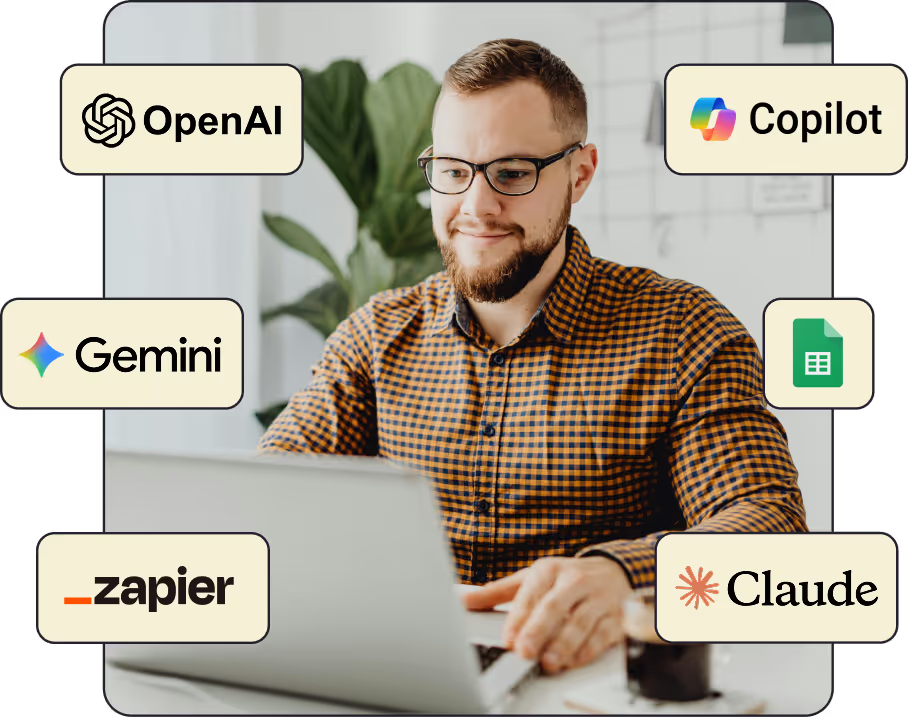
AI for Business learner using AI tools

88%*

of graduates get hired 6+ months after graduation

*Germany, as of July 2026. Includes learners whose program ended at least six months earlier and whose employment status could be confirmed. Unconfirmed outcomes were excluded.

Our mentors bring first-hand experience from companies and universities such as:

University of Cambridge
University of Oxford
Google
Amazon
Meta
Spotify
Vinted

The companies and institutions mentioned have no institutional affiliation or official partnership with Turing College.

AI-intensive sectors, such as services and IT, are experiencing productivity growth nearly 5x faster than less AI-focused industries.
- PwC

Master AI tools and transform your work

AI is no longer optional — it’s the key to staying competitive and delivering value in any role. With the AI for Business Analytics course, you’ll learn the tools and strategies to make data-driven decisions and boost productivity, gaining a powerful edge in your career.

Is it for me? Yes, if you’re:

  • Working professional looking to upskill

  • Looking to increase productivity with AI

  • Analyst or decision-maker wanting to integrate AI tools in your processes

What can you expect?

  • Practical AI skills for your current work

    Apply AI to common business tasks such as research, meeting notes, written communication, presentations, spreadsheets, data cleaning and workflow automation.

  • No coding background required

    The programme starts with AI fundamentals and introduces technical concepts gradually. In the final sprint, AI coding assistants help you write, understand and adapt simple Python scripts.

  • Practical projects

    Use AI to solve business problems rather than completing isolated quizzes. You will practise building reusable prompts, analysing information and automating processes.

  • 1:1 mentoring

    Receive personal feedback on your project work from experienced professionals. Use the feedback to check your approach, correct problems and improve the finished result.

  • Flexible online learning

    Most learners complete AI for Business in around 3.5 months. The programme can take approximately two months with full-time study or up to four months when studied part-time. If you are studying alongside work, plan for around nine focused learning hours per week.

  • 120+ hours of learning

    Complete more than 120 hours of practical learning across AI literacy, productivity, content creation, automation and AI-assisted Python.

  • Supportive learning community

    Ask questions, attend open sessions and workshops, and learn alongside other professionals applying AI to different industries and business functions.

  • Turing College certificate

    After completing the two core modules, you will receive a Turing College certificate listing the programme components you completed.

  • AI tools and technologies you will use

    • ChatGPT
    • Google Gemini
    • Claude
    • Perplexity
    • Fireflies.ai
    • Notta.ai
    • Grammarly
    • Spreadsheets with AI
    • SQL with AI
    • Python with AI
    • n8n
    • Zapier
    • Hostinger Horizons
    • Firebase
    • Lovable
    • GitHub Copilot
    • OpenAI Codex
    • Claude Code

Programme outline

The AI for Business course contains two core modules and six sprints. It moves from understanding and evaluating AI to applying it in practical business workflows.

01Introduction to AI

Understand what artificial intelligence is, how common AI systems differ and where businesses currently use them.

You will learn:

  • · The main types of artificial intelligence
  • · Common AI applications in business
  • · How large language models are trained
  • · Why AI tools produce inaccurate or invented answers
  • · How to recognise AI-generated content
  • · Security, privacy and compliance considerations
  • · Sustainable and responsible AI habits

What you will practise: Identifying suitable business uses for AI, recognising its limitations, and applying basic security, privacy and compliance rules.

02Prompting for better outcomes

Learn how to communicate clearly with generative AI tools and improve the relevance and reliability of their output.

You will learn:

  • · How ChatGPT, Claude and Gemini differ
  • · How to choose an appropriate model or tool
  • · Prompt and context engineering
  • · Setting clear goals, constraints and output formats
  • · Recognising and reducing hallucinations
  • · Retrieval-augmented generation
  • · Context windows and instruction dilution
  • · Creating reusable prompt templates
  • · Verifying AI-generated answers

What you will create: Reusable prompt templates for business tasks you perform regularly.

03AI for media and content creation

Use AI to develop visual and multimedia content while understanding its practical and ethical limitations.

You will learn:

  • · AI-assisted image creation and editing
  • · Describing visual styles clearly
  • · Planning and producing presentations
  • · Using AI for voice, audio and basic video
  • · Common problems such as text-rendering errors and style drift
  • · Deepfakes and impersonation risks
  • · Copyright considerations
  • · Reviewing AI-generated media before publication

What you will practise: Creating and refining AI-assisted images, presentations and multimedia content while evaluating its limitations and risks.

04AI for productivity and spreadsheets

Apply AI to meetings, research, writing and data work.

You will learn:

  • · How organisations use AI across different industries
  • · Using Fireflies.ai and Notta.ai for meeting notes
  • · Extracting decisions and actions from meetings
  • · Cleaning and transforming spreadsheet data with AI
  • · Working with Google Sheets or Excel using AI assistance
  • · Improving business writing with tools such as Grammarly
  • · AI-assisted research and search
  • · Verifying information and avoiding misinformation

What you will practise: Using AI to process meeting notes, improve written communication, clean spreadsheet data and verify information.

05Automations with no-code tools

Connect business tools and automate repetitive processes without needing a traditional programming background.

You will learn:

  • · How to recognise a suitable automation opportunity
  • · Using n8n or Zapier to connect applications
  • · Moving information between forms, spreadsheets and other tools
  • · Summarising, tagging and routing information with AI
  • · Branching logic, delays and error handling
  • · Testing and improving an automated workflow
  • · Building simple websites or internal tools
  • · Working with Hostinger Horizons, Firebase and Lovable

What you will create: A prototype automation that connects business tools and processes information automatically.

06Python programming with AI

Use AI coding assistants to write, understand and adapt simple Python scripts.

You will learn:

  • · Working in a notebook environment such as Jupyter
  • · Using GitHub Copilot or Claude Code
  • · Asking AI to generate and explain Python
  • · Reading and adapting existing code
  • · Cleaning data with simple scripts
  • · Processing files and automating small tasks
  • · Debugging AI-generated code
  • · Understanding the limits of vibe coding
  • · Deciding when a technical specialist is needed

What you will create: A simple Python script for data cleaning, file processing, automation or basic analysis.

Examples of projects

Explore and clean the dataset in spreadsheets or SQL to gather insights.

Run A/B tests to compare user behavior and calculate key performance indicators (KPIs).

Explore no-code environments, such as Zapier, for automating workflows.

Discover the best approaches to data cleaning by using effective formulas and tips for Google Sheets or Excel with AI assistance.

Visualize results in a table or graph format and suggest further analyses.

Understand how to utilize Python for automation tasks.

See what AI for Business learners have created

These projects show how learners have applied AI, automation and data tools to problems from their own work and industries

AI-assisted digital client intake for German traffic law firms

Created by Rasim Baybars

A mobile-first intake system designed to collect traffic-accident information and supporting documents before legal work begins.

The project replaces fragmented phone calls, emails and incomplete forms with a structured digital process. It is designed to reduce missing information, administrative work and delays while making client onboarding more consistent.

Rasim developed it as both a capstone project and a potential business solution.

Automated AI Players Behaviour Analyzer

Created by Aivaras Juškevičius

An automated workflow that turns raw betting-pattern spreadsheets into a formatted report and delivers it through Slack.

The system uses Google Drive, n8n, ChatGPT and PDF conversion to replace a repetitive manual reporting process. It detects new files, extracts the relevant information, generates the report and sends it to the appropriate team.

AI-powered social media reporting and content planning

Created by Aelita

A Google Sheets and Apps Script system that automates recurring LinkedIn and Instagram reporting.

The project brings performance data into a structured reporting workflow, analyses results at post level and gathers potential content ideas from newsletters and news sources. It was designed to replace a time-consuming manual process while retaining human control over content decisions.

No code, some code, or all code? Find your Turing College AI course

Compare AI for Business, Building with AI Agents, and AI Engineering by coding experience, time commitment, and what you'll build.

AI for Business

Building with AI Agents

AI Engineering

Coding experience needed

None

None (you direct AI coding agents like Claude Code instead of writing code yourself)

At least 1 year in Python or JavaScript

Best for

Business professionals, from marketing to finance to operations, who want to use AI confidently without becoming too technical

Professionals who want a structured way to build and ship software with AI coding agents

Developers who want to specialise in building LLM applications and AI agents

Duration

2-4 months

3.5-4.5 months

3-4 months

Weekly time commitment

9 hours a week

12 hours a week

10 hours a week

Examples of projects you will build

AI-assisted reports and presentations, spreadsheet workflows, no-code automations and simple Python scripts for data cleaning or repetitive tasks

A deployed full-stack web or mobile app with auth, database, and payments, capstone of your own design

LLM applications, RAG systems, and AI agents, capstone: a deployed end-to-end LLM application

Key tools

ChatGPT, Gemini, Claude, n8n, Zapier, Python with AI

Claude Code, Next.js, Supabase, Vercel, MCP

LangChain, LangGraph, RAG, ChromaDB, MCP

A unique learning experience powered by technology

Online learning is tough when you’re left on your own. That’s why we built Intra, our learning platform that combines the best of both worlds: human support and smart structure. We’ve also built adaptive AI features that personalise your learning even further - so your journey adjusts closely to your pace, needs, and progress.

Intra learning platform interface

Meet the AI for Business mentors

Learn from people who use AI, data and automation in their work

Our mentors bring experience from data science, analytics, automation, product development and business decision-making. They review learner work, explain how similar problems are approached in industry and keep the learning connected to current practice.

Vytautas Bielinskas

Vytautas Bielinskas, Senior Data Scientist at IBM

Vytautas has more than eight years of experience in data science and analytics. His work covers generative AI, multi-agent systems, statistics and automation for international clients.

He holds a PhD in Urban Engineering and has published scientific research and a US machine-learning patent. At Turing College, he helps learners turn complex AI concepts into practical approaches they can use.


Gedmantas Čepkauskas

Gedmantas Čepkauskas, Data Analyst at Continental

Gedmantas has more than five years of experience working with data across logistics, oil and manufacturing.

At Continental, he builds forecasting models and automations that help streamline operations. His background in applied mathematics and industry projects helps learners connect analytical concepts to real operational problems.

Irina Maria Ionescu

Irina Maria Ionescu, Analytics professional at Google and coach at Healthy Gamer

Irina has more than 12 years of experience across technology, consulting and investment banking. She specialises in turning complex data into insights that support growth and better decisions.

She is also a certified coach at Healthy Gamer. At Turing College, she combines analytical experience with a thoughtful, people-centred approach to project feedback.

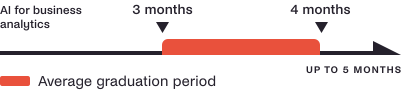
Flexible graduation: you set the pace

Graduation timeline — average graduation period between 3 and 4 months, up to 5 months

Our learners were hired by top companies

Kiloverse
Wise
Nord Security
Vinted
Tesla
Telia
Danske Bank
Hostinger
Wix
Continental
Macaw
Barbora
JIO
Accenture
Siemens Energy
Meta
Deutsche Bank
Western Union
Hitachi
Swedbank
Gjensidige
PwC
ING
Amazon
Guidehouse
Daimler Truck

How admissions works

Our application process has two simple steps designed to help you and our team understand whether the program is the right next step for you.

  1. 1

    Application

    Tell us about your background and answer two short questions about your motivation and goals. Your application goes straight to our admissions team, who review it personally and get back to you within 24 hours on working days.
  2. 2

    Consultation

    If the program matches your goals, we’ll invite you to a 20-30 minute consultation. This is your chance to ask anything, understand exactly how the program works, check your financing options, and decide whether it’s the right fit for you.

Basic admission requirements:

Focused hours

Focused hours are:

  • · Working on a computer (not a smartphone)
  • · Uninterrupted working time in a dedicated space
  • · Rested, not overworked (not after intense cognitive work)

Strong motivation

You need a clear and strong reason for joining this program. It should be your personal goal, and you should have specific reasons for wanting to improve your skills.

Good English skills

You must demonstrate an English proficiency of at least B2 level to join the program.

Up-to-date computer

You’ll need a computer that can handle large datasets smoothly and runs an actively supported and updated operating system.

Flexible payment and funding options

You’re resident of:

Upfront payment

Best for

Learners who want the lowest total price by paying upfront

Course duration

Flexible, 3-4 months

Time commitment

9+ h per week

Price

€3,500Save 17%
14-day money-back guarantee

Installments

Best for

Learners who prefer to split self-payment into monthly installments

Course duration

Flexible, 3-4 months

Time commitment

9+ h per week

Price

€1,055x 4 months

0% interest

14-day money-back guarantee

We have limited seats. Apply now!

Starting dates

August 24th

Deadline for applications: 2026-08-17

September 21st

Deadline for applications: 2026-09-14

Our graduates have achieved life changing growth. You can too.

Kata Hernádi
Turing College has been a great experience. I loved the structure and content of the material. I had constant contact with instructors and peer learners. I find the peer and senior review concept really efficient.

Kata Hernádi
Delegation Team Coordinator @ Siemens Energy
I've been a freelance web developer since the 1980s, mostly building sites for lawyers around Berlin. Going into Turing College's AI for Business program, the real question for me was: am I going to become an AI agency, or am I going to use AI in my own business? The program gave me the structure to actually answer that. I stayed a web developer, but now I build things I wouldn't have dreamed about before. My capstone became a digital intake system for law firms, and I signed my first paying client not long after the program ended.
Rasim Baybars
Rasim Baybars
AI for Business learner
I have used many various learning platforms, and Turing College is really different. Its learning model allows you to move at your pace while getting as much help from the community. I love that it doesn't just focus on your hard skills but soft skills as well.
Linda Oranya
Linda Oranya
Data Scientist @ Metasite Data Insights
After the course, I was able to get into work and solve real business problems easily.
Ovidijus Kuzminas
Ovidijus Kuzminas
ML engineer @ Oxus.AI
The sole fact that I joined Digital Marketing program by Turing College was a contributing factor to me getting a job.
Justas Sadauskas
Justas Sadauskas
Account Manager @ Defined Chase
I have finished two universities, and studied in most of the major online platforms to get extra certificates. And Turing College is one of the most advanced place so far.
Ignas Lukosevicius
Ignas Lukosevicius
Junior Media Buyer @ Pulsetto
Turing College is for those who want to master data science.
Edvard Sivickij
Edvard Sivickij
Data Analyst @ Kilo Health

FAQ

What is an AI for Business course, and what does it teach?

An AI for Business course teaches professionals how to apply artificial intelligence to workplace tasks and decisions.

Turing College's AI for Business programme covers AI fundamentals, prompting, content creation, productivity, spreadsheets, automation and beginner-friendly Python with AI assistance. It focuses on practical business use rather than training machine-learning models or becoming a software engineer.

Can I learn AI for Business without coding experience?

Yes. No prior coding experience is required.

The course begins with AI fundamentals and introduces technical concepts gradually. The final sprint includes simple Python tasks completed with support from tools such as GitHub Copilot or Claude Code.

You should be comfortable learning new digital tools, checking AI-generated work and solving problems when a workflow does not behave as expected.

What will I learn in the Turing College AI for Business programme?

You will learn how common AI tools work, how to write and reuse effective prompts, and how to check AI-generated information.

You will apply AI to content, meetings, research, spreadsheets and business workflows. You will also learn to build no-code automations and use AI assistance to write and understand simple Python scripts.

Which AI tools will I learn to use?

The curriculum includes ChatGPT, Claude, Gemini, Perplexity, Fireflies.ai, Notta.ai, Grammarly, n8n, Zapier, Hostinger Horizons, Firebase, Lovable, GitHub Copilot, OpenAI Codex and Claude Code.

You will also use AI assistance with spreadsheets, SQL and Python.

The exact tools may change as the market develops. The focus is learning how to select, direct and evaluate AI tools rather than memorising one interface.

How can I use AI in my current job?

The programme helps you apply AI to work you already understand.

You will learn to research and compare information, create reusable prompting workflows, analyse spreadsheets, improve reports and presentations, process meeting information and automate repetitive administrative tasks.

You will also learn to evaluate AI-generated answers, choose suitable tools and work more effectively with technical teams.

Can I learn to automate work without coding?

Yes. One of the six core sprints focuses on building business automations with no-code tools.

You will learn how tools such as n8n and Zapier can connect applications, move information and automatically summarise, tag or route content. You will also work with branching logic, delays, error handling and workflow testing.

Can I learn data analysis with AI?

Yes. The core programme includes AI-assisted spreadsheet work, data cleaning and a beginner-friendly introduction to Python.

AI for Business does not provide the same depth of statistical, SQL and dashboard training as the full Data Analytics programme. Learners who want to develop deeper analytical skills may be able to continue with the optional AI for Data Analytics route.

What are the risks of using AI at work?

AI tools can produce inaccurate information, expose sensitive data or create content with copyright, impersonation and deepfake risks.

The course teaches you to recognise these risks, apply basic security, privacy and compliance rules, and use verification techniques to check AI-generated information. You will also learn about common limitations such as hallucinations, misinformation, inconsistent branding and poor text rendering.

How long does AI for Business take, and can I study while working full-time?

The flexible AI for Business programme takes between two and four months and is typically completed in around 3.5 months.

If you are studying alongside a full-time job, plan for approximately nine focused learning hours per week.

The Germany-funded programme runs for three months on a fixed schedule of 30 hours per week and should be treated as full-time study.

What projects will I build during the course?

You will apply AI to practical business problems throughout the programme.

Previous learners have built an automated reporting workflow, an AI-assisted social-media reporting system and a digital client-intake solution for German traffic law firms. Your own projects will depend on the business problems and workflows you choose to explore.

What support will I receive while studying?

You will receive one-to-one feedback on project work from Senior Team Leads. Learners can also attend open sessions and workshops.

The Germany-funded programme includes daily stand-ups and four workshops during the funded period.

Will I receive a certificate after completing AI for Business?

Yes. After completing the two core modules, you will receive a Turing College certificate listing the programme components you completed.

How much does the AI for Business course cost, and are paid AI tools included?

The self-funded programme costs €3,500 when paid upfront or four monthly instalments of €1,055 at 0% interest.

Self-funded learners should also budget for a ChatGPT Plus subscription for up to four months, currently approximately €20 per month, and approximately €5 of OpenAI API or Playground credit.

Eligible learners in Germany can study at no personal cost with a Bildungsgutschein. Turing College provides the required ChatGPT Plus subscription and API credits during the funded programme.

Can I get a Bildungsgutschein for an AI for Business course in Germany?

Eligible German residents can study the fixed three-month AI for Business programme at no personal cost with a Bildungsgutschein.

The funded programme requires 30 hours of study per week. Eligibility is determined by the Agentur für Arbeit or Jobcenter.

Is AI for Business right for me?

We would rather you choose the right programme than enrol in the wrong one.

This programme is for you if:

  • ✅ You want to use AI in an existing business, management, analytical, marketing, finance, project or operations role
  • ✅ You want to understand tools such as ChatGPT, Claude and Gemini without becoming an AI engineer
  • ✅ You want to improve research, communication, spreadsheet and workflow tasks
  • ✅ You want to automate repetitive work with tools such as n8n or Zapier
  • ✅ You want practical projects and personal feedback rather than a passive video course
  • ✅ You do not have a coding background but are willing to learn basic technical concepts

This programme is not for you if:

  • ❌ Your main goal is to build full-stack web or mobile products. Building with AI Agents is designed for directing AI coding agents to create and deploy software
  • ❌ You already write Python or JavaScript and want to build RAG applications or multi-agent systems in code. AI Engineering is designed for that level
  • ❌ You want in-depth training in statistics, SQL, dashboards and analytical specialisations. Consider the Data Analytics programme
  • ❌ You want to train machine-learning models or study AI research in depth. The Data Science and AI programme is the more appropriate route
  • ❌ You need a university degree or academic qualification. This is a professional online programme built around practical work and feedback
  • ❌ You want a passive, video-only course without projects, deadlines or feedback

What is the difference between AI for Business, Building with AI Agents and AI Engineering?

Which Turing College AI programme to choose
Choose this programmeIf your main goal is
AI for BusinessUse AI for workplace research, analysis, communication, content and automation without becoming a software engineer
Building with AI AgentsDirect AI coding agents to build and deploy web, mobile and AI-powered applications without needing previous coding experience
AI EngineeringUse existing Python or JavaScript skills to build LLM applications, RAG systems and multi-agent systems in code
Limited seats!Limited seats!Limited seats!Limited seats!Limited seats!Limited seats!
Next group starts on August 24th