Key Takeaways
- VW Group is cutting 50,000 jobs across its German operations by 2030; Bosch has confirmed 22,000 cuts across its German Mobility division
- The Bildungsgutschein (§81 SGB III) covers 100% of approved training costs for workers who are unemployed, have received a redundancy notice, or are at genuine risk of job loss
- Both programmes are available fully online: Turing College's AI Engineering and AI for Business are AZAV-certified, listed in Mein NOW, and completable in 3 months at around 8–12 hours per week
- A Bildungsgutschein application typically takes 30–50 days from your initial consultation to a decision
- Germany had approximately 109,000 unfilled IT and technology positions in 2026, with 79% of companies expecting the shortage to worsen (Bitkom, 2026)
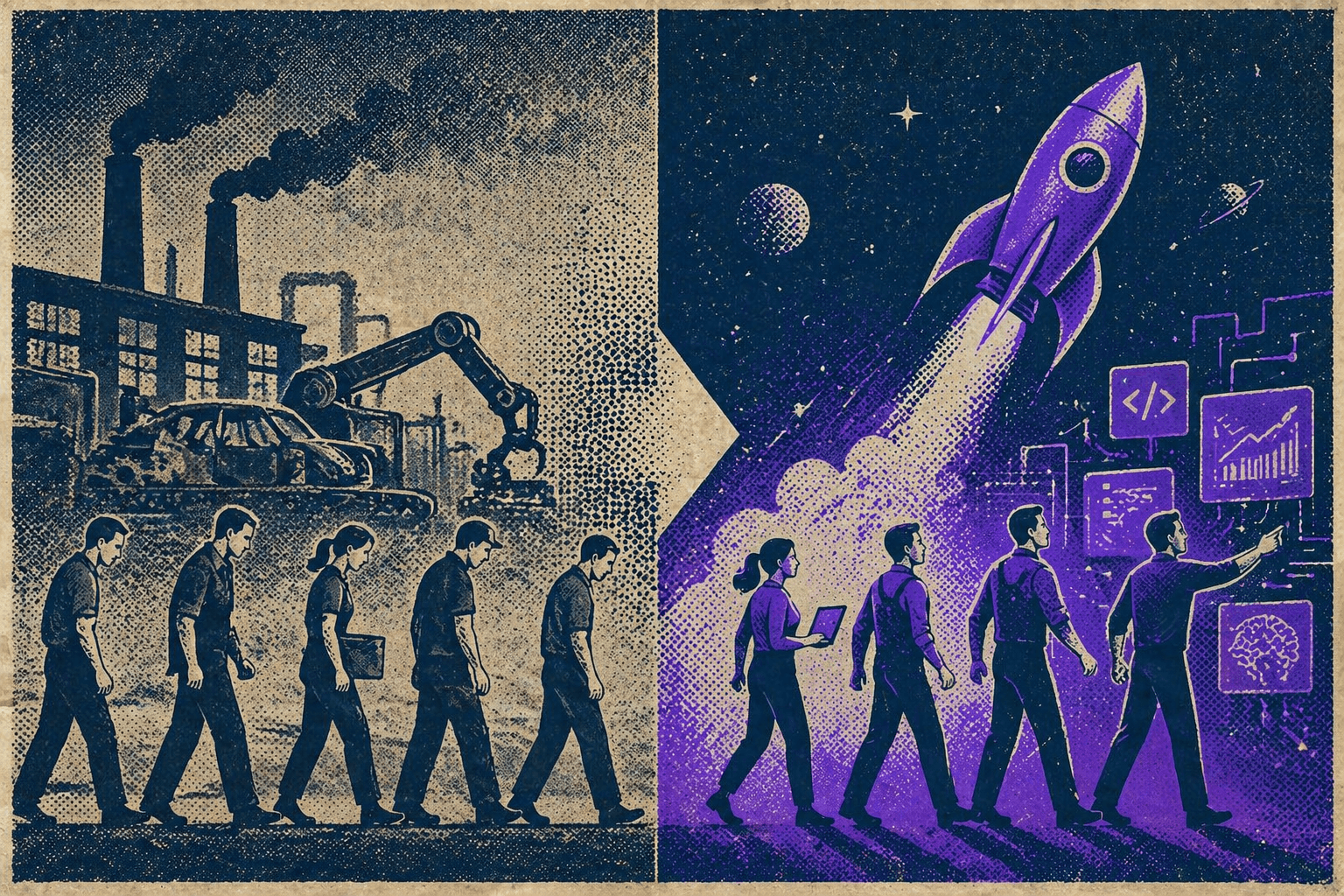
Germany's VW Group and Bosch alone have committed to cutting roughly 72,000 jobs from their German operations. For many of those workers, a government training voucher already exists that can cover 100% of the cost of an approved AI training programme.
The Bildungsgutschein is a government-issued training voucher, grounded in Section 81 (§81) of Germany's Social Code III (Sozialgesetzbuch III), that covers the full cost of an approved programme for eligible workers. It's available to people who are unemployed, have received notice of redundancy, or are at genuine risk of job loss, and it specifically favours shorter, vocational programmes that lead to a concrete employment outcome.
What is happening in Germany's automotive sector, and what does it mean for workers?
Germany's automotive sector is contracting sharply. VW Group plans to cut 50,000 jobs across its German operations by 2030, including 35,000 at the core Volkswagen brand. Bosch has confirmed 22,000 total cuts across its German Mobility division. For workers in those supply chains, the question isn't whether disruption is coming: it's how to respond to it.
The scale is significant. VW's net profit fell 44% to €6.9 billion in 2025, its worst result since the diesel emissions scandal, and Bosch is targeting €2.5 billion in savings through its restructuring and reported a net loss of €363 million in April 2026, its first loss in years. These aren't temporary cost cuts. They reflect a structural shift away from combustion engine production that analysts expect to continue through the decade. Beyond automotive, 36% of German companies plan to cut jobs in 2026, according to a survey of nearly 2,000 firms by the Institut der deutschen Wirtschaft (IW), meaning the further training question is urgent well beyond a single sector.
Workers in quality control, logistics, assembly, and administration formed the backbone of both companies. For them, this creates an urgent practical question: where do skills transfer, and who will pay for the transition? The answers are more concrete than most people in that position realise.
Am I eligible for a Bildungsgutschein after being made redundant?
Most workers who have been made redundant in Germany are eligible for a Bildungsgutschein. The voucher is available to anyone who is unemployed, has received formal notice that their employment is ending, or whose employer has indicated that their role is at risk. Eligibility is assessed individually by the Agentur für Arbeit and depends on your specific situation, not on your employer's size or industry.
The legal basis is §81 of Germany's Social Code III, which gives the Agentur für Arbeit the authority to fund professional retraining when the goal is to bring someone back into stable employment. Workers from VW, Bosch, and their suppliers who received formal redundancy notice in 2025 or 2026 are the exact population this legislation was designed for.
The voucher can cover 100% of course fees at any provider that holds AZAV certification, the government quality standard for funded training programmes. Turing College holds AZAV certification, which means both the AI Engineering and AI for Business programmes qualify. You don't apply for the voucher through the training provider: you apply through your local Agentur für Arbeit, and the consultation is free.
Are you unemployed or at risk of losing your job?
Which AI and tech programmes suit people from automotive backgrounds, and how long do they take?
Two Turing College programmes are worth considering for people from automotive and industrial backgrounds: AI Engineering and AI for Business. Both are available online, AZAV-certified, Weiterbildung-classified, and fundable through a Bildungsgutschein. The right choice depends on what your previous role involved: technical or analytical work points towards AI Engineering, while operations, coordination, or management roles align more closely with AI for Business.
AI Engineering is suited to people from technical or data-heavy roles who already have coding experience and want to build on it with AI-specific skills such as Python, LangChain, and agent development. AI for Business is designed for operations managers, team leads, supply chain coordinators, and analysts who understand business processes and want to integrate AI tools into the way they work. No prior coding required.
Turing College's programmes are built for people who need flexibility: self-paced modules, project-based work, and 1-to-1 mentor sessions rather than lectures. Both sit within the 3–6 month window that the Agentur für Arbeit's 2026 budget explicitly prioritises.
What do AI and tech roles actually pay in Germany in 2026?
The German market rate for AI Engineer roles starts at €55,000–€70,000 at entry level, rising to an average of €84,500 across experience levels and reaching €100,000 or more in senior positions. These are general market figures for AI engineering roles across Germany, with the strongest demand in Munich, Frankfurt, Berlin, and Hamburg.
Active hiring spans automotive, manufacturing, finance, and technology sectors across Germany, including in traditional industrial regions.
Prachi Dipak Deshmukh used a Bildungsgutschein to fund her place on Turing College's AI Engineering programme and is now a Software QA Engineer at Tesla:
"I gained hands-on experience with the latest AI trends and technologies. The programme strengthened my practical skills and prepared me to apply AI in real-world situations. After starting my job, I feel confident in using these skills effectively and continuing to grow professionally."
How do I apply for a Bildungsgutschein, and what improves my chances?
Start by applying to Turing College and completing the admissions process. This gives you an official education offer, which you then bring to your Agentur für Arbeit consultation. Advisors approve applications far more readily when you arrive with a specific, AZAV-certified programme already confirmed rather than a general interest in retraining. The consultation itself can be booked online at arbeitsagentur.de.
Four things improve your chances beyond that. First, collect at least ten current job listings in Germany for roles the programme leads to, bring printed copies to your consultation, and highlight the skills from the course that match each listing. Second, your chosen programme must both hold AZAV certification and be listed in the KURSNET (Mein NOW) database: Turing College's programmes meet both requirements. Third, explain why a focused, shorter programme suits your situation better than a multi-year Umschulung. Fourth, make the connection between your existing skills and the tech field explicit. A quality control background speaks directly to the precision and analytical thinking that AI engineering roles require.
Which Turing College programme fits your background?
| AI Engineering | AI for Business | |
|---|---|---|
| Best fit for | Technical, analytical, data-heavy roles | Operations, coordination, and management roles |
| Prior experience needed | Minimum 1 year of coding experience | No prior experience |
| Core skills gained | Python, LangChain, RAG, AI agents | AI strategy, data analysis, workflow automation |
| Roles you'll be qualified for | Machine Learning Engineer, Data Scientist, MLOps Engineer, AI Developer, Data Engineer, Cloud Engineer | AI Automation Specialist, Process Automation Specialist, AI Consultant, Operations Analyst |
| Industries hiring | Automotive, manufacturing, healthcare, finance, logistics, software and technology | Healthcare, finance, manufacturing, legal, marketing and any sector adopting AI tools |
| Programme duration | 3 to 4 months | 3 to 4 months |
| Bildungsgutschein eligible | Yes (AZAV-certified, listed in Mein NOW) | Yes (AZAV-certified, listed in Mein NOW) |
| Delivery | Online, self-paced with mentor sessions | Online, self-paced with mentor sessions |
How to apply this week: five steps
- Apply to Turing College first. Choose your programme (AI Engineering or AI for Business) at turingcollege.com and fill in the application form, which takes 10–15 minutes. If your application is accepted, you'll be invited to book a 30-minute consultation call with an admissions manager. If that call goes well, you'll receive an official education offer: the document your Agentur für Arbeit advisor needs to approve your funding.
- Register as job-seeking or unemployed with the Agentur für Arbeit. You can do this online via arbeitsagentur.de. If you know your contract end date in advance, register up to three months before it ends. The earlier you register, the more options are available to you.
- Book your Beratungstermin (consultation) and prepare your case. Collect at least ten current job listings in Germany for roles the programme leads to. Bring printed copies of the two or three strongest matches and highlight the skills from the course that appear in each listing. Prepare a clear explanation of why this specific programme connects to your background and what role you're targeting once you complete it.
- Attend your consultation with your Turing College education offer in hand. Your advisor will review your situation, the programme details, and the job market evidence you've brought. The process from consultation to receiving a decision typically takes 30–50 days, so be patient, follow up proactively if you haven't heard back, and keep Turing College's team informed of your timeline.
- Once approved, submit your Bildungsgutschein to Turing College promptly. The voucher is valid for three months from the date of issue. Submit it before that date to confirm your funded place and lock in your start date.
The fastest way to know whether you qualify for a Bildungsgutschein is our free eligibility quiz. Answer a few questions about your situation, and you'll have a clear answer in under two minutes.
Check your eligibility - it's free.
Frequently asked questions
Can I use a Bildungsgutschein for an online AI programme in Germany?
Yes. The Bildungsgutschein (§81 SGB III) can fund online programmes, provided the training provider holds AZAV certification. AZAV is a government quality standard confirming a provider meets the requirements for publicly funded training. Turing College holds AZAV certification, making both its AI Engineering and AI for Business programmes eligible for full Bildungsgutschein funding regardless of where in Germany you are based. You apply for the voucher through your local Agentur für Arbeit, not through the training provider.
I worked in quality control at a VW supplier. Do I have the background for an AI training programme?
Quality control roles involve reading measurement data, identifying variances, making decisions from metrics, and documenting processes with precision. Those analytical habits translate well into AI work. AI for Business has no coding requirement and suits people from operational and analytical backgrounds directly. AI Engineering requires prior coding experience, so it's the right fit if your quality control role involved scripting, automation, or data processing tools alongside the process work.
How long does a Bildungsgutschein application take to process?
From your initial Agentur für Arbeit consultation to receiving a decision typically takes 30–50 days, depending on your advisor's availability and how prepared you are at the meeting. Applications move faster when you arrive with a specific programme already confirmed, bring job listings as evidence of demand, and can explain the connection between your previous experience and the target role. It often takes more than one appointment before the voucher is issued: this is normal, not a rejection.
Which Turing College programme is right for me?
AI Engineering focuses on building and working with AI systems directly: writing code, training machine learning models, and working with data pipelines. AI for Business focuses on applying AI tools to operational decisions: identifying automation opportunities, interpreting data outputs, and managing AI-driven projects. Both are funded by the Bildungsgutschein at Turing College. The right choice comes down to whether your previous work was primarily technical or primarily operational.
Sources: VW Group 50,000 job cuts, Euronews March 2026 | Bosch 22,000 cuts, Bloomberg 2025 | Bitkom IT labour market study 2026 | §81 SGB III official text | AI Engineer salaries Germany, SalaryExpert 2026 | Bosch net loss April 2026, newmobility.news | 36% of German companies plan job cuts in 2026, IW survey via iamexpat |