Is Turing College worth it? Top-rated online AI bootcamp, 392 verified reviews (2026)
 Lukas Kaminskis · 10 min · May 18, 2026 · Updated June 4, 2026
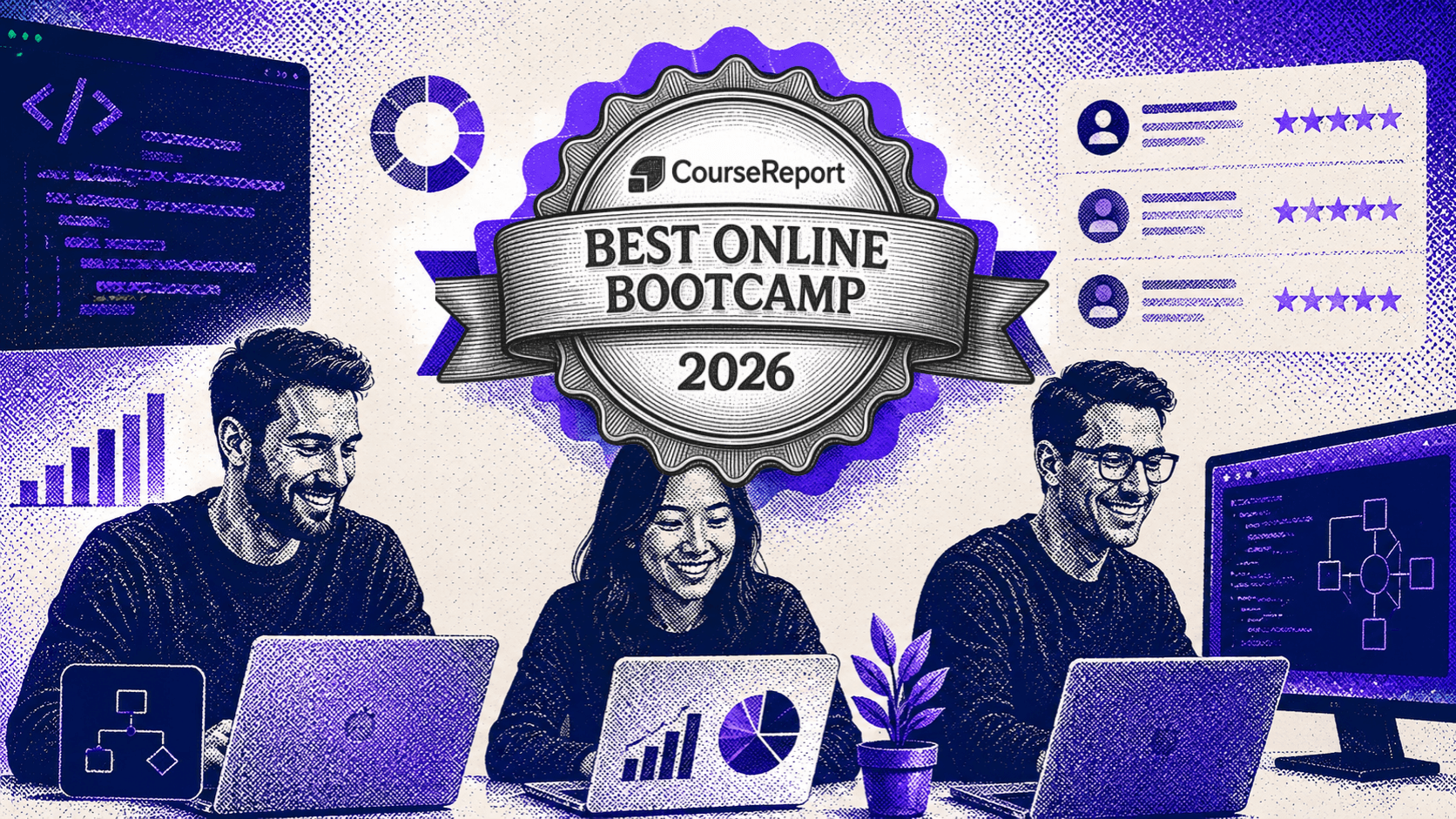
Turing College earned a 4.94 out of 5 rating across 392 verified alumni reviews on Course Report, placing it among the top-rated online AI and data bootcamps globally in 2026. Course Report is the largest independent bootcamp review platform globally, with over 70,000 verified reviews published since 2013. Schools cannot pay for inclusion on any best-of list.
Turing College is best suited for working professionals who want to build practical AI, data, or software skills without a computer science degree, at a pace that fits around a job or existing commitments.
Fewer than one in five bootcamps listed on Course Report earn the Top Rated badge. Turing College is one of five schools globally that made the 2026 list.
Key takeaways
- Course Report is an independent bootcamp review platform. Schools cannot pay for inclusion and all reviews are verified via LinkedIn or GitHub before publication.
- The Top Rated badge requires a minimum of 130 verified reviews and a rating of 4.7 or above. Fewer than one in five bootcamps on the platform earn it.
- Learners from non-technical backgrounds, including sales professionals and media producers, have completed Turing College programmes and built working AI tools from scratch.
- AI Engineering capstone projects from the most recent group include a multi-agent card game balancer, an offline manufacturing analysis system, and a RAG-powered knowledge assistant.
- In Germany, the Bildungsgutschein (AfA) route covers the full cost of the AI Engineering and AI for Business programmes for eligible candidates.
What Turing College learners actually build
Frank, AI for Business - Germany
Frank is a video producer and content creator with no prior coding or automation experience. He joined the AI for Business programme to figure out which AI tools belong in a working media professional's day-to-day workflow, not to become technical.
His capstone project was a YouTube Video Idea Generator: an n8n automation that scans three RSS feeds covering Science, Human Psychology, and History, processes the results through an AI agent, and outputs a spreadsheet of content ideas. The tool addresses a real problem for creators: finding trending ideas without spending hours on manual research.
The build took close to two weeks. He ran into API setup issues, then a debugging loop with AI-generated errors that pushed him close to quitting. He finished it. His reviewer encouraged him to develop it into a commercial product.
"AI is here to stay," Frank said. "If you want to up your game, embracing it is the first step.
Umi, Data Analytics - career changer from B2B sales
Umi spent years in B2B sales across cybersecurity, fintech, and SaaS companies. She came to Turing College's Data Analytics programme with no prior coding experience and left able to write SQL, work with Python, and train machine learning models.
Her most memorable project involved building a machine learning model to predict coronary heart disease risk using Python: "I could see how businesses could use it to do some predictive modelling. It was so fascinating doing it with Python."
She is currently targeting junior data analyst roles and estimates she meets around 80% of current job requirements. On using AI as part of her learning: "If you have learned something new while using AI, you're making progress. If you blindly prompted everything and copied without checking, you missed the learning opportunity."
Alwin, AI Engineering - AfA-funded, Hamburg
Alwin joined the AI Engineering programme through the German Bildungsgutschein (AfA) funding route, which covered the full cost of the programme. He completed it in three months, logging over 500 hours of study.
His capstone project was an agentic AI system built using LangChain, RAG, and AI agents. He brought prior experience from the Oxford AI Programme and the Perplexity Business Fellowship, and describes the Turing College programme as a practical, build-first complement to more theoretical training.
"I can genuinely recommend Turing College to anyone looking for a practical, build-first path into AI engineering," Alwin said. He is currently Founder and Managing Director at Rundblick 3D.
AI Engineering and AI for Business are eligible for Bildungsgutschein (AfA) funding in Germany, reducing the cost to €0 for eligible candidates.
Learners based outside Germany can apply from anywhere in Europe. All programmes are delivered fully online, with no campus attendance required. Standard programme fees apply for non-AfA learners, and full pricing is listed on each programme page.
What AI Engineering learners are building as capstone projects
The projects below are capstone submissions from the most recent AI Engineering group, each built independently by a single learner over the final stage of the programme.
Card Battle Auto-Balancer by Oleg Reva: a multi-agent AI system that automatically balances card game parameters using LangGraph and Monte Carlo simulation, running 1,000 or more battles per iteration across three deck archetypes. In typical runs it reaches a fitness score of 0.92 out of 1.0 in 7 to 15 iterations, taking two to four minutes to produce a fully balanced card set.
Manufacturing Design Review Engine by Tamás Vetési: an offline-first manufacturability analysis system for mechanical engineers. Given a STEP CAD file, it evaluates geometry against rule sets for eight manufacturing processes including CNC machining, additive manufacturing, casting, and forging, and produces an audit-ready report. The entire system runs without any cloud dependency, built for privacy-sensitive industrial environments.
GitScribe by Dimitar Hristovski: a documentation tool that connects to GitHub via API, reads recent commit history, and generates or refreshes project documentation automatically using the OpenAI API, solving the familiar problem of documentation drifting from what a repository actually does.
RAG Knowledge Assistant by Trung Ta: an LLM application augmented by a knowledge repository via retrieval-augmented generation, capable of finding specific information across a store of over 100 PDFs each 30 to 100 pages long, using ChromaDB and LangChain.
See more projects here.
What the 4.94 rating reflects
Course Report breaks ratings into sub-categories: curriculum quality, job support, mentor quality, and overall experience. The 4.94 figure places Turing College above the Course Report platform average of 4.6 for online bootcamps, across 392 reviews from learners on multiple programmes over multiple years.
The table below maps the criteria Course Report uses to evaluate bootcamps against what Turing College offers.
| Criterion | What Course Report looks for | Turing College |
|---|---|---|
| Verified alumni reviews | Minimum 130, verified via LinkedIn or GitHub | 392 verified reviews, 4.94 rating |
| Mentorship model | 1:1 instructor or mentor access, not just recorded content | Two 1:1 project reviews per sprint with senior industry professionals, plus weekly standups and drop-in sessions. Team leads come from companies including Amazon, Google, and Meta. |
| Curriculum outcomes-focus | Practical, job-relevant skills, not academic theory | 9 to 24 real-world projects per programme depending on the course, with each sprint ending in a project that replicates an industry challenge. |
| Career support | Dedicated job search guidance included | Career Sprint module covers job search strategy, LinkedIn presence, CV building, and mock HR and technical interviews. Self-paced, integrated into the learning platform. |
| Graduate employment | Evidence of learners landing relevant roles after graduation | Turing College graduates have been hired at companies including Wise, Nord Security, Vinted, Tesla, Siemens, and Deutsche Bank. |
Programmes available at Turing College
All programmes are delivered online with 1:1 project reviews, weekly standups, and career support included.
Short courses
| Programme | Duration | What you build |
|---|---|---|
| AI Engineering | 3–4 months | Real-world LLM applications using Python, LangChain, and Gradio |
| AI for Business | 2–4 months | AI-powered automations and workflows, no prior coding required |
| Building with AI Agents | 3–4 months | Full-stack web and mobile apps directed by AI agents, no coding experience required |
Career programmes
| Programme | Duration | What you build |
|---|---|---|
| Data Science and AI | 8–12 months | End-to-end machine learning pipelines and AI-powered data products |
| Software and AI Engineering | 6–9 months | Production-ready AI applications |
| Data Analytics | 6–10 months | Analytical dashboards, SQL pipelines, and machine learning models |
AI Engineering and AI for Business are eligible for Bildungsgutschein (AfA) funding in Germany, reducing the cost to €0 for eligible candidates.
If you're still deciding
Three videos worth watching before you apply.
Is AI Engineering the Right Career for You in 2026? - a straight answer to the most common question we get from people considering the programme in seven minutes.
Why Most Education Is Broken (And How We're Fixing It) - why Turing College works differently, with the research behind it
How to Get the Bildungsgutschein in Germany - Step-by-Step Guide (2026) - if you're based in Germany and want to understand the AfA funding process before applying, this covers every step.
Frequently asked questions
What is Course Report? Course Report is an independent bootcamp review platform founded in 2013. It publishes over 70,000 verified alumni reviews and produces annual best-of lists across bootcamp categories. Schools cannot pay for placement on any list. Reviews are verified via LinkedIn or GitHub before publication.
How did Turing College earn the Top Rated badge? By meeting all three Course Report criteria: a minimum of 130 verified reviews, a rating of 4.7 or above, and demonstrated evidence of mentorship-based learning and graduate career outcomes. Turing College holds 392 verified reviews and a 4.94 rating.
What rating does Turing College have on Course Report? 4.94 out of 5, based on 392 verified alumni reviews as of May 2026.
Which Turing College programmes are eligible for Bildungsgutschein funding? AI Engineering and AI for Business are eligible for Bildungsgutschein (AfA) funding in Germany, reducing the cost to €0 for eligible candidates. Check your eligibility with our free quiz.
How long does a Turing College programme take? Short courses run from two to four months. Career-changing programmes run from six to twelve months. All are part-time, designed for working professionals at 8 to 12 hours per week.
What companies have hired Turing College graduates? Turing College graduates have been hired at companies including Wise, Nord Security, Vinted, Tesla, Siemens, Amazon, Meta, and Deutsche Bank.
Do I need a coding background to join? It depends on the programme. AI for Business and Building with AI Agents require no prior coding experience. AI Engineering requires basic Python. Data Analytics and Data Science and AI start from the foundations but move into technical territory. Each programme page lists entry requirements.
Is Turing College accredited? Turing College is a ZAV-certified training provider in Germany, which is a requirement for Bildungsgutschein eligibility. Full accreditation details are available on the Turing College website.
How do I read Turing College reviews? Verified alumni reviews are published on Course Report. All Course Report reviews are verified via LinkedIn or GitHub before publication.
Can I apply if I am not based in Germany? Yes. Turing College accepts learners from across Europe and beyond. The Bildungsgutschein funding route is only available to learners in Germany who meet AfA eligibility criteria.