
Frank is a video producer with no coding background who built a working AI automation as part of Turing College's AI for Business programme.
Who is Frank?
Frank is a video producer, editor, writer, and content creator with extensive experience managing media production pipelines from concept to delivery. He's worked across marketing campaigns, corporate brand films, instructional content, and entertainment. Based in Hamburg after moving from New York City, he most recently produced data-focused marketing and training videos for a Berlin company, where he grew a YouTube channel by 200% - outranking the software brand's own channel.
He came to Turing College's AI for Business programme not as someone looking to become technical, but as someone trying to figure out which AI tools belong in a working media professional's day-to-day workflow.
What did he build?
Frank built a YouTube Video Idea Generator: an n8n automation that scans three RSS feeds covering Science, Human Psychology, and History topics - all high-viewership categories on YouTube - and processes the results through an AI agent before outputting a clean spreadsheet of content ideas.
The idea had been sitting in the back of his head for a while. The programme gave him the reason to actually build it.
"I didn't want to work on some hypothetical project, as that wouldn't resonate with me," Frank said. "So since I already had a vague idea for something like this, I thought perhaps it could help if I worked on something more oriented to a practical need."
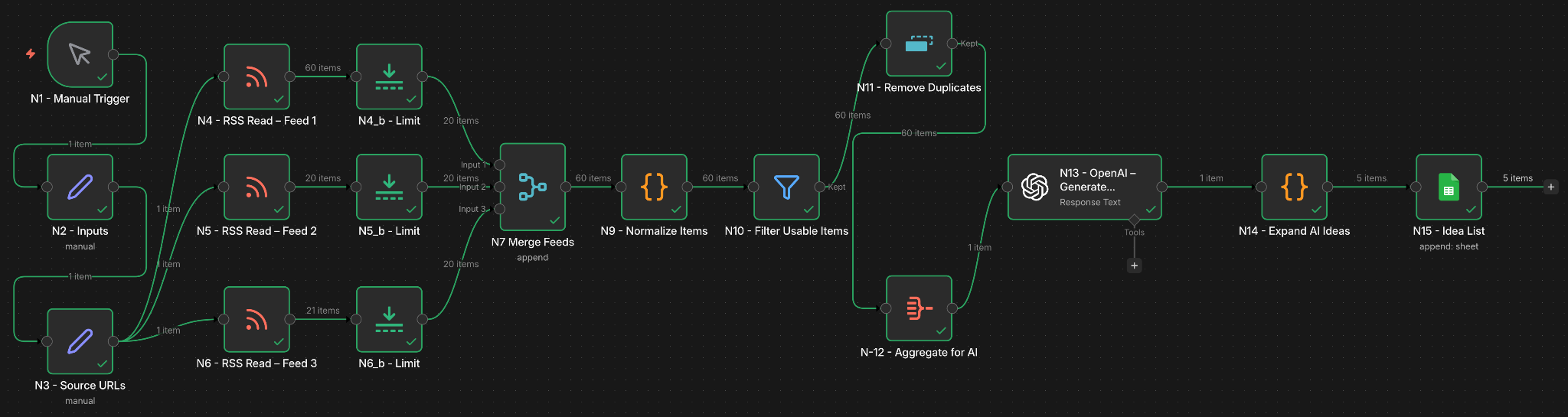
The tool he built addresses a real problem for content creators: finding trending ideas without spending hours on manual research or repeatedly prompting AI tools one query at a time. By pulling from focused sources, the automation surfaces concepts across three high-performing topic areas and delivers them as a starting point for further development.
The workflow is also adaptable. Frank designed it around his own needs for producing faceless YouTube videos, but noted that any creator could swap out the RSS feed links for sources that match their own niche.
How hard was it, really?
Frank was direct about his starting point. "I couldn't even wrap my head around it, at first," he said about n8n. "I'm a very visually oriented person, so anything behind the GUI has always been sort of a mystery to me."
He had no prior experience with automation software. His closest analogy was production scheduling - the process of arranging people, locations, and times in a sequence - which gave him a mental model, but nothing more.
The build took close to two weeks. Early on, he ran into delays acquiring API keys. Then the AI he was using to help generate instructions started producing errors: flawed JavaScript, incorrect guidance, and a debugging loop that pushed him close to quitting. "At one point, I was ready to throw in the towel," he said. "But it was thrilling to finally get it to work."
What carried him through the hardest parts was something he'd built before the programme: an ability to prompt and communicate with AI clearly. Knowing how to preface a request, give the AI the right context, and interpret what came back turned out to be the skill that mattered most when the instructions got complicated. 'The key,' he said, 'is figuring out how to communicate with AI to then help me craft the instructions to accomplish the project.
What he took from the experience
Frank completed the project. His reviewer encouraged him to develop it further into a commercial product. He's interested, but pragmatic about the current limits of the tools. He finished the programme with a clearer picture of where AI automation is useful for someone in his position, and where it still requires technical expertise he doesn't have and doesn't want to acquire.
He remains genuinely curious about where AI productivity tools are headed, particularly tools that let non-technical users build and export functional apps without coding. That curiosity - a working media professional trying to figure out which parts of the AI landscape actually belong in his workflow - is exactly what the AI for Business programme is designed for.
"AI is here to stay," Frank said. "If you want to up your game, embracing it is the first step toward unlocking possibilities you may not even know exist."