

Gender diversity in tech
We are committed to closing the gender gap in technology. Among learners with a recorded gender response, 43.2% identify as women.
- Women
- 43.2%
- Men
- 56.1%
- Prefer not to specify
- 0.6%
Turing College trains people in data, AI and related skills through online programmes built around their actual work. In England, we deliver government-funded apprenticeships from Level 2 to Level 4 for employees who want to do more with data, AI, cybersecurity or finance, alongside AI Leadership units for managers.
Apprenticeship services in England are provided by Boom Training Ltd (Company No. 08842128), trading as Turing College.
We work with HR, L&D and operations leaders to fit training into the working week. Learners schedule at least six hours of study within working hours, with no fixed classroom days.
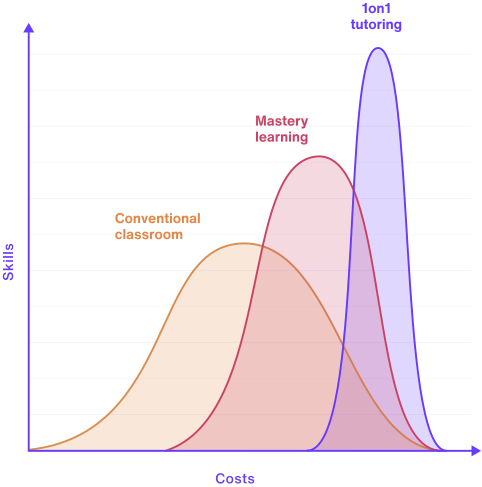
We believe high-quality education should be available at scale. Benjamin Bloom’s 1984 study, The 2 Sigma Problem, found that students taught one to one performed around two standard deviations better than students taught in a conventional classroom. Our model brings that one-to-one support to working adults: every learner has a Technical Mentor who reviews each project on a live call and a Learner Success Coach who is in touch with them at least once a month, alternating a 1:1 and a progress review, alongside hands-on projects based on their job.
Apprenticeships date back to 12th-century Britain as a way for young people to learn trades. While the methods have evolved, the goal remains the same: transferring skills from experts to the next generation.
Most current apprenticeship models still rely on an outdated 18th to 19th-century approach: one teacher, many students. We think that's obsolete.

Medieval era
Apprentices learned directly from master craftsmen through real work.
Training lasted 7+ years, with apprentices living and working under their mentor's guidance.

Industrial revolution
Training moved from small workshops to large-scale industrial settings.
Apprentices trained in specific trades rather than broad crafts to meet industry demands.

Tech and AI era
Our 21st-century model replaces one-to-many with one-to-one, providing personalised support from AI and industry professionals. Learning should feel like real work.
Training mimics real-world projects, not passive Zoom lectures. With programmes designed in collaboration with employers, apprentices work on actual business challenges from day one.
Every programme includes AI fundamentals, data analysis, and prompt engineering.
Learners use AI as a productivity multiplier, making the best of its strengths while sharpening their critical thinking and creativity.
Beyond technical training, apprentices develop communication, problem-solving, and ethical decision-making skills with the help of a dedicated community.
Apprentices book sessions on their schedule, ensuring learning never disrupts productivity.
Every mentor is an active industry professional who allocates their free time to provide feedback and share knowledge with apprentices, not a career academic.
Online, self-paced study built around live support from people who work in the industry.
Learners move to the next sprint only after passing a live review of their project with a Technical Mentor.
Every programme includes real-world projects, simulating actual business scenarios to reinforce practical skills.
Open Sessions once or twice a week and Industry Discussions twice a week, with weekly workshops on AI for Business and Applied AI & Automation.
Technical Mentors review every project on a live call. A Learner Success Coach is in touch with each learner at least once a month, alternating a 1:1 and a progress review.
Technical Mentors work in the industry and update programme material when a new AI model or tool, a better method or industry news changes how teams work.

Yet most online education relies on outdated, industrial age teaching methods, limiting workforce potential. Turing College redefines apprenticeships with a flexible, state-of-the-art platform built for progressive, AI-driven employers.

At Turing College, we believe that great ideas come from diverse perspectives. That's why our programmes are built to empower learners from all backgrounds, industries, and levels of experience.
Flexible, self-paced training that adapts to different needs and commitments.
A skills-first approach, ensuring that potential matters more than credentials.
A supportive network of mentors, coaches and a learner community to foster learning and collaboration.
We are committed to closing the gender gap in technology. Among learners with a recorded gender response, 43.2% identify as women.
Our learning community spans 89 countries of residence, creating a diverse and dynamic network that shapes our global collaboration. Our learners from Europe, North America, Africa, or Asia bring unique perspectives that enrich the learning experience.